Sunday, January 01, 2023

Science & Technology - 2022 Year in Review

AI

 2022 was the big year for Artificial Intelligence, the year when AI became a household word.  The image generators were first, like Dall-E, but by the end of the year the latest GPT release (Chat-GPT) had taken over.  

Overview of some of the big AI releases:  link


Space

Big milestones in space included the successful first images from the James Webb Space Telescope (JWST), showing individual stars inside galaxies at the very beginning of time.  Link to images from JWST.

The DART asteroid-impact missions was a success!  Video reviews here and here.  

And sadly, the Planetary Society's crowd-funded solar sail, Lightsail 2, crashed back into the Earth's atmosphere after 3 years sailing on sunlight.  Link.


Environment

While its hard to pick the top environmental story, the fact that Earth warmed at an all-time record pace created climate disruptions everywhere.  

On the positive side, researchers have created a form of ultra-white paint that can reflect more energy than is absorbs.  Buildings coated with this paint would have a natural cooling ability that could reduce ambient temperatures and reduce energy required for AC.  I'm very hopeful that this can become cost effective and widely used in desert cities.  Link.

Thursday, December 22, 2022

Plant-Pollinator Interactions in Yavapai County, AZ

 Introduction

Pollinators visit plants seeking nectar and/or pollen. Pollinators include insects (e.g. butterflies, moths, beetles, bees, wasps, flies), bats, and birds. In any geographic region, native and non-native pollinators visit native and non-native plants.

Pollinators may be specialists and/or generalists who visit plants for different reasons. For example, some pollinators specialize on the pollen of certain plant species such that they visit only certain plants to harvest pollen from them. These pollen-seeking specialists may be nectar-seeking generalists to the extent that they indiscriminately harvest nectar from any plant species.

Pollinator-plant interactions are a subject of ongoing study. In North America alone there are more than 3,600 bee species. Ecologists document pollinator-plant interactions to understand which pollinators visit which plant species and why.


Methods

We use iNaturalist—a citizen science computer application—to document our observations of pollinators and plants in the places we visit. We have five years of non-systematic observation data from Yavapai County, AZ that we use for our analysis. We looked at which plant species are most frequently visited by pollinators across different taxa. This will help us better understand which local plant species are popular amongst pollinators.

We annotated five years of pollinator observation records from Yavapai County, AZ with the scientific name of the plant species each pollinator is visiting. Our database includes a total of 265 distinct counts of pollinator-plant interactions (note this is different from the number of observations).

Here is a link to our current plant-pollinator interactions in iNat.

There are some notable issues that exist with our data:

·        We did not systematically collect the data. We did not employ ecological sampling methods, we did not sample data at regular intervals of time, and we did not take measures to ensure we systematically sought observations of pollinators across distinct plant taxa in unbiased ways. Therefore, our dataset contains bias.

·        We are analyzing our dataset for fun. Since the data contain unintentional bias, we do not intend for the results of our analysis to be reliable for landscape or species management decisions.

·        Our data contain blank fields (unknowns) at the level of insect taxon family, genus, and species. Because we cannot fill in the blanks with reliable data, we conduct our analysis at the level of insect taxon (e.g. insect family, genus, or species).

·        Our database’s plant records contain plant taxa information at the level of genus and species.

See this post for more thoughts on the limitations of this type of analysis.


Total insect taxa associated with plant genera


Count of distinct insect taxa associated with the top ten plant genera by month

This graph reflects the top ten plant genera ranked according to the counts of distinct insect taxa associated with them. In our database, we have data for many more plant genera than those shown.

The top ten plant genera include Asclepias, Baccharis, Ceanothus, Cirsium, Dalea, Ericameria, Helianthus, Hymenothrix, Machaeranthera, and Opuntia. 

There may be more associations between distinct insect taxa and plant genera during the summer months of June, July, and August but they are not reflected in this graph because we didn’t observe them due to extreme heat and/or monsoon rains.


This project and data analysis were a collaboration between Conor Flynn and Alexandra Permar.  

Sunday, December 11, 2022

High Mowing's 2023 Organic Seed Catalog

 Things I learned from High Mowing Organic Seeds's 2023 Catalog

Grafting: in vegetables, only used for tomatoes. Instead of transplanting, graft onto established roots.

I remember hearing some drivel about how tomatoes aren't vegetables, they're a fruit.  But, botanically, half of the vegetables are fruits.  Beans, cucumbers, eggplant, melons, okra, peppers, pumpkins, squash, tomatoes, watermelon, zucchini.  I don't hear anyone proclaiming "green beans are fruits!"

Most category-consistent omission:  strawberry seeds. It’s a berry, not a vegetable!  Even though they are often grown as annuals, maybe they are marketed under the category of fruit trees and perennial fruit bushes...

Spinosad and Bt are popular organic insect pest controls and are non toxic to humans and, if used correctly, mostly harmless to beneficial insects. 

Most surprising omission: sweet potatoes seeds.  Maybe because HM are mostly focused on northern crops?  Also surprisingly limited selection of collard greens, okra and swiss chard.   I noticed on the HM website that all of the conference/expos they attend are in Northern-tier states.

Least surprising omission:  cannabis seeds.  Cash crop anyone?

Most interesting omission:  mushroom seeds.   Inoculant is very popular in some areas, but with mixed success.  Is the omission a sign of lack of interest?

Most organic omission:  Imperator-type carrots.  The main type sold commercially (even "baby carrots" are whittled from these), and HM has all of the other types:  Nantes, Danvers, Chantenay… the catalog sometimes references mainstream conventional varieties of other vegetables (e.g. "Payday") but doesn't include them.  Seems organic breeders have mostly focused outside the mainstream.

Interesting which vegetables don't have disease resistance traits.  Do they not need it or has it not been selected yet?

Most confusing "seeds":  potatoes.  Apparently no one grows potatoes from seed.

Lowest-common denominator certification:  Non-GMO Project.  Is this the cheapest certification or just the best marketing logo?  Either way this seems to be the go-to certification for everything.  I have friends who say they won't buy GMO.  But organic?  Regenerative?  Bee Better?  Too expensive, what, what?  I guess it does make sense for High Mowing since they sell corn and soy. 

Pollinators

I was surprised there wasn't more mention of pollinator requirements.  Which vegetables need pollinators?  All of the fruits… 

But peas and soy can self-pollinate.  Corn should be planted in blocks so it can be wind-pollinated.

Gynoecious and monoecious cucumbers need to be planted with another variety for pollination. Parthenocarpic cucumbers don't need pollinators (= good for greenhouses). 

Seedless watermelons :  one variety needs pollination from a different variety. 

The insect apocalypse is real.  This summer I heard from people in different parts of the country who had to hand-pollinate their squash because they couldn't get any fruit otherwise.  I visited a remnant prairie patch in Ohio in July that was in full flower, but completely silent and devoid of insect life.  All blooming and no buzzing.

Hybrid vs OP vs Heirloom

Seed saving controversy:  Advocates like Bill McDorman make hybrid seeds seem almost immoral.  He claims seed-saving as an inalienable right of indigenous and small-holder farmers everywhere.  But its hard.  His very interesting book* gives detailed specifications for how far apart you have to plant different varieties to avoid cross-pollinating, in-breeding depression, or outbreeding depression.  I wonder how many farmers save seed?

Descriptions in HM imply that hybrids are better than OP.  Also interesting how many varieties are protected (from seed-saving) by UP or PVP. 

References

Bill McDoman. Basic Seed Saving: Easy step by step instructions for 18 popular vegetables. 

 Attachments

Excerpt from a conventional seed catalog.

SeedGenetics2023.png

Tuesday, November 15, 2022

Introduced versus Native Species

 Like almost all categories in nature, there are exceptions and ambiguities. 

How do we really know a species is non-native?  It might seem like an obvious category, but if you think about it, the "evidence" of absence before a certain date is just absence of evidence!  I know taxonomists who don't agree that certain species, widely regarded as non-native, are actually non-native.  They just think the species was under-collected before a certain date.  This is especially true when there is no strong ecological or geophysical reason for the species not to have spread naturally.  For example, species that are "native" to Eastern North America, but are considered "Introduced" in Western North America (e.g. American Bullfrog).

What about species that have both native and introduced genotypes?  Phragmites australis is a classic example from North America, where you have to ID to subspecies (often very difficult) to distinguish the native from invasive.  In iNat, if you only ID to species, it will say it is native.  Only the observations that have been ID'd to species have the Introduced tag. 

Other categories include:

Archaeophytes: plants which were probably introduced by humans to an area, but the introduction happened a very long time ago, and evidence is usually indirect. Most introductions before AD 1492 would fit in this category.  

Neo-natives: This is a rather new term denoting species that settle without human assistance in a new region (see Essl et al. 2019).  For example, range expansions due to global warming.  


More discussion:  https://forum.inaturalist.org/t/residency-status-for-archaeophyte-and-neo-native-plants/37252

What is Mitigation?

Different people have different definitions of "Mitigation" in the context of natural resource management, endangered species protection, and wetland permitting.


Technical Definitions
Technically, Mitigation (as defined by CEQ and DOI) includes avoidance, minimization, and compensatory mitigation.  

The mitigation hierarchy also adopts an inclusive definition of mitigation that includes a range of mitigation options.  The mitigation hierarchy is a framework that was formalized by IFC in 2012.  While there are many complexities in implementation, at its core the hierarchy offers a conceptually simple range of mitigation strategies, ranging from preventive (avoiding and minimizing) to remediative (restoring and offsetting).  

Mitigation hierarchy framework.(Source:  Exponent)


Popular Usage
However, many professional resources, including the USFWS webpage on Mitigation, simply define Mitigation as "projects or programs that help offset negative impacts to natural resources, such as a stream, wetland, and species-at-risk."  This definition excludes by omission any preventive mitigation.


Clarification
As usual, EPIC has a great resource summarizing the different types of mitigation, as well as synonyms that are often used.  According to EPIC, avoidance and minimization are called "conservation measures".  Only if a project is likely to cause take are compensatory mitigation measures proposed under 7(a)(2) consultation.  Compensatory mitigation, which is usually simply called "mitigation" in popular usage, is also called offset measures.

Table from EPIC report linked above.

In conclusion, mitigation can be a confusing concept, even for professionals.  Government agencies are trying to specify compensatory mitigation when that is the subset of mitigation they mean, but even in official publications they often use the simple term mitigation.  When someone says Mitigation they are usually talking about compensatory mitigation, or offsets.  However, when talking about the mitigation hierarchy, other preventive conservation measures such as avoidance and minimization could also be included.  

Friday, November 11, 2022

Popular plants for Monarch butterflies in Northern Arizona

**Updated 11/16/2022 


As of November, 2022, there were 260 observations on iNaturalist of monarch butterflies in the northern half of Arizona - basically everything north of Phoenix.  I analyzed these observations to try to identify which plants are most important nectar food sources.


iNat link.


I filled in the Life Stage annotation for all larva and pupa.  There are 62 observations of larva (caterpillars), 1 observation of a pupa, and 197 observations of adult butterflies.

The number of monarchs photographed each year has declined from a high of 75 observations in 2015 to an average of 55 a year in 2021 and 2022.  Since the number of iNat users and observations has increased more than 100x since 2014, it seems that the last 2 years represent more effort with less observations, indicating a possible decline in abundance.


For the adults, I annotated the observations using the Observation Field "Nectar / Pollen delivering plant" when I could ID the flower the monarch was observed on.  In some cases, the adult could be observed drinking nectar; in many other cases I assumed that a monarch adult resting on a flower was obtaining nectar.

In total, 71 adult monarchs appear to be drinking nectar from flowers that are identifiable to species or genus.  I documented 27 different plant species being used as nectar resources by monarchs.  This is a large diversity of plant species, considering that this data set included only 71 total observations of monarchs on flowers.

iNat link.

By far the most common plant species was Asclepias subverticillata, the common weedy milkweed species of northern AZ, and also a great plant for monarch caterpillars.  It is possible that some adults were just resting on the milkweed flowers in the process of depositing eggs on the plants, rather than drinking nectar.  Either way, clearly milkweed are important to monarchs.  This species is also popular with a diverse group of other pollinating insects.

Several aster species were also common nectaring plants, as well as butterfly bush (Buddleja), a planted ornamental that apparently lives up to its name!


Monarch presence in Northern Arizona is strongly seasonal, with most adults observed in late summer (August-September), so it is not surprising that some of the late summer Asteraceae such as Ericameria, Helianthus, Bidens and Heliomeris are popular nectar sources.  Since monarchs are generalist pollinators, this data could be consistent with opportunistic (no preference) nectaring.

However, there are many other common plant species flowering during September (such as Gutierrezia sarothrae, Dieteria canescens, Datura wrightii, Purshia stansburyana, Verbascum thapsus, Geranium caespitosum, Achillea millefolium), and no monarchs in this data set were observed nectaring on them. This suggests that monarchs do prefer certain species over others.


Also, there is the question whether the adults observed on flowers during August--October are migrating adults, mating adults, or newly metamorphosed adults.  Given that we do see caterpillars in September, and it takes about 30 days for a monarch egg to grow into an adult, it is likely that all three types of adults are making use of nectar resources in Northern Arizona.  


Caveats and Conclusions

Any mistakes or omissions are my own. I may have misidentified some flower species, but I don't think that would change the overall conclusions.

The small sample size limits the conclusions that can be drawn; more observations are urgently needed to better establish monarch plant preferences.  

Also, this data is subject to the biases of  the "citizen scientists" who use iNaturalist to document biodiversity.  They may be more likely to photograph monarchs on showy flowers, in areas near their homes (landscaped yards and ruderal/disturbed natural environments), and at convenient times of day.

Therefore, this study might be best used to help guide planting decisions to support monarchs in areas near where people live.


Acknowledgements

Thanks to iNaturalist user jdmore who created an excellent wiki explaining how to use the iNat search URLs to filter results, which was a crucial step to analyze this data.

Also, thanks to all of the iNaturalist community, including the 107 people who observed monarchs in the study area, and the 123 people who helped identify them.

Thursday, November 10, 2022

Is measuring biodiversity possible for non-experts?

I’m trying to measure pollinator biodiversity using iNaturalist, but I’m having doubts as to whether this is even possible for a non-expert.

Over the last five years I’ve photographed insects on flowers in my area, with the goal of creating a summary of total pollinator species per plant species per month. I'm using an Observation Field to associate the plant species with the insect Observation:  https://www.inaturalist.org/observations?place_id=1823&user_id=conorflynn&verifiable=any&field:Nectar%20%2F%20Pollen%20delivering%20plant=

I knew from the beginning that this would not be a perfect research study because I’m not systematically sampling the flowers with equal effort and equal time, and I knew I wouldn’t be able to ID every insect, due to the quality of my photographs.

But I hadn’t considered that the level of taxonomic ID could bias the total species counts. Even if I could ID every photograph to Genus, some Genera have dozens of species while others only have a few. Even worse, some taxa have more people helping ID and therefore have more detailed IDs, whereas other taxa have less interest and are stuck at Family level IDs.  

I think this makes comparing pollinator diversity difficult or impossible on iNaturalist. At best I could say something about how many different Genera or Families visit a particular species of plant --  but I’m not sure how important genera- of family-level biodiversity is...

iNaturalist is a great platform for documenting species observations, but now I think the utility of the data is taxa-specific.  For example, I recently went to a talk about rare talussnails and springsnails in AZ, and the speaker advocated using iNaturalist to document observations.  But how could he ID the rare species from iNat photos?  He just does it based on geography.  There’s no way to discover new snail species or new locations on iNat; DNA studies are needed for new populations to ID whether they are a new or existing species. 

I’d also hoped that I might be able to document new specialist pollinator-plant interactions, but I learned in The Bees in Your Backyard (the definitive bee ID book for North America) that even pollen specialists can be nectar generalists, so I don’t know how one would discover specialist interactions from photographs?  Do researchers have to analyze pollen grains on collected bee specimens??

Monday, November 07, 2022

Tree Risk - notes

 Notes from Tree Risk Assessment Qualification (TRAQ) class taught by Kevin Eckert for the Arizona Community Tree Council.  October 2022 


About 25 people are killed each year by falling trees in U.S.


Removal should only be an option when mitigations are not sustainable.  We have an ethical obligation to do no harm.  The benefits of trees are important.  


A risk is meaningless without a time frame.


Imminent - if a tear in the tree is weathered, the failure is not Imminent

Probable - failure would likely occur during normal (expected/seasonal) extreme weather.

Possible - failure would likely occur during abnormal (hurricane, tornado, derecho, etc) extreme weather.


Wounds

Thicker sap trees tend to compartmentalize better

If sap is oozing, touch and smell it:

Sticky = ok, its sap

Sour = bacteria

Slimy or foamy = fungus

Wet = just water


Drought

Tree dying from bottom up is over-irrigation

Tree dying from top down is drought (under-irrigation)


Failure

Soil failure vs root failure:  roots in air or roots break and stay in ground


Codominant is not a fault.  

Included bark is a fault because weak area doesn't hold stems.  

Aspect ratio near 1:1 for codom stems is a fault because don't have enough wood to wrap around union.  This is common cause of failure in pines, especially CA fire investigations.


Decay

Worse on compression side and at the base.  Hollow poles are strong. Most stress in tree is around the shell, so sapwood carries most weight, not heartwood (which is more brittle).

Heartwood - least concern

Sapwood - will start seeing tip dieback. 2nd worst.

Root - will also see tip dieback.  Not too bad if not structural; crown dieback will balance root dieback.

Basal - worst.  


Types of Response growth:

Reaction wood from tension/compression

Flexure wood from movement

Wound wood - e.g. lip around wound. More growth shows more stress


Likelihood of failure increases/decreases based on load (e.g. wind exposure) / response growth


Stress

Reproduction is sign of stress in trees (plants):  orchard trees cut to fruit more, but decreases lifespan.


Vigor/health does not always reduce tree failure risk

Adding N can increase leaf area and stem elongation, but that can increase load on stem and if stem doesn't thicken then can increase tree failure risk, even while increasing tree "vigor".  Sometimes reducing growth (ie use growth regulator) can improve mitigations.


Sheer plane: where tension and compression meet


Cracks: transverse (fiber failure) or longitudinal (with the grain)


Age

Old trees: retrenchment = natural process of aging, shortening and widening = more stable


Trees naturally move with wind.  Mass damping shows importance of inner branches and leaves.  Helps tree stems "undulate like snake in the wind".  Sharp bends or lack of inner leaf area can inhibit natural movement.


Construction

New concrete can leach lime/calcium oxate which raises soil pH and can harm some plants if too much


Adventitious branches = "water sprouts" (from topping = non ANSI cuts) = epicormic.  Poor attachments can rip out.


Shigo said:  "don't err on the side of safety….just do it right!"  :: Do the best you can based on your education, training, and experience.  

Wednesday, November 02, 2022

Arizona Monarchs Visit California and Mexico

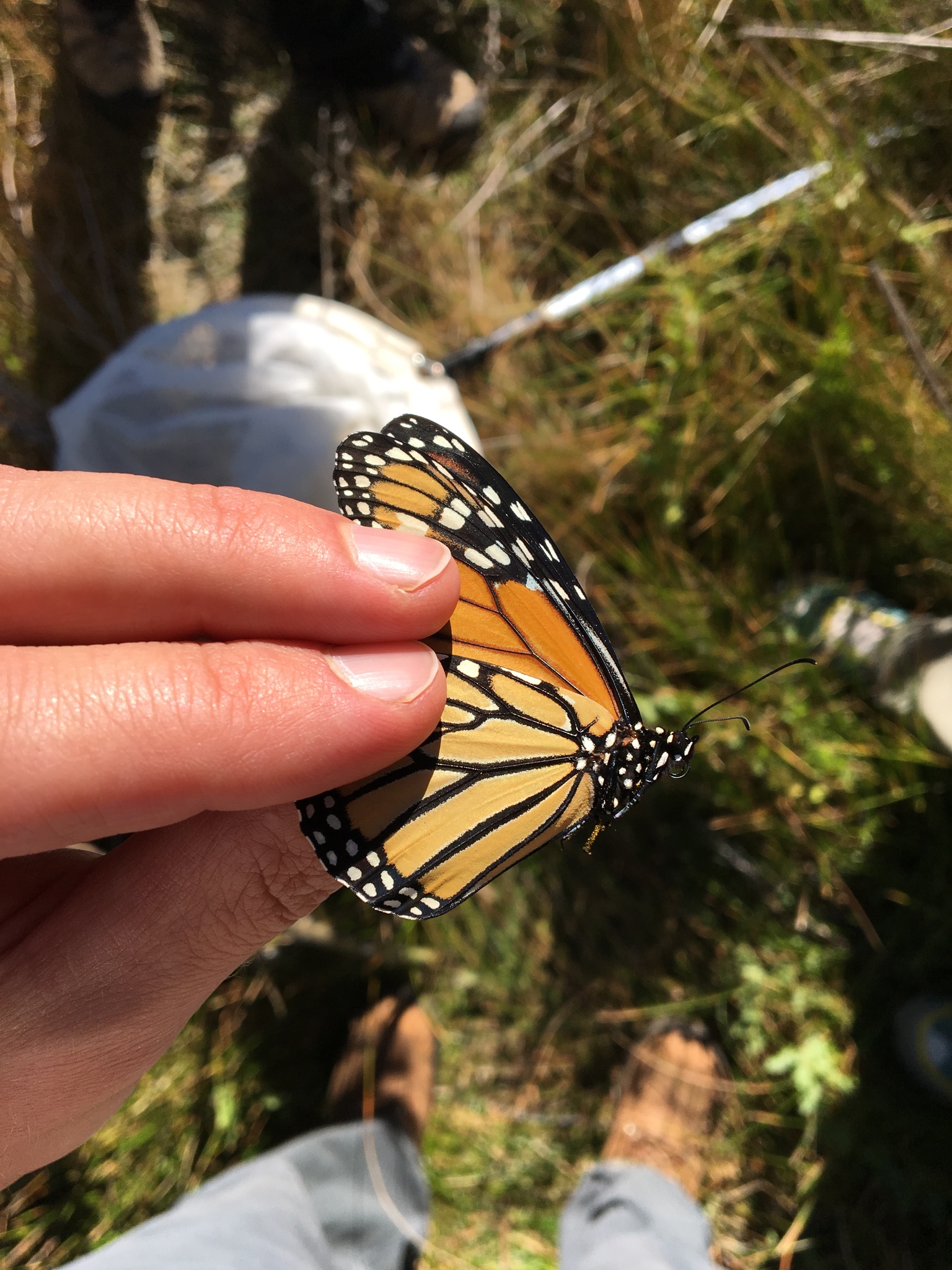
 Five years ago my wife and I joined other local citizen scientists at Willow Lake for an enjoyable afternoon catching and tagging monarch butterflies.  The tags are small stickers with ID numbers.  They  don't impair the butterfly's ability to fly, but they do let us humans track where they fly to!


A monarch in the hand.

 The Southwest Monarch Study group recently updated their map showing the location of recovered tags.  The straight lines indicate starting and ending locations, not necessarily the meandering paths monarchs take to migrate across the landscape. 

Image from Southwest Monarch Study.  

  Over the ensuing years, those tagged butterflies have turned up as far away as the monarch's overwintering grounds in Mexico. Interestingly, they also visit California overwintering sites.  Most monarch populations can be neatly divided into Eastern and Western populations based on where they spend the winter; Eastern go to Mexico and Western go to California.  But it seems AZ monarchs can go to either, which raises the fascinating question: how do they decide where to go?  Is AZ a meeting spot for different populations, and each return to their home wintering sites, or is AZ a melting pot, a single population where individuals decide each year where to overwinter?

Hopefully this citizen science research will help resolve some of the question marks on monarch migration maps.

Monarch migration map from Xerces.


Monarch migration map from Monarch Watch. 


Monday, October 31, 2022

Fire Retardant Visible From Space

The Bush Fire started on the West side of Highway 87 in Arizona on June 13, 2020.  Drive by strong winds from the SW, it soon spread to the highway median and then crossed to the East side of the highway.  From there, it went on to burn 193,000 acres until it was completely contained on July 6, 2020.
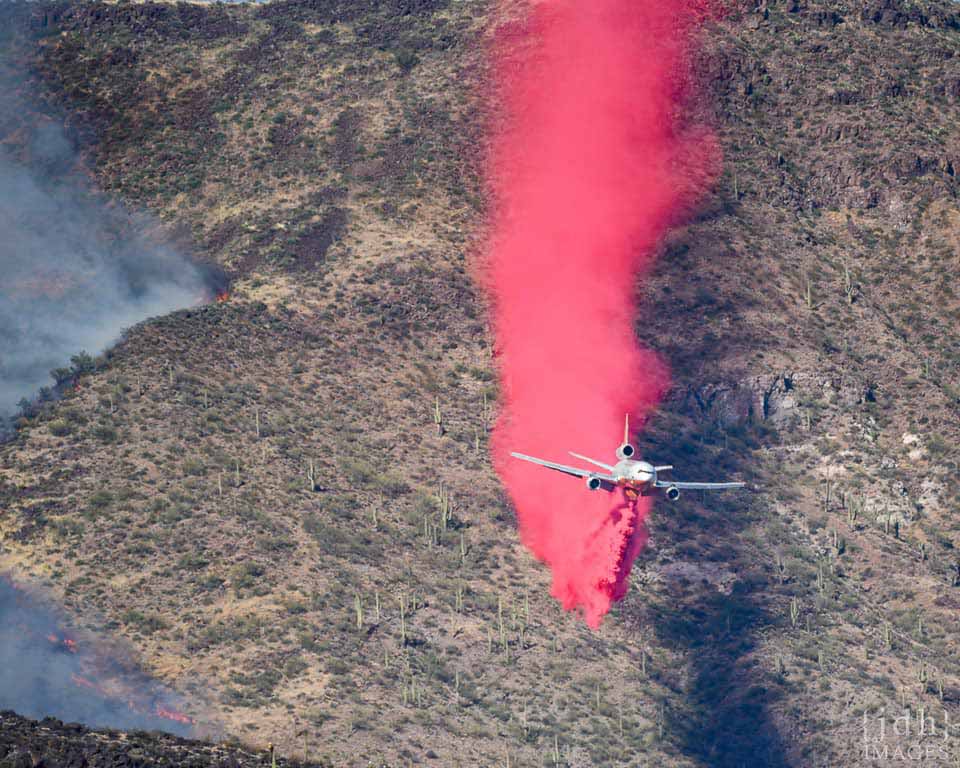
Air tanker drops retardant ahead of fire.  Photo by JDH images.  https://wildfiretoday.com/tag/bush-fire-in-arizona/

Air tankers were extensively used in the initial attack on the fire, and Google Earth images of the fire start location show some interesting features.  These images were taken on June 20, 2020, 7 days after the fire had burned this location.

The fire started on the West side of 87.  Fire retardant strips are visible in several locations.

Where the fire was backing against the SW wind, retardant drops were successful in stopping the spread of the fire.  A small bulge near the top of the image shows where fire crossed the line, but was contained.

Retardant drops on the south side of the fire were not successful in stopping the fire, but may have been instrumental in slowing the fire which allowed it to be stopped at the dirt road.

Retardant drops directly in front of the wind-driven fire were not successful in holding against the onrushing flames.  The fire spread over and around the retardant line in this image.

At another location on the same date, the fire can still be seen actively burning.