"We talk about what is important to us."
- Jacob Tetlow, APS
Regular safety meetings and striving for constant improvement are a sign that safety actually is important. APS has regular safety meetings where we try to proactively create safer working conditions. By sharing and talking about safety incidents we can learn from them before they happen to us. "The wise man learns from others' mistakes."
APS is implementing a new safety program called Safety Foward, based on the ideas of Todd Conklin, a retired senior safety adviser from Los Alamos National Lab. You can look up his talks on Youtube or look into his book “Pre Accident Investigations”. He talks about the difference between resilient and fragile systems. A fragile system is liable to a single point of failure, for example, an operator-dependent system where the only safeguard against risk is the behavior of the employee. Dr. Conklin says that such a system is basically "alligator wrestling" where you are telling the employee, "don't get bit!".
Some key ideas around moving Safety Forward
Create a resilient safety system: It's not IF an event occurs, but WHEN.
People are the solution: Employees doing the work are best suited to provide solutions to safety risks/hazards.
Focus on being a learning organization: Establish learning teams to collaborate and communicate learnings from an event or known risk.
Focus on leading indicators: Focus on safety observations and serious injury or fatality (SIF) potential.
More notes
• Failure is the mother of improvement – viewing an accident as an opportunity to improve processes, procedures, and overall culture
• All accidents are not preventable and don’t ask “if” questions – ask “when” questions – sets up individuals to recover better for when an incident happens
• Design a system that knows it will fail
• Detection and correction are the two most powerful tools in safety – getting at the idea of recoverability
• Three main controls to number of accidents include Compliance (procedures, rules, regulations), Design (engineering controls for safety) and human performance (place where work meets the worker)
• The new view of safety looks at workers as the solution rather than the problem
• Safety leaders should be asking what workers need in order to be safe instead of leading safety from a top-down approach
Showing posts with label work. Show all posts
Showing posts with label work. Show all posts
Friday, January 31, 2020

Wednesday, January 22, 2020
Tactical and Executive Leadership
Notes from a presentation at APS by Jason Gardner, Echelon Front, fomer Navy Sea Air and Land SEAL.
Sometimes good to let people fail so they can improve.
There is often the assumption that if you told someone what to do then it will work, but may not hold true in stressful situations.
Develop culture where everyone is included and understands that their contribution is important.
1. Cover and Move
If teammate fails, we all fail.
2. Keep it Simple
Everyone needs to understand the goal.
3. Prioritize and Execute
Detach from details. Don't be a robot, but don't forget to see yourself from the outside.
4. Decentralized Command
Everyone leads. Leadership is not just a title but an attitude.
Victory Mindset
-Default mode: aggressive. See and do. Often the most important things to do are in the places we least want to look.
-Innovate and Adapt - aggressively
-Humility: check your ego
-Influence up and down chain of command: develop relationships
-Lead and follow
-Discipline equals freedom
-Extreme ownership: no blame, no excuses.
Sometimes good to let people fail so they can improve.
There is often the assumption that if you told someone what to do then it will work, but may not hold true in stressful situations.
Develop culture where everyone is included and understands that their contribution is important.
1. Cover and Move
If teammate fails, we all fail.
2. Keep it Simple
Everyone needs to understand the goal.
3. Prioritize and Execute
Detach from details. Don't be a robot, but don't forget to see yourself from the outside.
4. Decentralized Command
Everyone leads. Leadership is not just a title but an attitude.
Victory Mindset
-Default mode: aggressive. See and do. Often the most important things to do are in the places we least want to look.
-Innovate and Adapt - aggressively
-Humility: check your ego
-Influence up and down chain of command: develop relationships
-Lead and follow
-Discipline equals freedom
-Extreme ownership: no blame, no excuses.
Wednesday, February 24, 2016
Wildlife Camera Photos - Winter 2015-2016
These photos were taken by a network of motion-triggered wildlife cameras in the Manzano Mountains, New Mexico:
 |
| Bobcat |
 |
| Snow |
 |
| Turkey |
 |
| Coyote |
Tuesday, October 07, 2014
Rio Grande SIlvery Minnow
 |
| Interactive version: http://www.usbr.gov/tsc/rivers/awards/Nm2/rg/riog/schematic/SCHEMATICalbuquerquediv.html |
The River. Like the Nile it rises in distant mountains, then flows down through farm, city, farm, and city, losing water to the desert. I've skipped over headwater steams in the highest alpine meadows in Colorado, and fished tributaries from the high peaks in the Wiemenuche, the San Juan, the Sangre de Christo mountains.
The Grande enters New Mexico as a whitewater river cut deep in a thousand-foot canyon, opens onto the agricultural floodplain of the (NM) Central Valley just north of Albuquerque and loses water continuously as it flows south toward Texas and Mexico.
It goes dry most years these days, fish left out under the oven sky. Agricultural diversions, cities. Dams and reservoirs. Water sinking into deep sand. Low-flow channels carry the remaining trickle south to satisfy more cities, interstate treaties. Fought over by water managers, farmers, and conservationists. (Link to article: How much water used by cottonwoods versus farmers versus cities. )
We went seining for fishes: white suckers, red shiners, catfish, chad and fathead minnows but most of all: Silvery Minnows, endemic to New Mexico and listed as Federally Endangered.
The Silvery Minnow is endangered for a range of reasons. Like many river fish it is negatively impacted by dams turning the river into lakes. The drying of the Rio Grande is probably more extensive now than it was before modern agricultural irrigation and pumping, but the Rio Grande probably always went dry and only remained wet in refugia...
Silvery Minnows: One thread in the tapestry of life. We were looking for silver needles in the full force of river water, the gush and rush, one and a half feet per second. We splashed into the surging river water, waded out to the river’s sand bars. We used bag and beach seines, color-coded buckets, rite-in-the-rain and water-resistant-(but susceptible) electronics, but the fish were nowhere to be found.
Mud flats held the first tiny dicotyledons of new weeds, sprouting. In a few isolated backwaters (I can’t say exactly where) we did find a few, or even many, Silvery Minnows, alive and wide-eyed. We photographed them, weighed and measured them, and checked whether they were tagged fish raised in a hatchery or a wild child, conceived in good ol’ mother nature.
For unknown reasons, the 2013 spawning was a good year for the Minnow and it seemed like it might bounce back then, but not much has been seen of that cohort since. Meanwhile, the lawyers aren't waiting .... (link to Wild Earth Guardians lawsuit)
Thursday, April 17, 2014
Water-year to Date Departure from Normal

The area East of Carlsbad, NM in Eddy county going into Lea county has had 2-4 or even 6 inches more rain than normal since October 1st. The figure above shows that this is almost triple the normal precipitation in places. The mesquite is bright green and there are many flowers, despite below-freezing temperatures at the beginning of the week. A good place for some springtime botany!
Sunday, June 16, 2013


Wednesday, August 22, 2012
Idaho Forest Fires
View of the Halstead fire in the Salmon-Challis National Forest on July 31st from SR-21.

Summer convective thunderstorms add only a small amount to the water budget of the Northern Rockies, and the fire season here typically picks up when evaporation greatly exceeds precipitation in the latter half of the summer.
Percent of normal precipitation, June 21st to August 21st:

from http://water.weather.gov/precip/
2012 has been a dry summer, and there are currently three major forest fires burning in central Idaho (from north to south): the Mustang Complex that grew out of the uncontainable Chrandal Creek Fire, the Halstead Fire Northwest of Stanely, ID, and the Trinity Ridge Fire Northwest of Anderson Ranch Resevoir and Pine, ID. This image from August 10th clearly shows the smoke plumes from these three megafires, which have each burned nearly 100,000 acres of forest so far, with no end in sight.

Craters of the Moon National Monument lavafields are visible in the lower right corner, Boise is in the lower left, Lake Cascade and McCall are in the center left, and Montana is just visible in the upper right.

Percent of normal precipitation, June 21st to August 21st:

from http://water.weather.gov/precip/
2012 has been a dry summer, and there are currently three major forest fires burning in central Idaho (from north to south): the Mustang Complex that grew out of the uncontainable Chrandal Creek Fire, the Halstead Fire Northwest of Stanely, ID, and the Trinity Ridge Fire Northwest of Anderson Ranch Resevoir and Pine, ID. This image from August 10th clearly shows the smoke plumes from these three megafires, which have each burned nearly 100,000 acres of forest so far, with no end in sight.

from http://activefiremaps.fs.fed.us/
Friday, January 14, 2011
Monday, November 16, 2009
Tamarix ramosissima survey on White Sands National Monument
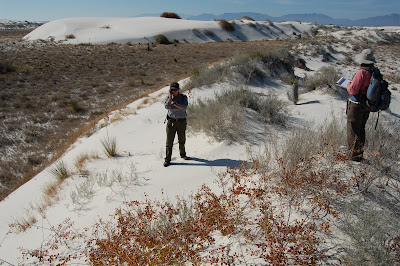
White Sands National Monument is located in the Tularosa Basin and surrounded by White Sands Missile Range, the site of the first atomic bomb test. The area is desolate and remote and still used for target practice. The dunes are composed of gypsum, a salt that accumulates in the dry lakes and playas of this closed basin.
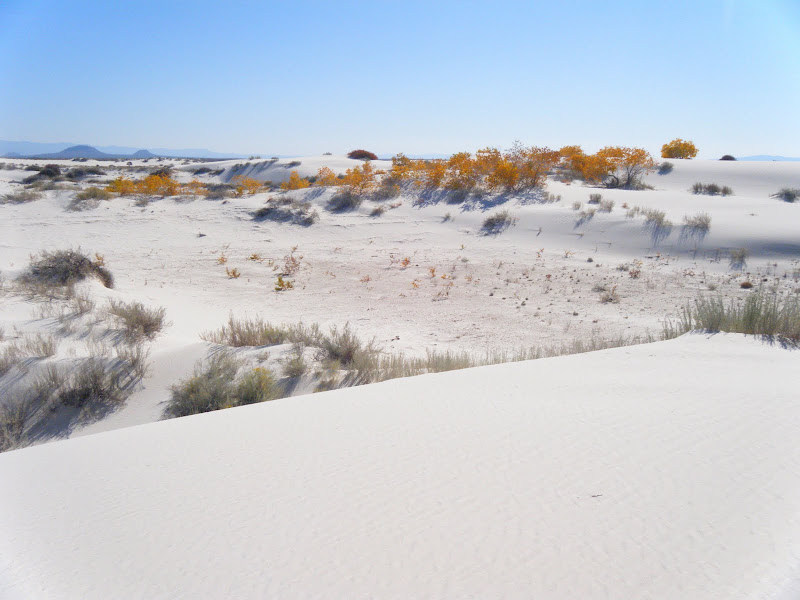
Our Mission: Vegetation mapping plus Search & Destroy Tamarix ramosissima AKA Russian Salt Cedar. Our goal was to ground-truth vegetation maps and locate populations of this invasive species for possible future air strikes.
Cottonwoods grow in the dunes because of the shallow water table.
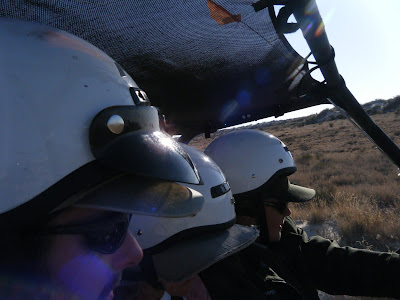
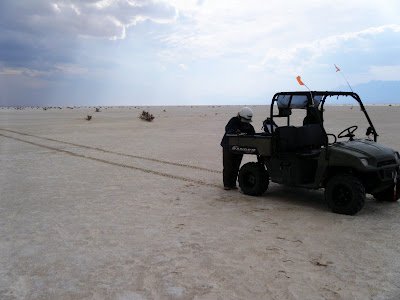
We traveled by sand buggy.
Many dunes are stabalized by Rhus Trilobata (Skunkbush Sumac), Poliomentha (Rosemary Mint Bush), Chrysothamnus (Rabbitbrush, Chamisa), and Yucca.
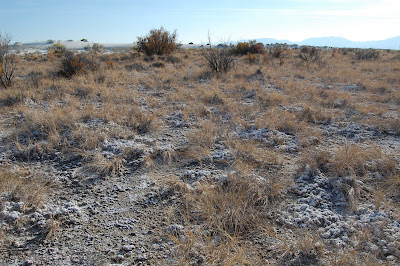
Tamarix ramosissima visible in the background. The foreground is covered by a thick salt crust.
 |
| From White Sands National Monument |
Our Mission: Vegetation mapping plus Search & Destroy Tamarix ramosissima AKA Russian Salt Cedar. Our goal was to ground-truth vegetation maps and locate populations of this invasive species for possible future air strikes.
 |
| From White Sands National Monument |
Cottonwoods grow in the dunes because of the shallow water table.
 |
| From White Sands National Monument |
We traveled by sand buggy.
 |
| From White Sands National Monument |
 |
| From White Sands National Monument |
 |
| From White Sands National Monument |
Monday, October 26, 2009
Mesquite Treatment Monitoring in Lesser Prarie Chicken Habitat
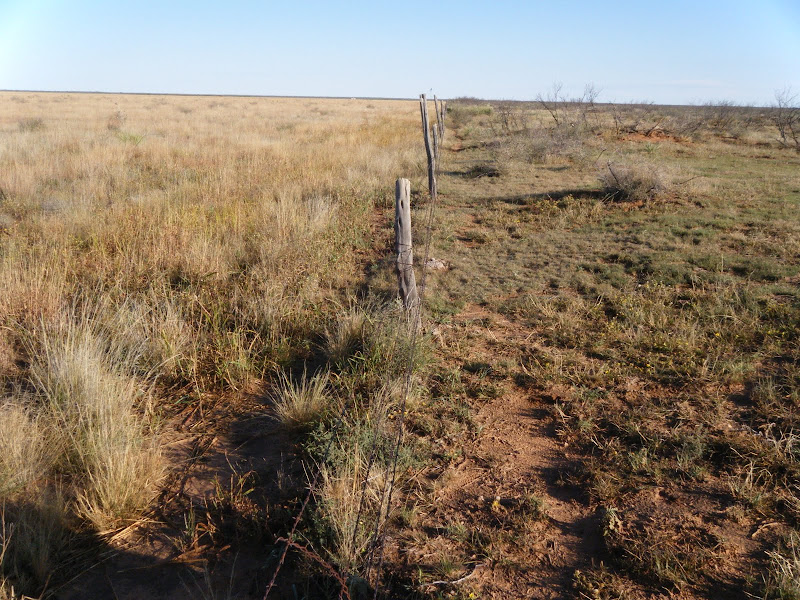
Mesquite has invaded large areas of warm semi-arid grassland, possibly due to a combination of land use and climate change. Fenceline contrasts usually indicate selective growth is due to land use; in the case below the field on the right is grazed while that on the left is a Conservation Reserve former farm field.
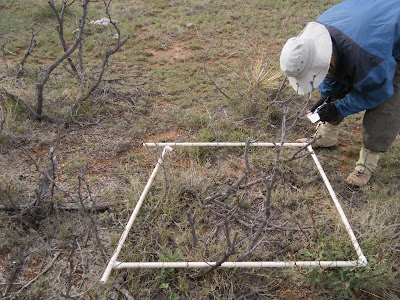
The mesquite has been sprayed with a selective herbicide in order to increase forage access for cows. Our goal was to monitor the vegetation changes associated with mesquite die-off. I also observed that mesquite and other shrubs clearly stabalize more eolian transport than do grasses.
Yvonne: "looks like pretty good kill to me. I don't know what he's complaining about. You never get 100% -- not in nature"
Rancher: "never seen it this green this time of year before"
--
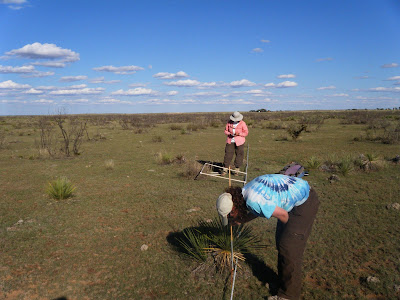
lark buntings dance from mesquite to mesquite
trilling as they fly: pipsqeek joy
horsecrippler cactus
we dug and boxed for home
two Great Blue Herons flap-float overhead
bringing/bearing profound stillness
tarantulas still crossing road
honk/gurgle of sandhill cranes float out
of clear blue sky
Damn scorpions - one just crawled under fridge
pocket gopher diggings everywhere!
Panicum obtusum, virgatum
spider webs shimmer parachute? balloon?
Look! a tiny spider clutching the tiptop of a tiny Buchloe grass
it flies away, and for a moment; Pure Magic
12:30 2 groups of 3 and 4 cranes, circling overhead
another group of 2 joins them
we hear them long after they are lost in sky
their presence gives it dimension, then dimensionless
 |
| From Milnesand, NM |
Yvonne: "looks like pretty good kill to me. I don't know what he's complaining about. You never get 100% -- not in nature"
Rancher: "never seen it this green this time of year before"
--
lark buntings dance from mesquite to mesquite
trilling as they fly: pipsqeek joy
horsecrippler cactus
we dug and boxed for home
 |
| From Milnesand, NM |
bringing/bearing profound stillness
tarantulas still crossing road
honk/gurgle of sandhill cranes float out
of clear blue sky
 |
| From Milnesand, NM |
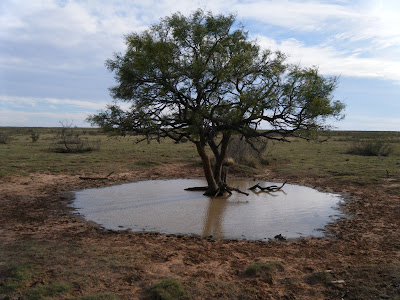
Damn scorpions - one just crawled under fridge
pocket gopher diggings everywhere!
Panicum obtusum, virgatum
spider webs shimmer parachute? balloon?
Look! a tiny spider clutching the tiptop of a tiny Buchloe grass
it flies away, and for a moment; Pure Magic
 |
| From Milnesand, NM |
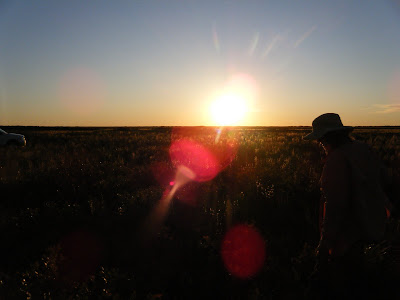
another group of 2 joins them
we hear them long after they are lost in sky
their presence gives it dimension, then dimensionless
 |
| From Milnesand, NM |
Saturday, September 26, 2009
Evaluating Restoration Potential at Taos-area Streams
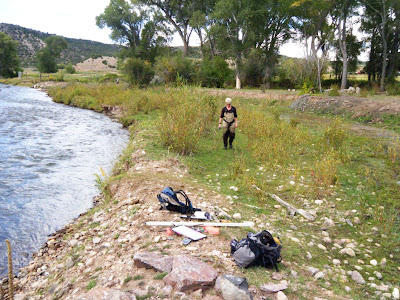
We use a four-tiered scale to rate restoration potential, basically A, B, C, D:
A is fine, possibly excepting some irrigation
B is for "needs beaver!", and/or stop grazing
C needs instream structures and earth moving equipment to restore functionality
D can't be helped
Rio Costillo. Upstream landowner's home is within flood-prone area and would certainly be an impediment to any restoration effort, while downstream landowner's stretch has been dredged. D
Rio Fernando: A thriving beaver population has created extensive wetlands composed of Typha and Salix exigua, but completely extirpated Populus from the reach. A (maybe plant cottonwood)
Santa Barbara Upper: A main channel circumvents the beaver ponds and side channels and appears somewhat channelized, with low habitat diversity (and hence few fish). What is causing the main channel to bypass beaver dams and downcut? A?
Rio Pueblo: Irrigation returns from irrigated pastures along the North; humans have attempted to replace breached beaver dams and drying beaver ponds with rock-and-plastic "fisherman's dams". B
For more site descriptions, click on the links above.
A is fine, possibly excepting some irrigation
B is for "needs beaver!", and/or stop grazing
C needs instream structures and earth moving equipment to restore functionality
D can't be helped
 |
| From Natural Heritage New Mexico - Taos Streams |
Rio Costillo. Upstream landowner's home is within flood-prone area and would certainly be an impediment to any restoration effort, while downstream landowner's stretch has been dredged. D
 |
| From Natural Heritage New Mexico - Taos Streams |
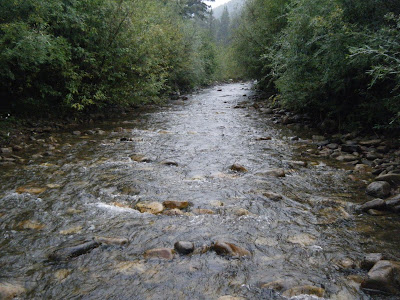
Rio Fernando: A thriving beaver population has created extensive wetlands composed of Typha and Salix exigua, but completely extirpated Populus from the reach. A (maybe plant cottonwood)
 |
| From Natural Heritage New Mexico - Taos Streams |
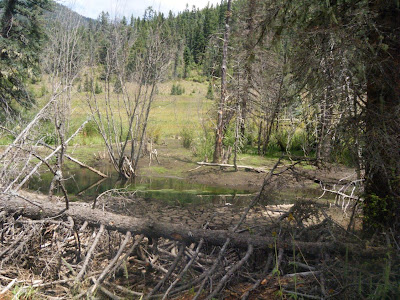
Santa Barbara Upper: A main channel circumvents the beaver ponds and side channels and appears somewhat channelized, with low habitat diversity (and hence few fish). What is causing the main channel to bypass beaver dams and downcut? A?
 |
| From Natural Heritage New Mexico - Taos Streams |
Rio Pueblo: Irrigation returns from irrigated pastures along the North; humans have attempted to replace breached beaver dams and drying beaver ponds with rock-and-plastic "fisherman's dams". B
For more site descriptions, click on the links above.
Wednesday, September 23, 2009
Rio Puerco, NM: BEFORE and AFTER
The furthest downstream restoration site is doing well. Note how the roads have revegetated.
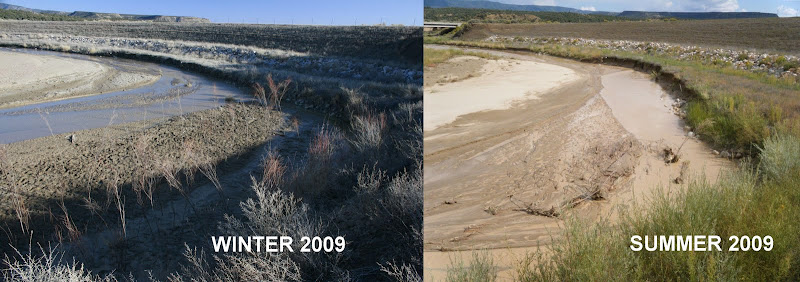
The large berm in the background is the "remeander" dam that was built a couple years ago to push the Puerco back into its original channel. In the foreground an In-Stream Willow Planting (ISWP) immediately after it was planted (left) and then after a single growing/flooding season (right). This planting did not incorporate wattles. It has largely washed out as the river channel continued its lateral migration toward river right. A large amount of new erosion is visible along the right side of the channel, which is exactly what this planting tried to prevent. Unfortunately, it is working against the natural migration of the river.
The same ISWP, looking upstream. The main channel is now flowing (and cutting) right along the bank. The point bar on the left has widened.
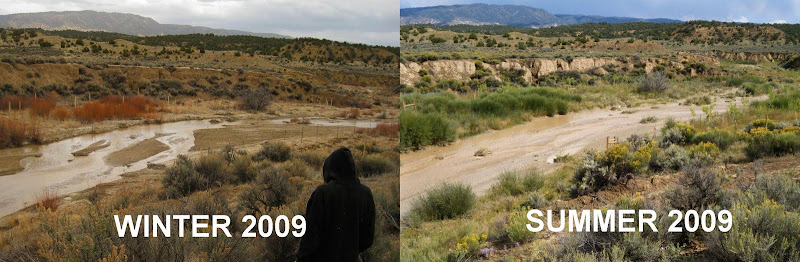
These photos show the Guardian's plantings immediately downstream from the bridge. This old channel is now receiving flow because of the remeander. It is a healthy channel with an active floodplain. All of the cottonwoods and willows received overbank flooding from the summer monsoons, and did very well. Its a real jungle down there!
These photos show an ISWP on Guardian's State Land. It is the middle of three such ISWPs on State Land. The channel through this reach is downcut and straight, almost like a ditch, and the plantings sought to induce meanders. While the plantings didn't wash out, it doesn't look like the willow are doing very well; in this wet year the bottom of the channel may have been too wet for them. Looking further downstream, one can see sedges growing into the channel, forming a natural meander pattern. Planting sedge plugs may be more effective below bankfull.
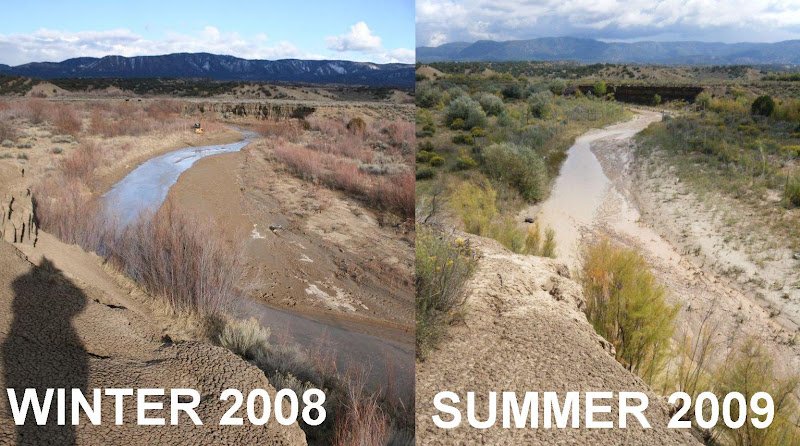
These photos show the downstream area of the Guardian's State land that was planted in 2008. The ISWP from 2008 is not quite visible under the large cut bank in the center distance. The development and change of the river's channel and associated point bars are visible in the foreground.
For more information and more photos, click on one of the photo links above.
 |
| From Rio Puerco Restoration Evaluation - September 2009 |
The large berm in the background is the "remeander" dam that was built a couple years ago to push the Puerco back into its original channel. In the foreground an In-Stream Willow Planting (ISWP) immediately after it was planted (left) and then after a single growing/flooding season (right). This planting did not incorporate wattles. It has largely washed out as the river channel continued its lateral migration toward river right. A large amount of new erosion is visible along the right side of the channel, which is exactly what this planting tried to prevent. Unfortunately, it is working against the natural migration of the river.
 |
| From Rio Puerco Restoration Evaluation - September 2009 |
The same ISWP, looking upstream. The main channel is now flowing (and cutting) right along the bank. The point bar on the left has widened.
 |
| From Rio Puerco Restoration Evaluation - September 2009 |
These photos show the Guardian's plantings immediately downstream from the bridge. This old channel is now receiving flow because of the remeander. It is a healthy channel with an active floodplain. All of the cottonwoods and willows received overbank flooding from the summer monsoons, and did very well. Its a real jungle down there!
 |
| From Rio Puerco Restoration Evaluation - September 2009 |
These photos show an ISWP on Guardian's State Land. It is the middle of three such ISWPs on State Land. The channel through this reach is downcut and straight, almost like a ditch, and the plantings sought to induce meanders. While the plantings didn't wash out, it doesn't look like the willow are doing very well; in this wet year the bottom of the channel may have been too wet for them. Looking further downstream, one can see sedges growing into the channel, forming a natural meander pattern. Planting sedge plugs may be more effective below bankfull.
 |
| From Rio Puerco Restoration Evaluation - September 2009 |
These photos show the downstream area of the Guardian's State land that was planted in 2008. The ISWP from 2008 is not quite visible under the large cut bank in the center distance. The development and change of the river's channel and associated point bars are visible in the foreground.
 |
| From Rio Puerco Restoration Evaluation - September 2009 |
For more information and more photos, click on one of the photo links above.
Sunday, November 09, 2008


Monday, August 04, 2008
Upper Rio Grande Watershed: Rio de los Pinos to Conejos River

Flanked by the Conejos River and Rio de los Pinos, this watershed includes Pinorealosa and Osier Mountain, along with many excellent creeks (named and unnamed), alpine meadows, and river bottoms. Controlled burns and selective logging seem to be keeping the woodland open and healthy, while fire or beetles have left enough dead and downed timber to create unnavigateable thickets, quite conducive (necessary and sufficient) for unfragmented, Wilderness landscape.
Thin, filamentous, and/or deeply pinnatifid leaves, everything with prickles, spines, or a dense covering of hair (tomentous) -- but not many poisonous. Hairs serve to insulate as well as defend. ... In the wetlands, poisonous and fleshy plants dominate. Elk and bear, fire and grazing, Rorippa, Mimulus, Penstemon, Geum, myriad rodents scurrying away in all directions, fawns hiding breathless in the grass, hellebores and corn lilies, the 'Umbel of God', ululation, mountain thunderstorms...
The coastal fog of California, gentled by a 1,000 miles travel. I heed the thunder, and elevate the advent of rain above dull annoyance. This morning, I climbed the cliffs above our campsite. When I reached the top I felt like crying. Don't know why. Looking out over the watershed I understand the pattern. All water runs downhill. There is a band of trees from a lower line where it is wet enough to grow to an upper line where it is too cold to grow. There is a line in-between those two, above which precipitation exceeds evaporation. All rivers originate above this line, in their Headwaters.
I was always thinking of new, clever, ways of getting ahead of Nature, ahead of myself, beyond lightspeed and Saturation, entropy, Capacity. Rainbows multiplying from the first: Asgaard, Bridge to Heaven. But why does it curve back to Earth? Everyone sees a different shape and distance, depending on their perspective. The kind of rain mosquitoes can still swim through to sting. Lightening and that particular sound of the thunder rolling off of the peculiar and idiosyncratic topography up-valley.
But what if the world refuses to be ordered by the human mind? We know honeybees can be trained to show preference between human faces, but will they ever understand them? Then how too will we ever understand our world? Words are useless if we rely on them to a fault, if natural variation is continuous and nonlinear, yet we expect it to conform by our contingent, evolutionarily-derived logical architectures and cognitive biases.
On the backbone of the continent, the Genesis of the Southwest; a looking-glass world, mountains in every direction, but the brooding presence of the Great Plains felt in the passes opening between. At times we thought we were in Kansas, or safe away in our beds dreaming, but we were in the San Luis Valley, ripening in the sun.
You have driven up and down the mountain valleys, the flanks that lead up from below or down from above, the highways and streams of rivers and clouds. You have stood, still, in the center of the valley, under Blanca, for days. Transfixed interest, blossoms like dollar bills in the breeze. You have climbed high up where there is more air than land, yet still cannot seem to breathe enough and the mountain says enough and the Thunderstorm says Enough and you flee their mutterings and grumblings
Storms billow on surrounding mountains, then range over the landscape. Powerful rain, thunder and lightening on into the night...sigh... San Juan rainstorms. The next day the storms grow but, despite our hurry to avoid them, only blow for early Evening Entertainment, and on into the night. Next day, storms brush by, delivering a soaking with bits of hail mixed in. These storms build on the San Juans, blow low over the valley --but nothing can slow them until the Sangres, where they slide silently up the crest, lick their salty skins, run a tongue along sharpened teeth, and watch the wounds of mankind's world.
Where have all the willows gone? The heart of the landscape dug out, munched, passed, trampled dirt. The magic and will to live that flowed wild, healthy, worshipful. Destruction AND Growth. Unsimplified. Wet, unique.
All land in the West is "wetland"; fear not. Although nothing fits into categories anyway, each consciousness, attuned to an unique understanding, attempting an unbiased account of who-knows-what for someone else. Under the roof of the world, wet with the aspen, the carex, and the rivers; mountain ridges diverge until they peter out, rivers seek their breathren and converge until they become one with the ocean. Flowing water flows together - it lubricates itself; whereas water soaking into sponge, expands -- it flees the mutual weight of multitude.
Oh now gentle rain, Conejos River hopping along...who understands?
Saturday, July 26, 2008
Upper Rio Grande Watershed: Rio de los Pinos to Conejos River


http://picasaweb.google.com/conorpro/CumbresAndToltecRioDeLosPinosWatershed
Wednesday, February 20, 2008
What are we doing out here?
"Forests are the lungs of our land, purifying the air and giving fresh strength to our people."
-Franklin D. Roosevelt

What are we doing out here? We come in with big yellow machinery, excavators and bulldozers and trucks, and lay waste to what we call unnatural and bad, to create a new ecosystem that we call good and natural. The alternative is accepting ecosystem "replacement" AKA ecological succession. Who can weigh all the ramifications of change to decide what is good and bad? How can we attempt to control what we don't understand? Is invasive species removal worth it?

For most of the riparian areas in the Southwest, the invasive species of focus is tamarisk:
"Tamarisk can usually out-compete native plants for water. A single, large tamarisk can transpire up to 300 gallons of water per day. In many areas where watercourses are small or intermittent and tamarisk has taken hold, it can severely limit the available water, or even dry up a water source.
Tamarisk can grow in salty soil because it can eliminate excess salt from the tips of its leaves. When the leaves are shed, this salt increases the salinity of the soil, further reducing the ability of native plants to compete. Because of its ability to spread, its hardiness, its high water consumption, and its tendency to increase the salinity of the soil around it, the tamarisk has often completely displaced native plants in wetland areas.
From a wildlife point of view, the tamarisk has little value and is usually considered detrimental to native animals. The leaves, twigs and seeds are extremely low in nutrients, and, as a result, very few insects or wildlife will use them. In one study along the lower Colorado River, tamarisk stands supported less than 1% of the winter bird life that would be found in a native plant stand. Because of the tamarisk's ability to eliminate competition and form single-species thickets, wildlife populations have dropped dramatically." Source: White Sands National Monument
So is invasive species removal worth it? It seems that, in the case of tamarisk, the best available science says yes. So we come in with the big yellow machinery.
We're not against natural change but we are against destructive change, change that impoverishes rather than re-invigorates. According to David Brower, restoration is the opposite of trying to stop the hands of time; it is an effort to keep the clock running: "The business of making something better, getting something back in shape--helping Nature heal--should make us feel good. And it will probably make our children feel better about us if we spent more time trying." David Brower Wild Earth Interview, Spring 1998.
-Franklin D. Roosevelt

What are we doing out here? We come in with big yellow machinery, excavators and bulldozers and trucks, and lay waste to what we call unnatural and bad, to create a new ecosystem that we call good and natural. The alternative is accepting ecosystem "replacement" AKA ecological succession. Who can weigh all the ramifications of change to decide what is good and bad? How can we attempt to control what we don't understand? Is invasive species removal worth it?

For most of the riparian areas in the Southwest, the invasive species of focus is tamarisk:
"Tamarisk can usually out-compete native plants for water. A single, large tamarisk can transpire up to 300 gallons of water per day. In many areas where watercourses are small or intermittent and tamarisk has taken hold, it can severely limit the available water, or even dry up a water source.
Tamarisk can grow in salty soil because it can eliminate excess salt from the tips of its leaves. When the leaves are shed, this salt increases the salinity of the soil, further reducing the ability of native plants to compete. Because of its ability to spread, its hardiness, its high water consumption, and its tendency to increase the salinity of the soil around it, the tamarisk has often completely displaced native plants in wetland areas.
From a wildlife point of view, the tamarisk has little value and is usually considered detrimental to native animals. The leaves, twigs and seeds are extremely low in nutrients, and, as a result, very few insects or wildlife will use them. In one study along the lower Colorado River, tamarisk stands supported less than 1% of the winter bird life that would be found in a native plant stand. Because of the tamarisk's ability to eliminate competition and form single-species thickets, wildlife populations have dropped dramatically." Source: White Sands National Monument
So is invasive species removal worth it? It seems that, in the case of tamarisk, the best available science says yes. So we come in with the big yellow machinery.
We're not against natural change but we are against destructive change, change that impoverishes rather than re-invigorates. According to David Brower, restoration is the opposite of trying to stop the hands of time; it is an effort to keep the clock running: "The business of making something better, getting something back in shape--helping Nature heal--should make us feel good. And it will probably make our children feel better about us if we spent more time trying." David Brower Wild Earth Interview, Spring 1998.
Tuesday, February 19, 2008
Restoration History: Hoedads
"In the middle of a clearcut, planting a tree is a spiritual act; doing it over and over is healing." Eugene Weekly.
 Photo courtesy of www.dechene.com
The Hoedads were an organized cooperative of tree planters, named after their tool of choice, a sort of pickax used to plant trees. Mostly college graduates, these young men and women went "back to the land" in the 1970s to care for the earth and try to live out the ideals of the the 1960's, although by the time my father was a forester in Oregon in the 1980's only "drunks and guys who couldn't make it doing anything else" were left. It was brutal labor, a job the Oregon State Employment Service lists as “the hardest physical work known to this office.., one person in fifty succeeds the three week training period.” But the scenery was fantastic, and the art, music, and poetry of the movement continues to speak to us...
...especially to those of us who follow in their revolutionary footsteps, planting trees and caring for the earth. Today, reading about the idealism of the Hoedads, it is tempting to romanticize their work in comparison with our own. For example, both men and women Hoedads commonly worked shirtless, while today we rarely work shirtless and there aren't really many women on the crew anyway.
But, reading further history reveals trade-offs even in paradise. The Hoedads were exposed to sprayed herbicides and pesticides, while today we avoid using most poisonous chemicals (except petroleum products). Our work today, like the Hoedad's, is a product of our times. We drive trucks and eat processed food and doubt whether we can make a real difference, while the Hoedads confronted prejudice, exploitation, and chemical toxins with the fresh idealism of the 1960's. 40 years later it can be hard to see if much progress has been made (there are still so many forests and riparian areas to re-plant!), but perhaps the important fact is what has stayed the same: the dedication, hard work, and, yes, idealism to try to make a positive difference on the earth.
"God almighty! Why am I here, saying this, and not there, and not doing, and making the forest?"
Please read this great verse poem by Richard Bear eulogizing the Hoedads.
-
How to use a hoedad.
 Photo courtesy of www.dechene.com
The Hoedads were an organized cooperative of tree planters, named after their tool of choice, a sort of pickax used to plant trees. Mostly college graduates, these young men and women went "back to the land" in the 1970s to care for the earth and try to live out the ideals of the the 1960's, although by the time my father was a forester in Oregon in the 1980's only "drunks and guys who couldn't make it doing anything else" were left. It was brutal labor, a job the Oregon State Employment Service lists as “the hardest physical work known to this office.., one person in fifty succeeds the three week training period.” But the scenery was fantastic, and the art, music, and poetry of the movement continues to speak to us...
...especially to those of us who follow in their revolutionary footsteps, planting trees and caring for the earth. Today, reading about the idealism of the Hoedads, it is tempting to romanticize their work in comparison with our own. For example, both men and women Hoedads commonly worked shirtless, while today we rarely work shirtless and there aren't really many women on the crew anyway.
But, reading further history reveals trade-offs even in paradise. The Hoedads were exposed to sprayed herbicides and pesticides, while today we avoid using most poisonous chemicals (except petroleum products). Our work today, like the Hoedad's, is a product of our times. We drive trucks and eat processed food and doubt whether we can make a real difference, while the Hoedads confronted prejudice, exploitation, and chemical toxins with the fresh idealism of the 1960's. 40 years later it can be hard to see if much progress has been made (there are still so many forests and riparian areas to re-plant!), but perhaps the important fact is what has stayed the same: the dedication, hard work, and, yes, idealism to try to make a positive difference on the earth.
"God almighty! Why am I here, saying this, and not there, and not doing, and making the forest?"
Please read this great verse poem by Richard Bear eulogizing the Hoedads.
-
How to use a hoedad.

Wednesday, March 07, 2007
Manduca DARPA Project
Flying is a difficult problem in an integrated system. The question is at what level of neurobiology could our course/coarse control (100 bits, 10 times a second) steer a moth? Will it be lower on a descending neuromuscular nerve bundle, causing the moth to jerk to the side and fall five feet, but regain a course that is say 30 degrees to the left, with a standard deviation of 30 degrees, so that it barely staggers and zigzags to the target, or can we hit the brain at the right spot to make it fly at exactly the azimuth we tune our dial to, or somewhere in between, say the cervical connective, so that we can bias the flight in some kind of nonlinear function --which might require a skilled operator not to over-correct in this situation, like sailing a boat?
Subscribe to:
Posts (Atom)