Showing posts with label california. Show all posts

Wednesday, November 02, 2022

Arizona Monarchs Visit California and Mexico

 Five years ago my wife and I joined other local citizen scientists at Willow Lake for an enjoyable afternoon catching and tagging monarch butterflies.  The tags are small stickers with ID numbers.  They  don't impair the butterfly's ability to fly, but they do let us humans track where they fly to!
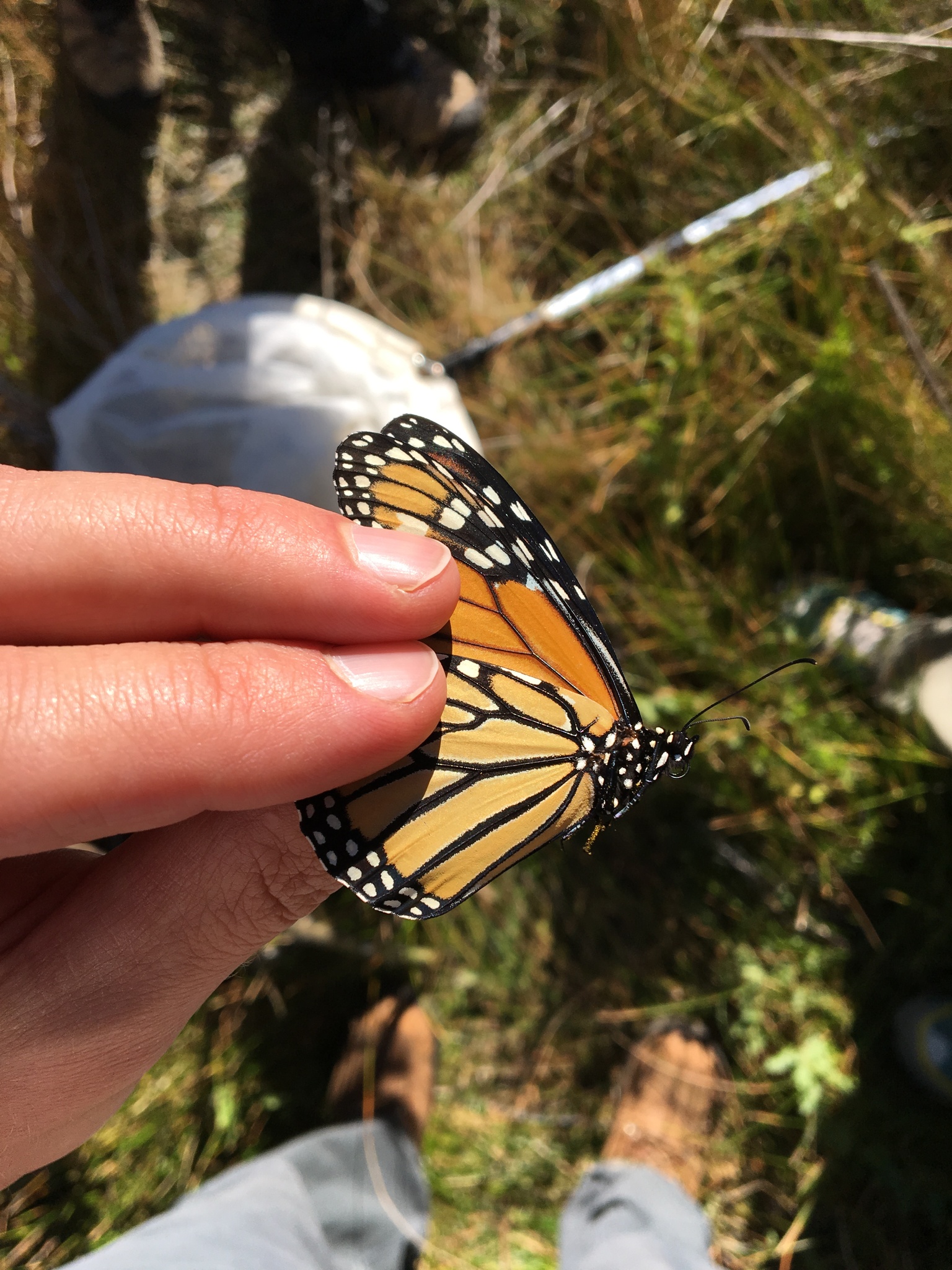

A monarch in the hand.

 The Southwest Monarch Study group recently updated their map showing the location of recovered tags.  The straight lines indicate starting and ending locations, not necessarily the meandering paths monarchs take to migrate across the landscape. 

Image from Southwest Monarch Study.  

  Over the ensuing years, those tagged butterflies have turned up as far away as the monarch's overwintering grounds in Mexico. Interestingly, they also visit California overwintering sites.  Most monarch populations can be neatly divided into Eastern and Western populations based on where they spend the winter; Eastern go to Mexico and Western go to California.  But it seems AZ monarchs can go to either, which raises the fascinating question: how do they decide where to go?  Is AZ a meeting spot for different populations, and each return to their home wintering sites, or is AZ a melting pot, a single population where individuals decide each year where to overwinter?

Hopefully this citizen science research will help resolve some of the question marks on monarch migration maps.

Monarch migration map from Xerces.


Monarch migration map from Monarch Watch. 


Tuesday, October 19, 2021

2021 California Wildfires and Fuel Treatments

This post and discussion on The Smokey Wire is one of the best, with in-depth reviews of the effectiveness of forest thinning to control wildfires.  


https://forestpolicypub.com/2021/09/17/the-caldor-fire-and-fuel-treatments-sf-chronicle-la-times-and-sac-bee-stories/

Wednesday, October 02, 2013

What does a natural forest fire look like in the Southwest?

What is "natural"?  Ecologists use the range of natural variability to define proper functioning condition (PFC) or minimally disturbed condition (MDC), etc (in the jargon of ecologists -- basically, what was it like before we mucked it up?)  The question is surprisingly hard to answer.

Tom Swetnam has been quoted drawing a distinction between burn severity (high-intensity burns are natural) and extent (but high-severity burns across large landscapes are not natural).  These statements are part of an ongoing debate that, like many debates in ecology, may be dependent on local factors.  

In Arizona, Dr. Wally Covington became famous for championing open park-like Ponderosa forests.  Indeed, many landscapes are dominated by frequent low-intensity grass fires that clear out underbrush and young trees.  But at longer time scales it seems equally clear that these same forests can catastrophically burn.  This has been pointed out by Dr. Baker's work in Arizona, and by Dr. Grant Meyer in Sacramento Mountains of New Mexico.  More evidence is not hard to find.  For example, a study of the geomorphology of the Rio Cebolla river in the Jemez Mountains noted extensive sediments with large burned logs indicative of high severity fire in what must have been extensive headwater areas. 

Dendrochronologists  often focus on the last 1,000 years, whereas geomorphologists have a much larger picture, often spanning not just this interglacial, but also the last several ice ages.  (CF Great Basin Riparian Ecosystems by Miller and Chambers et al)

Fires are transformative, but both more and less impactful than commonly thought.  They accelerate and are accelerated by climate change.  Most large fires are not as bad as news reports indicate -- they are bananzas for wildlife and fire-dependent trees and shrubs like aspen and oak.

Most "megafires" aren't really managed with a full suppression strategy, but a containment strategy -- still not 'let-burn' but pretty close.  Unfortunately, suppression and containment efforts can be as damaging as fire.  

Whether or not fires are natural, the inevitable question is raised as to whether humans can restore the environment better or faster than natural succession would?  This is a loaded question, because of the salvage logging controversy.  One logger expressed confusion about why thinning before a fire is justified, but salvage logging after isn't.  But either may be ineffective in preventing the next conflagration.  If ERC is high enough and there is enough ventilation, anything will burn, even the Olympic Peninsula rainforest! (Cf Dr. Gavin's ESA talk)