Showing posts with label environment. Show all posts

Friday, March 24, 2023

In These Cheatgrass-Infested Hills


Matthew Miller, The Nature Conservancy writer/editor, has written a beautiful article about coming to grips with beautiful yet non-native landscapes.

In my opinion, there are too many conservationists lost in a dream of pure "native" nature, unable to see the flawed-but-still-beautiful world around them.  I empathize with his struggle to learn to love degraded places, even the hard-to-love places that are infested with cheatgrass.  

Trying to widen our circle of appreciation to include even nasty invasives helps us appreciate the natural in the unnatural: the native pollinators that use invasive wildflowers, the native birds that nest in invasive trees. 

To quote Princess Mononoke, our task now is "to see with eyes unclouded by hate."

Tuesday, November 15, 2022

What is Mitigation?

Different people have different definitions of "Mitigation" in the context of natural resource management, endangered species protection, and wetland permitting.


Technical Definitions
Technically, Mitigation (as defined by CEQ and DOI) includes avoidance, minimization, and compensatory mitigation.  

The mitigation hierarchy also adopts an inclusive definition of mitigation that includes a range of mitigation options.  The mitigation hierarchy is a framework that was formalized by IFC in 2012.  While there are many complexities in implementation, at its core the hierarchy offers a conceptually simple range of mitigation strategies, ranging from preventive (avoiding and minimizing) to remediative (restoring and offsetting).  

Mitigation hierarchy framework.(Source:  Exponent)


Popular Usage
However, many professional resources, including the USFWS webpage on Mitigation, simply define Mitigation as "projects or programs that help offset negative impacts to natural resources, such as a stream, wetland, and species-at-risk."  This definition excludes by omission any preventive mitigation.


Clarification
As usual, EPIC has a great resource summarizing the different types of mitigation, as well as synonyms that are often used.  According to EPIC, avoidance and minimization are called "conservation measures".  Only if a project is likely to cause take are compensatory mitigation measures proposed under 7(a)(2) consultation.  Compensatory mitigation, which is usually simply called "mitigation" in popular usage, is also called offset measures.

Table from EPIC report linked above.

In conclusion, mitigation can be a confusing concept, even for professionals.  Government agencies are trying to specify compensatory mitigation when that is the subset of mitigation they mean, but even in official publications they often use the simple term mitigation.  When someone says Mitigation they are usually talking about compensatory mitigation, or offsets.  However, when talking about the mitigation hierarchy, other preventive conservation measures such as avoidance and minimization could also be included.  

Wednesday, January 20, 2021

Carbon offset controversy


https://carbon180.medium.com/in-search-of-carbon-removal-offsets-42abf71b3ccc


https://forestpolicypub.com/2020/12/10/bloomberg-green-on-the-nature-conservancy-and-meaningless-carbon-offsets/


Monday, February 24, 2020

Tropical Reforestation

Tree Meditation
Trees are somehow a focus for my life.  Ayurveda teaches that I should be like a tree: no-harm, no killing, no lying, no stealing, no sexual misconduct, no intoxicants.  Simple clean food offered freely, with fresh air and rain.  And a place to stand and grow - upward and downward.

Earth molds water.  Water nourishes trees.  Trees touch the earth and feel the air.  Trees stand apart from all philosophy, and yet are subject to our philosophy, our economy.  Strange that in my job I plan the cutting of hundreds of trees from computer documents and databases. Somehow I am both, I have my roots in the reality of trees and mud, but my arms in the ethereal computer worlds of planning and economy, laws.

Can I do something to balance the world, something electronic for the trees?

Forest Reforestation
There are problems with many reforestation efforts. Monocultures that don't help local people, protests around the world against REDD+.  In Japan, people are waking up to the problem.  (Link)  The problem of monoculture or few species planted in US cities has led to invasive insect pests wiping out large areas, for example in Worcester, MA.  The International Society of Arboriculture says the goal should be to follow the 20% rule (max 20% of any genus/species).

Example solutions: Health in Harmony listen to people. They give people healthcare, pay them to plant and monitor forest.  Other groups like Eden also pay people to plant.  Trees for the Future tries to create sustainable agroforestry.  Search engine ecosia donates money to these and other organizations.

But I have concerns about cost effectiveness and the ability to scale.  TFTF has only helped a few thousand farmers in the 30 years they've been around.  But CharityNavigator rates these groups highly; they have good governance, but they may not be as effective.

Policy action to improve REDD+ payments could make a huge difference, but the scale is too big for me to think about, and maybe for anyone. There will always be problems with a system that big.  The Effective Altruism community's assessment of Coalition of Rainforest Nations (CoRN) tries in vain to wrap their analysis around policy.  Policy is just too amorphous to apply straightforward risk and return.

WRI's Global Forest Tracker (10 year report on deforestation) will be important to measure and monitor leakage.  Mondabay also has good rainforest statistics page.

WRI supports restoration with venture capital as a way to scale, it is unclear how this makes money. they speak in corporate-ease, another example of how the real work is in board rooms or on the ground? Its hard to tell.

Ecosia has nice on-the-ground videos showing the work they support.

Conclusion
I need to research more, learn more.  Restoration is a passion project for me, but to be professional it may need to be something like WRI or EDF. But i'm not a corporate person, being in the field is what inspires me.  Maybe, like a tree, I can grow from the earth and reach into board rooms?

Thursday, February 11, 2016

The Problem with Ecosystem Services

There is a controversy in the conservation community about monetary valuations.  A recent podcast on Freakanomics looked at rational altruism using a Consequentialist cost/benefit analysis.

The example was between treating HIV and malaria.  A person infected with HIV might cost $100,000, while a person dying of malaria might only cost $1,000 to cure.  Since we can help 100 people with malaria for every one with HIV, shouldn't we focus first on malaria, and only turn to HIV once we've helped everyone we can with malaria?

The logic is sound, but try telling that to a doctor working on HIV (let alone a patient with HIV).  But how else could we decide?

The big idea seems to be to add up the (monetary) costs of charities and look at some simple metric (like lives saved) to pick and choose the best charities.(link to bjorn lomberg's thinktank)  But do we only care about a single metric, a single value?  And how compare education to disease, senile dementia to juvenile delinquency?

The same problems bedevil conservation...

I think the simple answer is that there are no simple answers, and every approach has a place.  If some government minister will only listen to economic arguments, use them... but others will listen to other values, and those also matter.  Whether people care about the scariest diseases (terminal diarhea) or the cuddliest endangered animals (link to cockapo), these interests are meaningful.
There is a long tradition in decision science and economics of critiquing irrational human preoccupation with infrequent, but salient/scary crises (link to risk diagram disasters axis) as opposed to rational actors (link to behavioral economics discussion, maybe wikipedia) dispassionately evaluating statistics.  I try to avoid news sources because of our (link) well-demonstrated cognitive biases, but I don't think we can (or should) "fix" every element of human thinking.

Yes, every decision is a choice to focus on one priority over another, and yes it is not rational to make that decision without comparing and ranking all choices.  But pure rationality doesn't take account of the full richness of human life.  We care about many values, not just The Most Important. Is it absurd to try to save endangered species when many people don't have adequate nutrition?  (link to weird conservation stories, nature conservancy).

Wednesday, January 27, 2016

Why Are You Interested in EDF's Chemical Wristband Study?


I'm interested in science and the environment. I think we need more science, more data, more documentation.

I've looked into the quantified self movement for personal health improvement and think that a similar focus could transform all of our environments -- especially the indoor spaces we spend most of our time in.

 I recently ordered a Air Quality Meter  to attempt to look at chemicals in the environment.

So I'm also interested in EDF's Chemical Detection Initiative, that recently documented our exposure to hundreds of chemicals in the environment.

The graphic above describes how this technology works.

I'm hoping to learn the identity, industrial use, and possible harm of chemicals from my environment. It would be a great opportunity to learn chemistry! I took the 23andme test last year for my wife and I -- and it was a great opportunity to learn about state-of-the-art genomics.

I'm also interested to connect with others who have similar chemical exposure patterns and join a growing community of people interested in improving their own health and become agents of change to all of society.


Level of Concern pre-test:

Pesticides -4

Air Pollution -3


Chemicals in cosmetics/skin care products - 2


Chemicals in cleaning products - 2


Chemicals in furniture and building materials - 4


Pharmaceuticals - 4

Friday, January 01, 2016

Top Conservation of Stories of 2015

Looking back on the year, I feel that victories and gained ground made good News:  US Congress acting(!) to ban microbeads,  Supreme court upheld Clean Power Plan to reduce emissions of  mercury by 1,000 million tonnes and thereby save more than 1,200 lives/year.  CO2 reduction plans from the 2015 Paris COP 16.  Administrative action to create a new office of ecosystem service financing (read: more support for restoration) and to standardize and promote mitigation banking.

However, there were some problems.  The gargantuan natural gas leak in S. Ca. highlighted the fact that natural gas leaks way too much to be a clean bridge fuel.  We either need to clean up natural gas or resolve to skip over it altogether.


Tuesday, November 17, 2015

NEPA Impacts Now Require Mitigation

President Obama has recently issued an important new Memorandum directing Federal agencies to employ mitigation banks to offset impacts to natural resources.

The directive re-emphasizes that agencies should seek to avoid any negative environmental impacts first, then minimize impacts, and finally, only seek compensatory offsets for harm that still occurs if necessary.  Within the limits of existing law, agencies should set ‘no net loss’ and ‘net benefit’ goals that apply to more natural resources.   (CEQ Blog Post)

The following analysis of the impacts of this memorandum are from the law office of Holland and Hart:

"We have entered a new regime in federal natural resource management, one that brings to mind Aldo Leopold’s observation that “Conservation . . . is a positive exercise of skill and insight, not merely a negative exercise of abstinence or caution.” In time, we will have a better sense of what the new regime will mean in practical terms. For now, the natural resource community will want to focus on the various agencies’ efforts to implement the directives. Across the federal government, for months to come, new rules and policies will be under development with implications for an enormous range of decisions affecting natural resources “that are important, scarce, or sensitive, or wherever doing so is consistent with agency mission and established natural resource objectives.”

These directives deserve considerable attention from those active in the natural resource law and policy arenas. There are new rules of the road for resource agency decisions subject to NEPA review, and they may significantly influence implementation of ESA and other resource protection laws. Federal resource planning efforts will likely change to include substantial consideration of “net gain/no net loss” benchmarks. Most fundamentally, the new directives seem likely to change the transactional environment facing developers seeking federal approvals for: infrastructure projects; energy, water, and mineral development; or other activities potentially impacting federal natural resources.

Agencies’ permitting and compliance decisions involve significant elements of subjectivity and uncertainty. The permitting process is often defined by bargaining over the allocation of risk between an agency wary of potentially unforeseen resource impacts and a developer or resource user wary of potentially unforeseen costs or delays. The Presidential and DOI directives can be seen as ratifying and calling for even greater effort by resource agencies to minimize or eliminate the risk of unforeseen impacts on natural resources. In effect, the agencies are being told to bargain harder, demand greater assurances, and accept little or no risk of adverse impacts when rendering decisions potentially affecting natural resources.

The directives raise the bar, but are not entirely one-sided. They encourage agencies to promote conservation banking, stewardship contracts, and other financial-incentive-based tools that generate “credits” that developers can use to offset adverse impacts of proposed projects. The internal logic of the directives appears to be that the new, higher standards for resource mitigation—net gain, or at least no net loss—are realistically achievable because any project’s unavoidable adverse impacts can be offset with conservation credits.

The agencies’ mandate to bargain harder will create difficulties for almost all resource users. To begin with, baseline resource information often lacks the empirical certainty that would make it obvious how to get to a net gain or no net loss. And what is a “net gain”? How big must that be? More challenging, the directives call for “durability” in mitigation, meaning that the quantitative and qualitative relationship of impact to compensation should endure so long as the impact continues. But natural resources change over time. Even resources that once seemed static are now recognized to be mobile as temperature, precipitation, fire, and other variables change across the landscape. The new directives will particularly frustrate those resource users who are not inclined to anticipate nor internalize within their project planning and business judgments the agencies’ resource management goals. Whatever the agencies were bargaining for yesterday, they’ll soon be bargaining for more.

There is something encouraging here for those resource users who approach the regulatory environment with a transactional mindset. The directives’ embrace of compensatory mitigation means that, once the directives have had time to be incorporated into agency procedures, there should be a predictable regulatory “solution” for a project potentially posing the risk of adverse resource impacts. In theory, the ultimate decision about whether - and on what terms - to approve a permit or other authorization should be somewhat less vulnerable to an agency official’s reluctance to countenance unavoidable adverse resource impacts. This is particularly so if the agencies do, in fact, embrace the use of mitigation banks and other credit-generating tools.

The other potential winners from the directives will be private investors in mitigation banks and similar financial structures that produce resource “credits” to exchange for impacts. 

Friday, August 28, 2015

Juridicational Wetlands

 The Clean Water Act (CWA) regulates all of the "navigable" water bodies in the U.S.  The precise definition of navigable waters is important for specifying what impacts may or may not be allowed to the Waters Of The United States (WOTUS).  However, since the inception of the CWA, numerous Supreme Court cases have challenged the definition of WOTUS.  On May 27, 2015, the U.S. Army Corps of Engineers (USACE) and Environmental Protection Agency (EPA) issuing a new definition of WOTUS.  While the new definition is already the subject of numerous lawsuits, it is now the new basis of the CWA.

Graphic from SWCA, The Wire.
So what does the new definition say?  Well, it is pretty straight-forward.  There are just 8 possible cases:  

1. traditional navigable waters
2. interstate waters
3. territorial seas
4. impoundments (of 1 - 3 above and 5 below)
5. tributaries
6. adjacent waters
7. five special groups of similarly situated waters
8. case-specific significant nexus waters  

For more information, see this excellent article in SWCA's The Wire.

Monday, March 16, 2015

Air Quality in New Mexico

The New Mexico Environment Department maintains a network of 22 air quality stations scattered across the state in high-risk areas.  Stations are color-coded to reflect air quality, and currently it looks like all stations are green, representing "good" air quality.

(Albuquerque has their own air quality monitoring data)

The Carlsbad station shows levels of common pollutants over the last week:


And here is the Hobbs station data for the same time period (note the different y-axis scales):


Carlsbad has had much worse air quality over the last week, especially in the early mornings, when nitrate and nitrite spike.  Ozone and PM2.5 are not visible on the Carlsbad graph because of the large NO spikes.  In Hobbes, increases in ozone (O3) are associated with winds blowing more pollution over the sensor.

These time periods experienced moderate wind and rain.  It will be interesting to check back in during a temperature inversion.

For good national data, check out the U.S. Air Quality Smog Blog

Thursday, January 15, 2015

Is Organic Agriculture Healthier for the Environment and the Consumer?

This deceptively simple question is difficult to prove.  In a widely-read science blog post, Dr. Christie Wilcox (her PhD is in marine biology, not agriculture) argues that the supposed benefits of organic farming are all myths.

While some of her specific claims, such as that organic farmers are allowed to use the incredibly toxic natural compound rotenone, are off-mark, much of her critique appears to stand.  The reasons are various, but telling:  there are costs and benefits to different agricultural systems, and organic farms face many of the same challenges of conventional farming.  For example, herbicides allow no-till farming, with myriad benefits for soil structure and water quality.  It is extremely difficult to practice no-till without some means of removing weeds.

Certified organic farms may not use synthetic pesticides, herbicides, fungicides, etc.  But if organic farmers choose to use a natural compound to kill weeds or pests there is nothing to guarantee that such a compound would be less toxic to the ecosystem and to humans. Natural compounds on organic farms may be more toxic than their synthetic analogues!

Unfortunately, while there are comprehensive databases of the type and amount of pesticides found on conventional food (see the Environmental Working Group's annual Dirty Dozen list), no such testing of natural compounds on organic produce is conducted.  Apparently synthetic compounds are investigated more than natural compounds, perhaps due to an unstated belief in the Naturalistic Fallacy, i.e. that natural chemicals must be healthier than synthetic chemicals.  But many plants (for example, nightshades) contain totally natural compounds... that are totally toxic as well.

A good take-home message would be to wash all of your fruit and veggies, whether they are organic or not.  And learn which plants are poisonous.  I'm not even going to get into all of the (natural and synthetic) chemicals and preservatives in grains, let alone refined flours, etc.

Monday, September 15, 2014

A streamlined, GIS version of USDA's Environmental Benefits Index

USDA calculates the environmental benefits of applying conservation easements to farmland.  The University of Minnesota has developed an online tool for mapping three important components used by decision-makers to prioritize farmland conservation funding:

Soil loss is calculated using the Universal Soil Loss Equation, which factors in slope angle and distance, soil texture,

Water quality risk was calculated using a Stream Power Index, and proximity of land parcels to streams.

Habitat quality was calculated using by intersecting known stressors such as roads and development with known areas of high quality habitat, such as areas with endemic or endangered species, high biodiversity, and/or high game abundance.

The combined metric for all three layers generates the Environmental Benefits Index.
Screenshot from maptool from the EBI page of the Natural Resources Research Institute at the University of Minnesota.


Environmental Benefits Assessments for USDA Conservation Reserve Program

The USDA uses an  Environmental Benefits Index (EBI) to rank Conservation Reserve Program land applications by prioritizing soil conservation, water quality, and wildlife habitat.  Six factors are considered:
  1. Wildlife habitat benefits resulting from covers on contract acreage 
  2. Water quality benefits from reduced erosion, runoff and leaching 
  3. On-farm benefits from reduced erosion 
  4. Benefits that will likely endure beyond the contract period 
  5. Air quality benefits from reduced wind erosion
  6. Cost
1.  Wildlife habitat is determined by looking at planting composition (introduced or native), number and composition of species (more species, and more functional groups such as legumes, shrubs, trees, forbs, and grasses have higher value), and landscape context (strips, blocks or mixtures that form corridors or gaps).  Points are also available for providing pollinator habitat and for enhancing wildlife in areas high-priority areas.

2.  Water quality benefits are determined by whether or not the property is in a designated surface water quality impairment zone, the type of soil, potential soil erosion, and distance to major waterbodies.

3.  Not discussed.

4.  Enduring benefits are determined subjectively based on the probability that conservation will continue beyond the CRP contract.  For example, trees would be expected to live longer than the 10-year CRP contract.

5.  Air quality benefits are determined by calculating potential wind erosion (based on average wind speed and soil texture), whether the property is in a air quality nonattainment area, and the potential to sequester carbon in the soil by planting trees, shrubs, or grass.

For more information, see the CRP Farm Science Administration website at USDA.gov.


....USDA also periodically reviews the effectiveness of their programs using the Conservation Effects Assessment Project.  Data and papers can be found here.


Monday, February 03, 2014

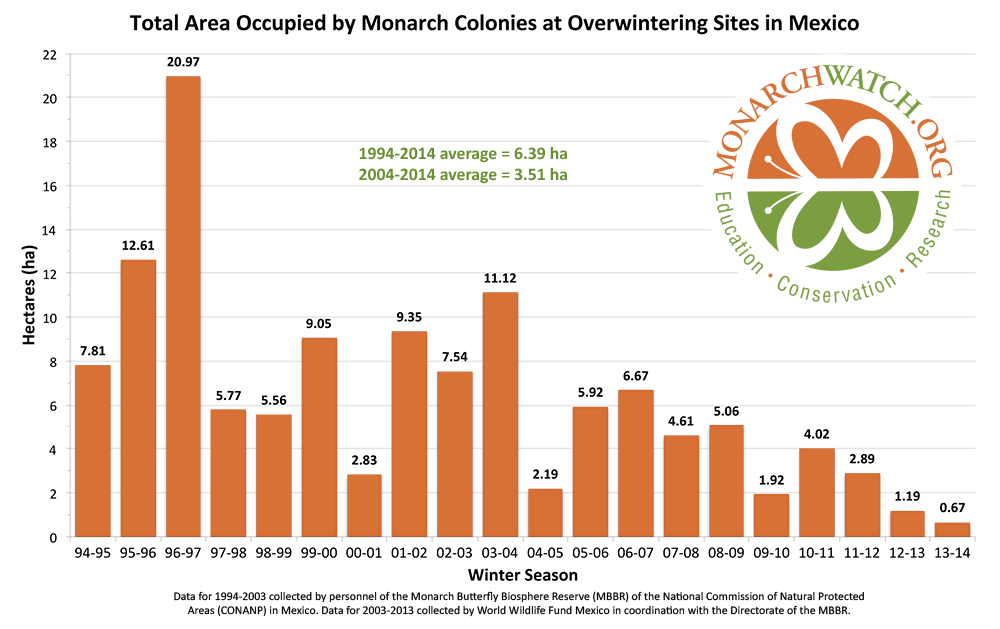
Monarch Decline Blamed on Changing US Agriculture


Graph of returning migration Monarch Butterflies from MonarchWatch.org


CBS quoted entymologist Lincoln Brower: "The main culprit," he wrote in an email, is now genetically modified "herbicide-resistant corn and soybean crops and herbicides in the USA," which "leads to the wholesale killing of the monarch's principal food plant, common milkweed."

The website MonarchWatch.org has the best in-depth analysis of the triple threat of habitat loss.  What to do?  Plant milkweed!

Saturday, January 25, 2014

Keystone pipeline presents environmental quandary

This was a boreal forest.
Domestic energy production would be a boon to our economy and security, but mining coal sands in environmentally horrific.

Mining proponents point out that the tar sands oil will be mined even without the pipeline.  Trains would carry tar sands oil if Obama denies the pipeline.   But trains are (apparently) more risky than pipelines in terms of frequency of spills (what about size of spills?).  So not building the pipeline could actually result in worse environmental consequences.  Catch 22?

What if....instead of building the keystone pipeline, we reduced the equivalent amount of energy (negawatts) by guaranteeing loans or rebates or tax incentives on geothermal systems.  Solar panels on roofs are nice, but electric technology has a shorter lifespan, whereas geothermal heating and cooling is a truly long-term infrastructure investment.  Cutting off supply only works if we reduce demand.

More photos.  Video presentation.

Tuesday, November 19, 2013

Best Public Lands GIS

There are no perfect web viewers for ecological and public land GIS.

ProtectedPlanet is an open-source platform that has the most comprehensive map of special protected areas for the whole world.  In the US, highlights include BLM Areas of Critical Environmental Concern (ACEC), USFS Research Natural Areas, Special Botanical Areas, etc.

Peakbagger.com has the best index of free online topo maps, and their database is searchable for mountain ranges and peaks (Google often can't find geographic features).

SEINet is fast becoming the most comprehensive botanical specimen map database in the world, with new collections constantly expanding their coverage.

Wundermap has many useful features, including a better display of, for example, USGS's Stream Gauge Network, as well as weather and sea surface temperature.

I'm still trying to decide if the Forest Service's ForWarn system, or their Disturbance Mapper, is a better way to view forest fire, insect infestation, and phenology data.  Both are slow and clunky as of this writing.

Tuesday, February 14, 2012

Stormwater vs Toxic Polluted Runoff

The Sightline Institute, from Cascadia, has a great short video about how to talk about stormwater runoff. First, they say, be specific and vivid: its not just natural storminess. Its toxic polluted runoff. Check it out:


http://www.sightline.org/research/sust_toolkit/communications-strategy/pollutedstormwatervideo

Thursday, December 29, 2011

Canadian Tar Sands

While groping for words to describe mining tar sands in Alberta, Canada, I realized the only word I had was Hell. Humans are creating Hell. I don't know if that is a moralistic judgement or simply the most accurate description. I don't know how I feel about getting oil from the tar sands by strip mining the wilderness fens and forests, nor do I have a definitive "scientific" judgement of how bad for the environment this really is. I don't have a political opinion on the associated plans to haul 3-lane wide super-trucks across Lolo Pass and through Missoula, Montana; nor do I have a completely educated opinion of the necessity of building mega pipelines across the Oglalla Aquafer of Nebraska and through the primeival British Columbia "ghost bear" rainforest to transport the oil steamed out of the tar.

All I know is this:


BEFORE

AFTER

From National Geographic

Wednesday, January 12, 2011