 |
| Dr. Jeff Masters discusses. |
Showing posts with label ENSO. Show all posts
Showing posts with label ENSO. Show all posts
Wednesday, July 29, 2015

Wednesday, June 10, 2015
El Nino in the Spring
 |
| March, April, May and the first week of June have been quite wet for the East slopes of the Rockies and the Western Great Plains, with large regions receiving more than three or four times normal precipitation. Meanwhile, the West has continued its drought, with CA looking especially dry. |
 |
| NM has significant regions above 400% of normal precipitation. While there is lush growth in some areas, other areas are not appreciably greener than they might otherwise be. Sometimes this can be attributed phenology (e.g. to summer grasses not responding to early spring rains, or perhaps the exact timing is important for annual germination), but some must also be due to the severe productivity reduction of overgrazed and eroded soils. |
 |
| El Nino has strengthened in recent months. An active fall hurricane season supplyied NM with abundant moisture in the fall, In the winter a steady progression of Pacific storms brought an average amount of precipitation. And since late May we have already experienced large moisture plumes from yet more unusually-strong Eastern Pacific hurricanes, Andres and now, currently, Blanca. |
Tuesday, August 16, 2011
Drought and Heat, Summer 2011
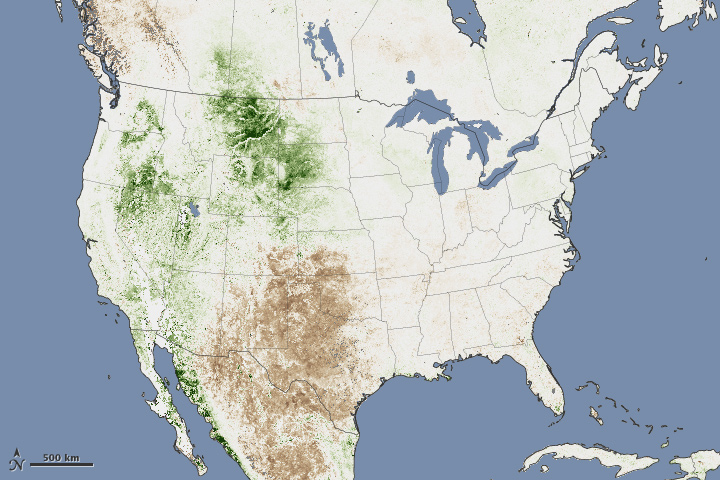
 Earth Observatory.
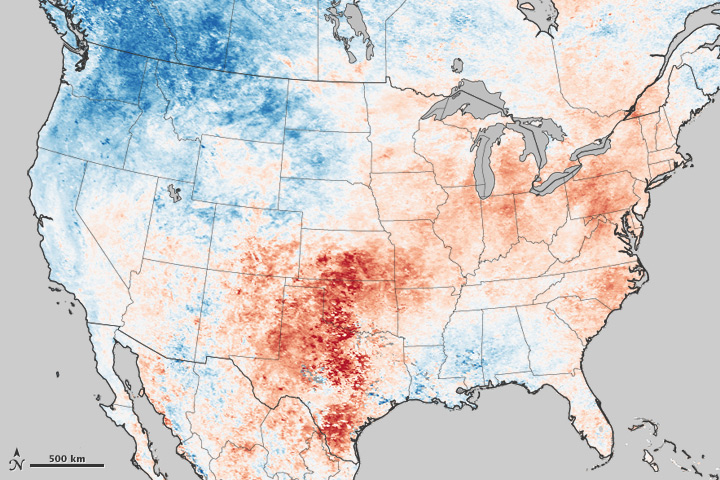
 Earth Observatory: Heat Wave July 20-27 2011.
Explanations: NWS
 Normal July pattern, which has been amplified by strong ridge, the opposite of the winter time "Aleutian Low" NWS.
Saturday, August 07, 2010
Fires in Borneo track El Nino


In the year 2000, about 36.8Mha of Kaliman-
tan were under timber concession licenses. Production
and conversion forests were generally more affected
than the limited production forests and also showed
much higher impacts during El Nin ˜o years with 10.0%
and 10.6%, respectively, in comparison with 2.8% for the
limited production forests. While 67.6% of the area of
Kalimantan is timber concession, about 77.4% of the
total fire-affected area over the whole period was
located in these concessions. This number rose to
80.9% in El Nin ˜o years.
LANGNER, ANDREAS; SIEGERT, FLORIAN Spatiotemporal fire occurrence in Borneo over a period of 10 years. Global Change Biology. 2009.
Subscribe to:
Posts (Atom)