Quotes from Arizona Daily Star:
In his 37-page decision, Soto hammered almost exclusively at the Forest Service’s approval of Hudbay’s plan to dump mine waste rock and tailings from its 955-acre pit onto 2,447 acres of nearby public land on the Santa Ritas’ eastern slopes.
Opponents’ lawsuits argued that only public lands directly above valuable mineral deposits are covered by the federal 1872 mining law’s definition of mining rights.
Soto wrote in his decision that for Hudbay to gain access to valuable copper, molybdenum and silver from the pit, the company would need to extract about 1.2 billion tons of economically worthless waste rock and about 700 million tons of mine tailings.
The Forest Service's primary error in this case was to accept, without question, that Hudbay's unpatented mining claims on those 2,447 acres were valid, thereby allowing them to be used for placement of the waste rock and tailings, he wrote.
Source.
Showing posts with label tucson. Show all posts
Showing posts with label tucson. Show all posts
Wednesday, August 07, 2019

Wednesday, November 20, 2013
Rosemont Mine and the Scientific Method
In today's Arizona Star Opinion Section, Dr. Ostercamp discusses recent hydrologic research about whether the proposed Rosemont Mine would affect surrounding groundwater levels, and how much.
The upshot? "More research is needed." A classic scientific result that, in this case, sides with environmentalists' opposition to the proposed copper mine. I was interested that this result shows how science often works differently from how most people think. Instead of generating facts to aid society's decisions, normal science (and scientists) thrive on ambiguity, controversy, and the unknowability of the world.
I believe that science, as a human institution, should work this way. I am deeply suspicious of any scientific field with easy answers and a "97% consensus". Scientific culture harnesses the creativity, jealousy, and competition inherent in human nature when it is most controversial, when there are a plurality of opinions and accusations. When I hear that, for example, climate change researchers are united behind the IPCC report, I worry that the incentive structure of that field of science has become corrupted; instead of working to prove each other wrong in order to gain fame and fortune, they have all jumped on the same bandwagon to champion their cause.
In the same way that monopolies are bad for capitalism, unified "consensus statements" are bad for science. This is not to say that I disagree with the IPCC's conclusions. In the same way that a monopoly might act in society's interest, the IPCC may well be acting in our best interests. But without dissent and opposing voices there is no guarantee. Of course, one might argue that monopolies can be efficient; scientific consensus is necessary to accept what we know and move on. I agree that arguments and democracy are very inefficient and often only result in stalemate, acrimony, and confusion. Perhaps the "best" way of running an economy or the scientific method is ultimately a political decision?
Politically, science (as I have described it in the first and second paragraphs) often argues for the status quo, because any change is inherently unknowable and the amount or "further research" needed is infinite; we can never comprehend everything. So, in its current manifestation, science plays into the hands of industry when industrial processes are already ongoing: this is why Monsanto's fight for GMOs to be labelled "generally recognized as safe" and widely disseminated is so important. Science would have argued for limitless further testing if GMOs were acknowledged to be a legitimately novel subject of study. Conversely, science plays into the hands of environmentalists whenever new industrial projects are proposed. In the case of the proposed Rosemont Mine, scientists would need to comprehensively understand the geology, hydrology, ecology, and meteorology of the entire Santa Rita mountains, if not the county and beyond, before being able to pass judgement on the effects of the mine.
But what about situations where environmentalists and industry would like to work together to advance some project for the good of society? For example, thinning projects on national forests are badly needed prevent continuing damage to watersheds and ecosystems, as well as human life and property. But what can science say about the best way to thin forests? "Further research is needed..."
The upshot? "More research is needed." A classic scientific result that, in this case, sides with environmentalists' opposition to the proposed copper mine. I was interested that this result shows how science often works differently from how most people think. Instead of generating facts to aid society's decisions, normal science (and scientists) thrive on ambiguity, controversy, and the unknowability of the world.
I believe that science, as a human institution, should work this way. I am deeply suspicious of any scientific field with easy answers and a "97% consensus". Scientific culture harnesses the creativity, jealousy, and competition inherent in human nature when it is most controversial, when there are a plurality of opinions and accusations. When I hear that, for example, climate change researchers are united behind the IPCC report, I worry that the incentive structure of that field of science has become corrupted; instead of working to prove each other wrong in order to gain fame and fortune, they have all jumped on the same bandwagon to champion their cause.
In the same way that monopolies are bad for capitalism, unified "consensus statements" are bad for science. This is not to say that I disagree with the IPCC's conclusions. In the same way that a monopoly might act in society's interest, the IPCC may well be acting in our best interests. But without dissent and opposing voices there is no guarantee. Of course, one might argue that monopolies can be efficient; scientific consensus is necessary to accept what we know and move on. I agree that arguments and democracy are very inefficient and often only result in stalemate, acrimony, and confusion. Perhaps the "best" way of running an economy or the scientific method is ultimately a political decision?
Politically, science (as I have described it in the first and second paragraphs) often argues for the status quo, because any change is inherently unknowable and the amount or "further research" needed is infinite; we can never comprehend everything. So, in its current manifestation, science plays into the hands of industry when industrial processes are already ongoing: this is why Monsanto's fight for GMOs to be labelled "generally recognized as safe" and widely disseminated is so important. Science would have argued for limitless further testing if GMOs were acknowledged to be a legitimately novel subject of study. Conversely, science plays into the hands of environmentalists whenever new industrial projects are proposed. In the case of the proposed Rosemont Mine, scientists would need to comprehensively understand the geology, hydrology, ecology, and meteorology of the entire Santa Rita mountains, if not the county and beyond, before being able to pass judgement on the effects of the mine.
But what about situations where environmentalists and industry would like to work together to advance some project for the good of society? For example, thinning projects on national forests are badly needed prevent continuing damage to watersheds and ecosystems, as well as human life and property. But what can science say about the best way to thin forests? "Further research is needed..."
Wednesday, January 23, 2013
Best Map of Tucson and Mexico

Friday, November 06, 2009
USGS concludes 2006 was 1,000-year flood near Tucson

Floods are described in terms of their recurrence interval. A 10-year flood has a 1 in 10 chance of occuring each year. Many engineers and flood planners work with 100-year floods, since this is approximately the length of accurate and reliable observations in the West. However, much larger events can, and do, occur.
After studying the aftermath of the floods that wiped out Sabino Canyon in Tucson in 2006, the USGS has concluded that the event was virtually unprecedented. By dating geological deposits, they estimated that the floods that swept down most of the West-facing canyons in the Santa Catalina Mountains were probably on the order of a 1,000 year flood.
However, with climate change and associated land cover changes on the mountains, that interval may no longer hold. Pearthree, section chief of AZGS Environmental Geology, warns, “increasing fire frequency on the steep slopes of the Santa Catalina Mountains due to invasive species like bufflegrass may result in greater runoff, and possibly increased debris flow frequency, in the coming decades.”
Details, including an map.
Other recent flash floods.
Saturday, February 14, 2009
A New Conception of My Home-Watershed: the Gila River Basin

It took me three years of living and traveling extensively around Tucson to understand the local watershed. I grasped early on the basin and range topography of parallel North-South mountain ranges, but these ridges served to confuse rather than clarify the overall drainage, since I did not know how the meandering rivers and dry washes of the bottomlands connected. Some went north, others flowed south. Where was the continental divide? Where did they meet the sea?
It was only by fortuitous circumstance that the last year found me exploring the full scope of an area I finally recognized as my home watershed. I new conception of the Gila River Basin emerged from these vast peregrinations, a new understanding of the lay of the land and a meshing of medium and large scale aspects:
The Sonoran desert in Arizona exists in the Gila Basin, surrounded on three sides (north, east, and south) by concentric rings of grassland valleys and mesas, woodland hills and forested mountains. The Gila, which rises on the continental divide to the east (in NM), is joined by tributaries from the north and south, representing, respectively, the Mogollon Rim divide and another divide which roughly approximates the U.S./Mexico border.
This general schema is interrupted, of course, by the basic and range, which further divides ecotones and watersheds, creating a kind of comb effect wherein numerous drainages flow parallel before their confluence with the Gila. The Gila itself is also indistinct, since it virtually disappears in an amorphous wash in the middle of its basin. And, since it flows through sparsely inhabited parts of the countryside, it is even easier to ignore its central role in ordering the landform. Most people living in the large metropolitan areas of Phoenix and Tucson do not realize their place along the cusp of the Sonoran lowlands, or the importance of the placements of their cities at the ecotone divide between grassland and desert, where rivers [used to ] bring water from the mountains before evaporating in the desert. [Theoretically,] the Gila eventually flows into the Colorado, before that crosses the U.S. Mexico border, reaches its estuary, and flows into the Sea of Cortez (Gulf of California). The Colorado rises from the western rocky mountains and the high colorado plateau to the north of the gila basin. To the south, in Mexico, streams flow directly off the Sierra Madre into the Sea of Cortez, without joining together in a large basin such as the Gila. To the east, on the other side of the continental divide, are the Chihuahan desert and the Rio Grand. These areas combined form the Southwest, and a large part of three out of four of the N. American deserts.
Saturday, October 11, 2008
Buffel Grass Removal at Saguaro National Park
Before:

After:

Buffel Grass is an invasive species that threatens to choke and burn out the Saguaro cactus and Sonoran Desert ecosystem.
 It looks somewhat like fountain grass, which is also a noxious invasive in our area:
For more photos, click here.

Friday, August 22, 2008
The Sub-Tropical Sonoran Desert
My goal for the winter is to explore the extent of my home ecosystem: The Sonoran Desert and its six subdivisions.
 The Sonoran Desert and its six subdivisions.
Saturday, August 02, 2008
20 Years' Phenology, Santa Catalina Mountains, Tucson
"One remarkable legacy dataset...is the record of plant species in bloom along the Finger Rock trail in the Catalina Mountains north of Tucson, Arizona, collected by Dave Bertelsen. The data represent an enormous effort. Covering a major elevation gradient, a 20-year period, and a comprehensive record of all species in bloom, they contribute invaluable information at a scale very few individuals would ever attempt."
Using this dataset, scientists demonstrated clear patterns in the seasonality of alpha diversity (species richness) of species in bloom across an elevation gradient (Crimmins et al. 2008). This diversity was strongly influenced by precipitation at lower elevations and by temperature at upper elevations. In addition, over the course of the study, average summer temperature showed an upward trend, as did the number of species in bloom in summer at the highest elevations."
A discussion of the importance of "citizen scientists".
Thursday, July 31, 2008
Alien Invaders in Tucson, Arizona
Don't Panic, but the mayor and other elected officials are unanimous: this is an urgent threat to our home and way of life: if something isn't done soon, our fair city may be "unrecoverable".
high resolution
high resolution
Friday, July 11, 2008
The Monsoon has begun (in Tucson)
The monsoon has begun in Tucson:
 Source.This NOAA graph shows dewpoint, a measure of humidity. The blue line for this year is above the average, red line, and passed the 54 degree cutoff in early July. The monsoon is somewhat arbitrarily defined as any period of three or more consecutive days when the dewpoint is 54 degrees or above. In Tucson this kind of moisture only happens during the monsoon, when the wet tropical air pushes north. More info.
 The rainfall so far has been above average as well. This graph does a good job of showing the variability of rainfall between cities that are less than 100 miles apart. When it comes from isolated thunderstorms, sometimes they hit you, sometimes they miss you.
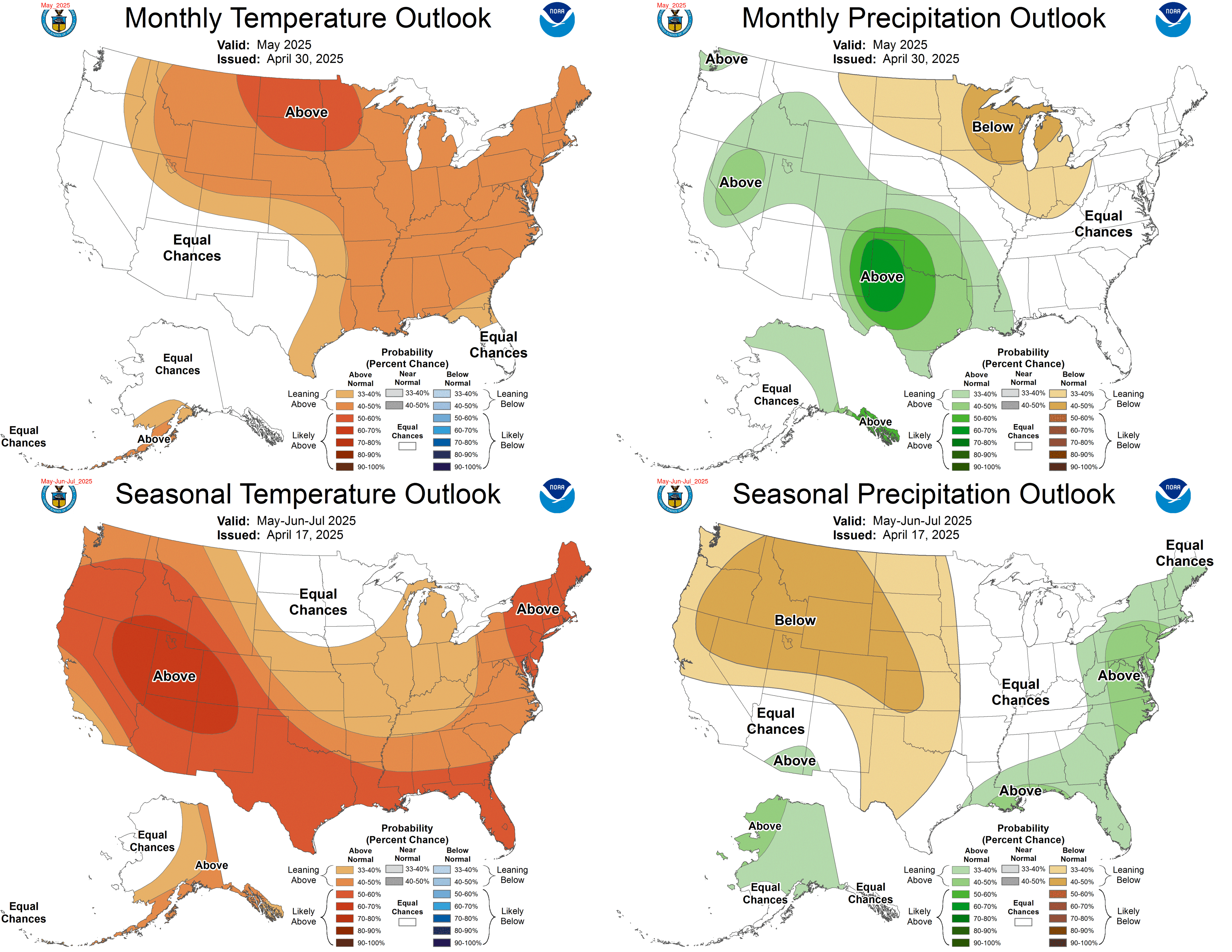
 The rain has not yet helped out New Mexico and Texas (source), but the climate forecast is for New Mexico to get a good amount of moisture over the next month:
 Source.
 Source.This NOAA graph shows dewpoint, a measure of humidity. The blue line for this year is above the average, red line, and passed the 54 degree cutoff in early July. The monsoon is somewhat arbitrarily defined as any period of three or more consecutive days when the dewpoint is 54 degrees or above. In Tucson this kind of moisture only happens during the monsoon, when the wet tropical air pushes north. More info.
 The rainfall so far has been above average as well. This graph does a good job of showing the variability of rainfall between cities that are less than 100 miles apart. When it comes from isolated thunderstorms, sometimes they hit you, sometimes they miss you.
 The rain has not yet helped out New Mexico and Texas (source), but the climate forecast is for New Mexico to get a good amount of moisture over the next month:
 Source.
Friday, February 15, 2008
I. Toilet to Tap
comment on Facing the yuck factor. How has the west embraced water recycling? Very (gulp) cautiously. Peter Friederici. HCN p.10 September 17, 2007
Americans are different from most people on the planet. We have indoor plumbing and can turn on fresh, drinkable water any time we want. But the combination of the two may be our undoing. We don't pay a quarter of our salaries and spend hours waiting in line to get potable water, and maybe because of that we have abused our privilege. Now that the rivers are drying up in the West, cities are looking to new sources of fresh water. But where?
Ironically, "San Diego has both a water-supply and a water-disposal problem." Why not use the water in need of disposal as a new supply? Maybe because the slogan is "Toilet to tap"?? Sustainability advocates in Tucson (myself included), recently tried to pass a ballot initiative (Prop.200) with just such a slogan. Our reasoning: if Tucson doesn't want "toilet-to-tap" we had better start limiting growth now, before that's our only option. The opponents of the measure (ie proponents of growth such as developers) argued that Tucson would never need to divert wastewater into drinking water. But, just weeks after Prop.200 went down in flames (after mafia-style threats from the developers), amid reports of more drought, the Tucson papers began suggesting that perhaps Tucson really does need to start looking into the idea, after all.
Of course, all water is recycled eventually. Tucson is currently "recharging" its aquifer with wastewater. As the wastewater seeps through hundreds of feet of sand the hydrologists claim it will be cleaned enough to draw back up a well for drinking water. Las Vegas uses an even more direct filtration approach: "Los Vegas alone discharges roughly 60 billion gallons of wastewater a year some miles upstream of its own water intake -- a feat of urban engineering that would seem to prove that most of what happens in Vegas really does stay there."
All of which just points up the rationale San Diego used in its (failed) attempt to utilize wastewater: "We can have a lot more monitoring and control if we oversee our own reclamation than if we're relying on a river with a billion gallons of recharge [in the Colorado River] from other sources every day." Bruce Reznik, executive director of San Diego Coastkeeper. Just as no place is truly a wilderness "untrammeled by man" anymore, so too no source of "clear mountain springwater" is truly without some contamination, e.g. some "clear mountain streams" high in Colorado have enough man-made chemical estrogen mimics to feminize fish.
Friederici, a journalism professor, has written a great article that touches on some very deep issues in the interplay of science, technology, and society; E.g. the trust ordinary citizens place in their own biased perceptions versus the scientific analysis of professionals. The article suggests that that "perceptual shortfalls" in ordinary citizens might in fact be a reasonable, precautionary reaction to the belated discovery of the harms of rGBH in milk and endocrine disruptors in plastics. Without the ability to "see" contaminants that affect them ordinary people may have to rely on the history (story, narrative) of their water to determine quality rather than the quantitation (appeal to authority) of scientists.
-
A simple solution the article overlooked: *abandoning our water-treatment infrastructure* and giving in to the bottled water craze. This water crisis is caused by the average American household sending 150 gallons of fresh, drinkable water down the drain every day. If we could use untreated or sub-potable treated water for most domestic needs and bottled water for drinking and eating we would eliminate the source of the dilemma: overconsumption. However, if, in the end, the punishment for being spoiled Americans is drinking our own toilet water, perhaps there is some justice in this crazy universe after all.
Americans are different from most people on the planet. We have indoor plumbing and can turn on fresh, drinkable water any time we want. But the combination of the two may be our undoing. We don't pay a quarter of our salaries and spend hours waiting in line to get potable water, and maybe because of that we have abused our privilege. Now that the rivers are drying up in the West, cities are looking to new sources of fresh water. But where?
Ironically, "San Diego has both a water-supply and a water-disposal problem." Why not use the water in need of disposal as a new supply? Maybe because the slogan is "Toilet to tap"?? Sustainability advocates in Tucson (myself included), recently tried to pass a ballot initiative (Prop.200) with just such a slogan. Our reasoning: if Tucson doesn't want "toilet-to-tap" we had better start limiting growth now, before that's our only option. The opponents of the measure (ie proponents of growth such as developers) argued that Tucson would never need to divert wastewater into drinking water. But, just weeks after Prop.200 went down in flames (after mafia-style threats from the developers), amid reports of more drought, the Tucson papers began suggesting that perhaps Tucson really does need to start looking into the idea, after all.
Of course, all water is recycled eventually. Tucson is currently "recharging" its aquifer with wastewater. As the wastewater seeps through hundreds of feet of sand the hydrologists claim it will be cleaned enough to draw back up a well for drinking water. Las Vegas uses an even more direct filtration approach: "Los Vegas alone discharges roughly 60 billion gallons of wastewater a year some miles upstream of its own water intake -- a feat of urban engineering that would seem to prove that most of what happens in Vegas really does stay there."
All of which just points up the rationale San Diego used in its (failed) attempt to utilize wastewater: "We can have a lot more monitoring and control if we oversee our own reclamation than if we're relying on a river with a billion gallons of recharge [in the Colorado River] from other sources every day." Bruce Reznik, executive director of San Diego Coastkeeper. Just as no place is truly a wilderness "untrammeled by man" anymore, so too no source of "clear mountain springwater" is truly without some contamination, e.g. some "clear mountain streams" high in Colorado have enough man-made chemical estrogen mimics to feminize fish.
Friederici, a journalism professor, has written a great article that touches on some very deep issues in the interplay of science, technology, and society; E.g. the trust ordinary citizens place in their own biased perceptions versus the scientific analysis of professionals. The article suggests that that "perceptual shortfalls" in ordinary citizens might in fact be a reasonable, precautionary reaction to the belated discovery of the harms of rGBH in milk and endocrine disruptors in plastics. Without the ability to "see" contaminants that affect them ordinary people may have to rely on the history (story, narrative) of their water to determine quality rather than the quantitation (appeal to authority) of scientists.
-
A simple solution the article overlooked: *abandoning our water-treatment infrastructure* and giving in to the bottled water craze. This water crisis is caused by the average American household sending 150 gallons of fresh, drinkable water down the drain every day. If we could use untreated or sub-potable treated water for most domestic needs and bottled water for drinking and eating we would eliminate the source of the dilemma: overconsumption. However, if, in the end, the punishment for being spoiled Americans is drinking our own toilet water, perhaps there is some justice in this crazy universe after all.
Tuesday, February 12, 2008
Tucson

0.
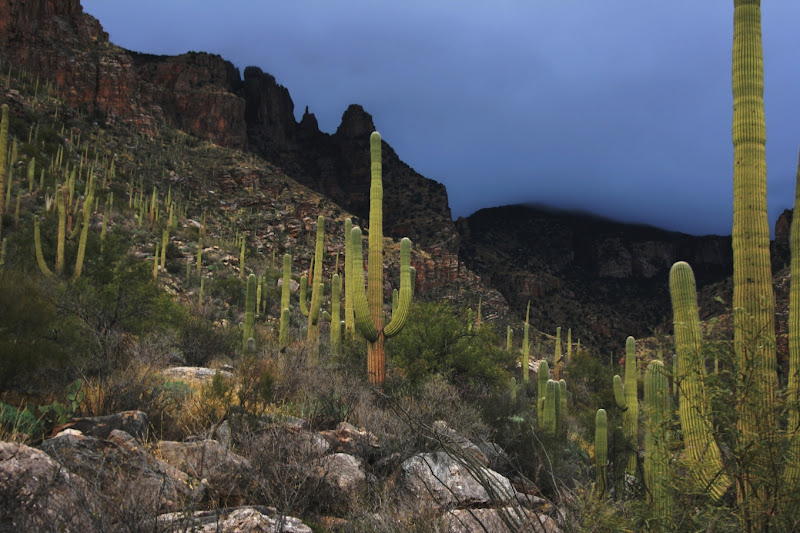
Even the great amoeba cities, clutching each other, skewered on their endless myopic highways, shrink in comparison to the vastness of the landscape in the West. These desert cities, surmounted and circumscribed by wondrous mountains wink small and lonely in the dark night, lost in all-encompassing wilderness. We live that we may be worthy of this landscape.

I.
Tucson, loud city of impolite dogs and cars, planted with inedible fruit and painted with bland colors, at least you are ringed by mountains for every mood. The humble-yet-graceful hump of the Rincons, huge on the Eastern horizon. The jagged charismatic physiognomy of the Santa Catalinas looming in the North, dominant, heroic, common. The austerely lush, picturesque Tucson mountains, dry yet creative, flowering along the West. And finally the distant-beyond-estimation Santa Ritas, spooky at a distance, foreign and strange and Southerly.

II.
Santa fe, quiet city of streamlined roads twisting past close-set fences...[unfinished]
Wednesday, October 24, 2007
Tucson Pride

On the right is an energy bar made locally in Tucson. On the left is a leading-brand energy bar from anywhere else....
Label:

Friday, July 20, 2007
Breath. Deep. Ecology.
The lights of Tucson turn black sky blue on the horizon,
obliterating the stars there and I think of the numberless salmon who, in their ardor, turned the waters pink,
so thick you could walk across, from bank to bank, on their backs (source: probably apocryphal story believed by Lewis and Clark).
But we embraced progress and prosperity
and built the dams that killed the illimitable salmon,
numberless as the stars.
In my career I see reflected
this history of society embracing technology,
perhaps to prove to ourselves that we can.
I've done genetic engineering and brain surgery,
great endeavors that now seem hollow.
In their stead, I would
Embrace the wild uncertainty of nature....
obliterating the stars there and I think of the numberless salmon who, in their ardor, turned the waters pink,
so thick you could walk across, from bank to bank, on their backs (source: probably apocryphal story believed by Lewis and Clark).
But we embraced progress and prosperity
and built the dams that killed the illimitable salmon,
numberless as the stars.
In my career I see reflected
this history of society embracing technology,
perhaps to prove to ourselves that we can.
I've done genetic engineering and brain surgery,
great endeavors that now seem hollow.
In their stead, I would
Embrace the wild uncertainty of nature....
Tuesday, June 19, 2007
the desert speaks I
the desert speaks &
the heat swallows you
there are mountains surrounding
to the northeast the rocks are black: "tucson"
as if balloons were inflated and popped
in a pool of molten lava
at the confluence of two dry rivers
we camp on the surface in billowing white tents
the ground crackles and pops
we spit watermellon seeds
cicadas lost in the pads of a prickly pear
"love and rely on the desert"
we camp amid the stranded fortresses of blasted, bygone greatness
mine tailings
mixed with broken
clay tablets, pueblos
a shared hallucination:
sun cuts through sparse leaves
many thin things, split apart
a few scattered hermitages and
six emaciated deer in a dry stream
too tired to run away
ghost paths over empty ground
waiting for the monsoon
it is hard to swallow here
the wind and
El sol y sombra,
Sonora
the heat swallows you
there are mountains surrounding
to the northeast the rocks are black: "tucson"
as if balloons were inflated and popped
in a pool of molten lava
at the confluence of two dry rivers
we camp on the surface in billowing white tents
the ground crackles and pops
we spit watermellon seeds
cicadas lost in the pads of a prickly pear
"love and rely on the desert"
we camp amid the stranded fortresses of blasted, bygone greatness
mine tailings
mixed with broken
clay tablets, pueblos
a shared hallucination:
sun cuts through sparse leaves
many thin things, split apart
a few scattered hermitages and
six emaciated deer in a dry stream
too tired to run away
ghost paths over empty ground
waiting for the monsoon
it is hard to swallow here
the wind and
El sol y sombra,
Sonora
I woke at 4 am
I woke at 4am today after dreaming about the design of the hanging mobiles hanging outside my door. They are wine bottles spiral-wrapped in wire, hanging above an adobe wall. The cactus all around are Sonoran, but working with mud (adobe) I can finally make snowmen like Calvin and Hobbes. I made use of the cedar sawdust composting toilet and fed the bitch-chickens, who just want me to chase them so they can squwak. Imagine how much estrogen you'd need to lay an egg every single day. These are not happy birds. Luckily I am an enlightened creature, with 7 chakras and the names of 12 zodiac constellations tucked under my belt. Saw the sun rise and went for a jog with my spear -- no game today, limped back to the casita and downed a liter of coconut juice. Dehydration's a killer that stalks by night. Then I went to inspect the latest bathtub full of clay mud. Earthy bentonite, straw, and (if in Afro-India a hefty dab of manure) combines to make a swell concrete. I'd like to try digging a nice badger-burrow like all the other animals in the desert, but don't know how they keep the floods out. I'd like to try planting a bamboo forest and coming back 5 years later to weave a giant basket/yurt/tepee house, replete with multicolored hammocks and a dozen kites or hot air balloons to mark the spot when I'm out on forages. More and more feral every day. Wearing a bear-tooth necklass. ...Then i got on my motorcycle and rode up over the mountains to my neuroscience job, where frankenstein-esque shit goes down. Brain surgery, computer-brain interfaces, weird stutter-start blown fuse littered benchtop CYBORGS, and the latinas all mutter under their breath "!dios mio!". Escape is only 6 hours and a couple months away. Then I'm taking the high road right up the backbone of the continent to get a brrreath of fresh air. Crazy. Colorado. Cool? Shout the ancestors, speak the many tongued forks in your road, swirl with the gastrointestinal juices that wash the fruit of four continents in your local deli. Raw milk is heavenly. I feel Kalahari. And having way to much fun with this. Got to go cut up some insects.
Friday, April 27, 2007
I Vote Every Week
Most Senators and Congressmen have email forms that can be used to contact them. Although they probably don't read 99.9% of the letters they receive, you might get lucky. Plus, there is usually a place to input the subject of an email, and I'm willing to bet that they do keep track of how many letters they get about bills they vote on.
Here are my Senators and Representatives
Senator Jon Kyl
Senator John McCain
Representative Gabrielle Giffords (85719-2857 )
Representative Raúl M. Grijalva (85735-8803)
Here are my Senators and Representatives
Senator Jon Kyl
Senator John McCain
Representative Gabrielle Giffords (85719-2857 )
Representative Raúl M. Grijalva (85735-8803)
Tuesday, April 17, 2007
50 and 100 miles from home

This is an old AAA map of Arizona, with modifications. Since my van can be towed 100 miles for free, it seemed prudent to determine the extent of my get-home-free zone. This is where I feel comfortable; anything beyond that starts to stretch my luck and my umbilical. This zone, my home, includes most of Arizona's sky island mountain ranges.
Monday, March 26, 2007
Local NGO Links
New Mexico Wilderness Alliance
Upper Gila Watershed Alliance
Sky Island Alliance
Friends of the San Pedro River
Tucson Audubon Society
SaveThePeak
Center for Biological Diversity
Friends of the Santa Cruz River
Sustainable Tucson
Friends of Buenos Aires National Wildlife Refuge
Coalition for Sonoran Desert Protection
Upper Gila Watershed Alliance
Sky Island Alliance
Friends of the San Pedro River
Tucson Audubon Society
SaveThePeak
Center for Biological Diversity
Friends of the Santa Cruz River
Sustainable Tucson
Friends of Buenos Aires National Wildlife Refuge
Coalition for Sonoran Desert Protection
Thursday, March 01, 2007
Wildflowers and Drought in the Southwest
http://www.desertusa.com/wildflo/az.html
drought watch:
The ag station's weather monitoring:
http://ag.arizona.edu/azmet/
drought watch:
The ag station's weather monitoring:
http://ag.arizona.edu/azmet/
Subscribe to:
Posts (Atom)