Showing posts with label books. Show all posts

Thursday, September 02, 2021

Pessoa: A Biography

 This biography covers many topics, some of which are synopsized here in quotes from the book.


Portugal

Pessoa was born into a world in which ghostly shades of former splendors hovered amid palpable poverty and decay.

What united them, besides the succulent food in the fine restaurants where they met, was not a feeling of failure in their personal careers as writers and artists but the conviction that, despite their best efforts to encourage reform, Portugal had failed and would continue to fail to be organically progressive, original, and self-determining. This larger failure was both the cause and consequence of saudade, a word that signifies intense longing, yearning, nostalgia, both as a temporary mood or state of mind and as an existential condition.

BUT LISBON WAS AND remains, even in the twenty-first century, majestic. Built, like Rome, on seven hills—or six, or eight, depending on what you call a hill—and stretching along the wide estuary of the Tagus River, which is sometimes called the Mar da Palha, or Straw Sea, because of how it goldenly reflects the sun at dusk, the city offers an ever-changing spectacle of light glinting off the pastel-colored buildings of its slopes. And the sky in Lisbon is more dynamic than in other European capitals, with sun and clouds and rain often entering and exiting in rapid succession, as if the pagan gods were still alive, vying for control of the weather.

Pessoa is one of those writers, like James Joyce, whom we automatically associate with the city of their birth, as if one were the reconfigured equivalent of the other.

“My nation is the Portuguese language,” he famously wrote in 1931, affirming a patriotism that was in the first place linguistic, rather than geographical. Far less quoted, since it is politically or socially incorrect, is this admission: “An adjective matters more to me than the real weeping of a human soul.” Which is not to say that Pessoa was insensitive to human tears. He shed many of his own. But words—and what words could represent—were what he lived for.


-------------------

A Victorian Novel

Of his mother: Maria's high-placed friends were impressed with her intelligence and regretted that she had not been born a boy, in which case she could have aspired to a brilliant career.

Pessoa's father is an enigmatic figure. Perhaps Pessoa's mother fell for a man she perceived as an artistic type, but he never tried to make art or music or to write creatively. He would have needed audacity for that. And a willingness to handle, shape, and transform the raw matter of his deep thoughts and emotions.

Pessoa’s father had neither the inclination nor the physical stamina for the armed forces. He was consumptive, to use an outmoded word that has the virtue of graphically evoking the effect of pulmonary tuberculosis.

Pessoa wrote: "I remember his death as a grave silence during the first meals we ate after learning about it. I remember that the others would occasionally look at me. And I would look back, dumbly comprehending. Then I’d eat with more concentration, since they might, when I wasn’t looking, still be looking at me."


THEN—AS HAPPENS IN FAIRY tales and also, less often, in real life—her fortune abruptly changed.  Maria’s new sweetheart was many things that her first husband was not: close to her in age (four years older instead of eleven), strong and a little husky, outgoing, jovial, and serene. In her mind his whole being radiated serenity and safety.

But, in yet another blow to the weary bride, who had dreamed of wearing a fancy dress made of black velvet for the occasion,  the captain-turned-consul could not make a trip home so soon after taking up his new post, she had to settle for a wedding ceremony with his older brother, a gentleman with wild eyes and a walrus moustache whom she hardly knew, serving as proxy.

No less strange for Pessoa than the fact that things end, including things as enormous and profound as his father’s soul, was the fact that life continues, inexorably.

Together they would set sail (as they learned several months later) for the town of Durban, on the eastern seaboard of South Africa.

If they had not gone to South Africa, the rest of this story would be very different, or, more likely, there would be no story to merit a biography. Not only genes but also myriad contributions from one’s surroundings all combine to shape one of those rarely occurring specimens known as a genius.

Pessoa would always feel a little out of place, there but not all there, irremediably foreign. Strange soil, it turned out, was exactly what he needed for his kind of genius to flower.


----

Gandhi and Pessoa in South Africa

However much they resisted mixing with and being influenced by other groups, and however superior they deemed their own culture to be, they were forced to recognize that it was not the only one.

Racially tripartite Durban, with its imbricated subdivisions along religious, economic, and class lines, may have been just the right breeding ground for the spirit of tolerance that marked the thinking of Pessoa as well as of Gandhi, both of whom deemed truth to be as variable as the people who live by truth.

Durban was indeed well managed, for the comfort of white people, and if life there impressed Pessoa as a quasi-socialist paradise, it was because even strictly middle-class whites could live like kings and queens, thanks to the racist division of labor.

Like virtually all the city’s white residents, he would have instinctively preferred to remain as ignorant as possible.

The article in The Natal Mercury described how the hostile crowd of pursuers “began to assert itself, and Mr. Gandhi became the object of kicks and cuffs, while mud and stale fish were thrown at him. One person also produced a riding whip, and gave him a stroke, while another plucked away his peculiar hat. As the result of the attack, he was very much bespattered, and blood was flowing from the neck.”

The admiration Pessoa expressed for Gandhi in the later years of his life suggests that Pessoa—who was not a vegetarian, a teetotaler, or a nonsmoker, let alone an active defender of humanitarian causes—somehow identified with Gandhi, almost in an atavistic way.

They [both] conceived salvation as a private matter, insofar as each person has to find and follow their own path toward self-realization, and at the same time as a joint concern, with all individual efforts contributing toward human betterment. Their asceticism, taking different forms, implied in both cases a rejection of conventional notions of well-being and progress.


---------

The Writer

Pessoa was a volcanic writer, and when the words started flowing, he used whatever sort of paper was close to hand….

All of which he deposited in the large wooden trunk, his legacy to the world.

But as we read the work, it almost seems that Fernando Pessoa, and even we ourselves, are variations on this invented self, who expresses with uncanny precision our unuttered feelings of disquiet and existential unsettledness, speaking not only to us but also for us. “The only way to be in agreement with life is to disagree with ourselves,” observes Bernardo Soares, who refuses to adapt to the world.

Pessoa, like his semiheteronym, was an abundance of qualities that did not cohere and would not settle into just one soul.  “The active life has always struck me as the least comfortable of suicides,” he wrote.  He remarks on his instinctive hatred “for decisive acts, for definite thoughts.”  He is actively, militantly passive. Dreaming is not a vice that hinders him from accomplishing his goals; dreaming is what he lives for, and he organizes his existence accordingly.

He wrote “Nature is parts without a whole” , yet he often berated himself for being unable to create whole works of literature.

Pessoa could not imagine that his literary dispersion, which faithfully mirrors our ontological instability and the absence of intrinsic unity in the world we inhabit, would make him required reading by the time the next century arrived.

His universe of disconnected parts prefigured our own worldview, with developments in history, science, and philosophy having disabused us of whatever harmonious wholes we once cherished.

His fashioning of the heteronyms may be construed as a religious act, as his way of paying homage to God, by realizing his divine potential as a co-creator, made in God’s likeness and image.

One day he copied out, on a sheet of paper tossed into the trunk and not discovered by researchers until the present millennium, a single verse from the ninth chapter of St. Paul’s First Epistle to the Corinthians: “I became all things to all men, that I might save all.”

But what he imagined, envisioned, and projected was uniquely vast and varied. “Be plural like the universe!” he imperatively wrote on a slip of paper found in the trunk in the 1960s.

"Ever since I was a child, I’ve felt the need to enlarge the world with fictitious personalities—dreams of mine that were carefully crafted, envisaged with photographic clarity, and fathomed to the depths of their souls. When I was just five years old, an isolated child and quite content to be isolated, I already enjoyed the company of certain characters from my dreams, including a Captain Thibeaut, the Chevalier de Pas, and various others whom I’ve forgotten, and whose forgetting—like my imperfect memory of the two I just named—is one of my life’s great regrets."

"And instead of ending with my childhood, this tendency expanded in my adolescence, taking firmer root with each passing year, until it became my natural way of being. Today I have no personality: I have divided all my humanness among the various authors whom I’ve served as literary executor. Today I am the meeting-place of a small humanity that belongs only to me…."


Zenith, Richard (2021-07-19T22:58:59). Pessoa: A Biography . 


Friday, January 24, 2014

Hydrophobic soils after fire? All soils are more or less hydrophobic...

As explained by "Geomorphology: Themes and Trends".  The book is worth it just for the classic essay on erosion and runoff.  A combination, it turns out, of pore size and particle characteristics.

These images are from Chapter 5, "Geomorphological processes, soil structure, and ecology" written by A.C Imeson.  Yes, the x-axis is scaled as square-rooted minutes.
Plant roots can change both the permeability and wettability of soil (as well as many other qualities).  For more information, read Reid, TB and Goss, MJ. 1981.  Effect of living roots of different plant species on the aggregate stability of two arable soils.  Journal of Soil Science.
The book also has a chapter on the Geomorphology of stream channels and craters on Mars!

Sunday, February 26, 2012

Ecology quotes from Loreau

From Populations to Ecosystems: Theoretical Foundations for a New Ecological Synthesis, Loreau (2010) contains a large number of pithy postulates.

A) Comparative data often indicate a unimodal relationship between diversity and productivity driven by changes in environmental conditions. (B) Experimental variation in species richness under a specific set of environmental conditions produces a pattern of decreasing between-replicate variance and increasing mean response with increasing diversity, as indicated by the thin, curved regression lines through the scatter of response values (shaded areas).

Mutualistic interactions, ecosystem engineering, and trait-mediated indirect interactions (see Schmidz) are not described in simple trophic food webs.

Too much interaction (too many species, too many connections, or too strong connections) destabalize complex ecosystems.

Vertical diversity, in contrast to horizotnal diversity, does not increase productivity but does increase stability. Production (flux) is less affected by top down forces than is biomass or population density (stocks). Horizontal diversity enhances resource exploitation. But note Schmitz: "Weak carnivore indirect effect on plant (biomass, diversity) does not necessarily mean weak effect on ecosystem properties (NPP, N mineralization).

While positive species interactions such as facilitation and mutualism are on eof the biological mechanisms that contribute to generate functional complementarity, and hence positive relationships between species diversity and total biomass and production with single trophic levels (horizontal diversity), their impact in multitrophic systems is more complex because they tend to increase the resource exploitation ability of species at all trophic levels. Consequently, they can enhance the efficiency with which limiting resources are usesd and transferred along the food chain, thereby contributing to enhance ecosystem functioning, but they can also exacerbate the negative effects of trophic interactions when consumers are generalists, including the potential for overexploitation (hyperpredation), intense resource and apparent competition, and reduced functional comiplementarity at consumer trophic levels. Since a higher species diversity provides more opportunities for both trophic and nontrophic interactions, it can also exacerbate these negative effects and result in weaker, or even negative, relationships with total biomass or production.

Overyielding occurs when plant assemblages outperform monocultures. Transgressive Overyielding occurs when when these plant assemblages...

Internal (re)cycling of nutrients (P, N) typically an order of magnitude greater than inputs or outputs (Vitousek and Matson 2009).

Indirect Mutualism Through Nutrient Cycling can occur through Plant-Decomposer Interactions (unless decomposers compete with plants for limiting nutrients?)

Predicts that species traits that improve nutrient cycling efficiency of either plants or decomposers should have a strong positive effect on ecosystem cycling efficiency, primary production, and secondary production. Plants may produce litters of different qualities, thereby controlling patterns of nutrient cycling (Hobbie 1992); they may modify soil structure, which in turn strongly affects nutrient retention (Wood 1984); they may recycle some limiting nutrients internally via biochemical pathways (Switzer and Nelson 1972); or they may directly control nitrification, and hence nitrogen outputs, in the vicinity of their rooting system through inhibition of nitrifying bacteria (Lata et al. 2004).

Grazing Optimization Hypothesis: primary productivity, or even plant fitness, is maximized at an imtermediate rate of herbivory. See McNaughton 1979 for example in Serengeti.

Thursday, February 16, 2012

Bruno Latour


I've been reading a lot of Bruno Latour, the French sociologist and philosopher of science. His book, We Have Never Been Modern contains what may be the best review of another awesome book, Leviathan and the Air Pump, by Steven Shapin and Simon Schaffer. Latour reconceptualizes their work as showing the invention of separate spaces for scientific versus political discourse, not just the clash between the two realms. Latour goes on to propose a three-category conceptual framework for everything: natural, social, and textural.

In the Prince and the Wolf, Latour out-argues a professional philosopher by refusing to believe in the necessity of a single viewpoint. Instead, he argues in favor of 'Occasionalism' which finds its philosophy in each new moment.

Friday, February 03, 2012

Resolving Ecosystem Complexity

Dr. Os Schmitz wrote Resolving Ecosystem Complexity with the aim not of solving the entire nexus of ecological problems, but of trying to disentangle the Gordian Knot. The book slices through ecology from individual behavioral tradeoffs to ecosystem nutrient cycling rates. Individuals must balance tradeoffs between eating and being eaten, so that behavioral responses to predators ripple through an ecosystem to change overall species evenness and NPP.

Schmitz first lays out a distinction between ecosystems that are absolutely resource limited and those that are relatively resource limited, citing the work of Andrewartha and Browning (1961) as well as implicating stress-gradient theories used in biogeographic studies. If herbivores are absolutely limited by the availability of resources (time, food) then a unit reduction in their numbers will not have an effect on plants because another individual will simply step in to take the place of the missing individual. On the other hand, if herbivores are relatively limited, they could eat quite a lot more if predation pressure were decreased.

Schmitz insists on treating ecosystems as (at minimum) three-level systems, because every level is limited by the availability of nutrients in the level below it and the risk of predation from the level above. Schmitz does not limit his treatment to traditional community trophic interactions however, because his individual-focussed approach shows that individual behavioral responses can be as important as population changes.

For example, when herbivores alter their behavior (phenotypic plasticity)(link to evolutionary ecology) in environments with predators, different plants can grow and different ecosystem structures can develop. He calls this the Landscape of Fear theory.

Thursday, June 10, 2010

Top-Down or Bottom-Up?


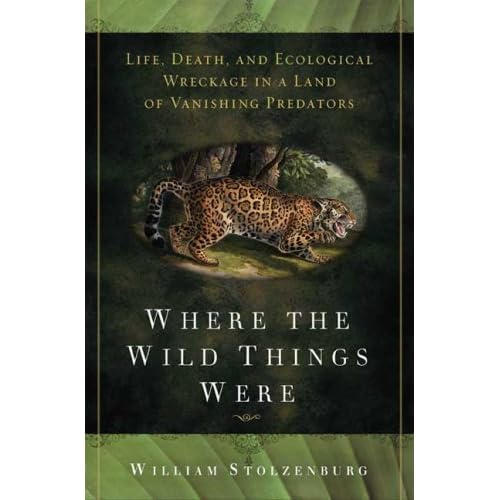
A number of science controversies surrounding trophic cascades are well-presented in William Stolzenburg's book, "Where the Wild Things Were: Life Death, and Ecological Wreckage in a Land of Vanishing Predators". 2008. The book deals with the 20th century history of population ecology and the struggle to understand whether populations of animals and plants are controlled from the top by large predators or from the bottom by primary productivity. From Elton's realization of the pyramid of biomass on Spitzbergen to Hairston, Smith, and Slobodkin's Green World Hypothesis, to Paine's experimental verification of top-down control in starfish and mussel systems, the book covers the origin and development of such key concepts in ecology and conservation as keystone species and trophic cascades.

In addition to covering classic work such as Paine's starfish and mussel studies, the book also delves into controversies over killer whales and sea otter populations. While the latter are controversial because the results are relatively new, other controversies such as those over the rise and collapse of deer herds on the Kaibab plateau after the removal of top predators are controversial because the data are so old.

I wish the book had covered more of the controversy surrounding the Yellowstone wolves-grazing story in Wicker 2003 . The classic story of the wolves restoring Yellowstone's ecosystem to equilibrium should be interrogated because of differing interpretations of top-down (predator controlled) or bottom-up (hydrology-controlled) factors. For example, Wolf, Cooper, and Hobbs (2007) call much of Wicker's simplistic assumptions into question. And Meyer and Persico (2009) question Wolf, Cooper, and Hobbs' climate assumptions for the Holocene. The latter are both good papers, coming from different paradigms, all illustrating some of the difficulties for assigning "cause" and "effect" in dynamic and contingently evolving ecosystems.

Stolzenburg writes that "while the fall of the great terrestrial predators can be summed up as a casualty of the agricultural age, the subsequent collapse of their marine counterparts owes itself to the coming of the technological age." The work concludes with an excellent analysis of the conservation biology idea of linked conservation reserves, and the human opposition to acceptance of large wild animals. In the end, whatever the ecological story, the human social story will always get the last word.

Friday, May 09, 2008

Fire Ecology

Review of The WildFire Reader: A Century of Failed Forest Policy. Edited by George Wuerthner.

"...for the latter half of the twentieth century, every decade has been followed by a decade of increased expenditures on fire suppression activities, yet each decade has also been followed by one of increased losses in property and lives." Like the militarized "war on drugs", the equally militarized "war on fire" is doomed to failure, as pointless as shooting into a mirror. And how much more metaphorical can you get: that we are fighting the raging, fiery passion of irrational nature? The more we push, the more nature pushes back. Every "victory" in our mismanaged and ill conceived war on wildfire insures that the next fire will be even bigger and burn even hotter.

But the losses are not only in property and human lives, but in natural environments and diversity. Many authors wax lyrical about the ecosystems that existed before our warping of their fire ecology. Here is an example from my native Southwest:

"In prehistoric times, the Southwest's valleys were filled with perennial grasslands, blending to sparse stands of desert scrub (e.g. pinyon and juniper) in the higher valleys and deciduous desert scrub (e.g. catclaw acacia) in the more southern valleys. Pinyon and juniper woodlands merged to ponderosa pine forest at middle elevations (7,000 to 9,000 feet) and thence into mixed conifer highlands, depending on the latitude of the mountains. Ponderosa pine forest were open parklands of mostly older (100 to 600 year old) trees, with thick grama and bunch grasses at their bases. Those grasses prohibited most pine seeds from taking root, and they carried frequent, widespread low intensity fires that would kill most of the rest of the seedlings. Streams flowed from mountains in relative abundance to the valleys below to join larger rivers like the Gila, Rio Puerco, Rio Grande, Pecos, San Pedro, and San Juan. Those streams and rivers were sheltered by willow and cottonwood riparian forests, where beaver created wetlands critical to subsurface hydrology, and wolves and grizzly bears lurked among the flood nurtured trees.

Today, the Southwest is a land of relatively barren, deeply eroded valleys and overly thick uplands forests. The wold and grizzly bear are gone, the beaver is all but gone, exotic vegetation competes with native vegetation in key environments, and fire has a radically different place in the landscape. Deep human misperceptions about nature have forced dramatic change on the regional ecology."


from Fire in the Southwest: A Historical Context by Tom Ribe in The WildFire Reader: A Century of Failed Forest Policy.

Tom Ribe's description highlights not only how much we have lost biologically from the natural fire adapted ecosystems, but how much we have lost aesthetically. The former forests were beautiful, accurately described as "parklands", while the current forests are referred to as "doghair" thickets. Not exactly inviting. This is a great opportunity for strategic conservation: when natural state and fire safe are also most pleasing to the eye, we have the opportunity to synchronize values among otherwise ideologically disparate voters. For example, the Nature Conservancy's firesafing through thinning for fuelwood program in NE Arizona could and should be rapidly expanded to "treat" most of the critical forest lands in America, perhaps thirty of a hundred million acres. Of course, grazing needs to be reformed as well, and if it could be tied into this matrix of [to usurp the Administration's maligning of the phrase] "healthy forest initiatives".

My only concern about thinning in the Southwest, is that I believe the ecosystems here are often carbon limited, especially in the topsoil, but also in terms of total biomass. There just isn't enough structural diversity to go around. I.e. there is not enough ground cover; downed trees to provide habitat, erosion control, and nutrient sink/sources. This, along with the vastly increased erosion of destabilized soils, is the reason "salvage logging" is one of the worst ideas. If the forest has already burned it should be left to recover, and the regrowth can be thinned at an appropriate time. Ideally, I believe thinning should leave biomass in the ecosystem.

For Gary Snyder's contribution to the volume, see http://www.urbandharma.org/udharma6/smokey.html

Thursday, May 01, 2008

Grassland: The History, Biology, Politics and Promise of the American Prairie

Grassland is definitely not the work of a doting professor, but the keen wit of a hard-hitting journalist, which Richard Manning is. Reading Manning can still be difficult, though. Not because he writes poorly - the euphony is verse poetry at times. And not because he writes badly - the precision and economy of prose is exemplary. But because he is so smart it hurts, and so honest you want to crawl under a blanket and hide.
They say we should love that which is better than us, for we tend to become what we love, and by that logic I would want to edit this unwieldy tome. Grasslands feels as if it were written in pieces, which perhaps such a vast and encompassing interest as an entire biome must be. There is literally the feeling of your mind being tugged in many different directions;"broadening". Yet the entire work is cohesive, inevitable; massive yet solid. You feel it in your forehead. He wants to download everything, and it is delightful and excruciating to wonder at which droplets out of the entire firehose of creation, heaven and hell and the human psyche, he lets fall to the page, perfect and complete and confusing.
The work is relatively short - if he had taken more liberty with tangents, as Barry Lopez in Arctic Dreams, the read could easily have topped 1000 pages. This is, afterall, the story of an entire ecotype, 1/6 of the world. Walt Whitman's Leaves of Grass falls easily within its radius, but so too does history and interview, travelogue and diary, speculative science and definitive natural history.
When I saw Richard Manning speak last summer I listened breathless as his shaking rustled the crumpled notes he'd scribbled "some contrairian thoughts on". His son had just left to a second tour in Iraq, and I wish him all of the best in his travels, and the forests around his home were all on fire, and I wish these natural places the undisturbed recovery that only nature, in her wisdom, can provide. That was Manning's point then -- that perhaps we shouldn't believe in the perfectability of humans anymore, of the good inherent in our work. Perhaps our every action is a mistake, and the idea of a sustainable agriculture, and hence civilization, is an illusion.
Such are the troubling thoughts Manning, and I, end with.

Thursday, March 27, 2008

The Natural West: Environmental History in the Great Plains and Rocky Mountains by Dan L. Flores
I disagree with the assertion that, just because aboriginal hunter-gatherer societies didn't practice (efficient) resource management or population control, aboriginal peoples share our modern day ecological failings. For, despite the causes of the Pleistocene extinctions, it does appear that Native Americans lived in North America for 12,000 years without bumping off many, or even any, of their animal neighbors (an achievement we moderns seem unlikely to match).

Flores argues that the disparity in environmental damage between Moderns and aboriginals is merely one of degree, and that somehow this ecological disharmony is hardwired into the 'carnivorous, clan and kin-centered primate brain'.

I would like to point out that all animals create or accumulate additional or enhanced habitat for their neighbors. Modern humans, not hunter-gatherers, are the only exception to this rule, with out urban deserts and suburban shopping centers. Aboriginal peoples, as long as they utilized local resources, invariably created more habitat and enhanced ecologies. Of course, the proof of this assertion is (hundreds of?) years of back-breaking ecological fieldwork measuring productivity and species richness.

The Eternal Frontier: An Ecological History of North America and Its Peoples by Tim Flannery
What's the difference between centripetal and centrifugal evolution? Despite needing better editing and a careful cross-checking of important numbers (pre-1492 population of the Americas anyone?), this is an inspiring book with lots of grist for the mental mill. In the interest of Big Ideas this book (written at Harvard don't you know) plays loose and easy with facts and rhetoric, often glossing important points and proclaiming rather than analyzing. But the Big Ideas are worth it! The parallel between the 300 year heyday and collapse of Clovis culture (11,000BC-12,700BC) and the 300-year opening of the American frontier (1580AD -1880 AD), the influence that growing weeds (succesional colonizers) as crops had on creating r-selected (weedy) society, the placing in context of our own extinction event with the last 100 million years of extinction and colonization events...the analysis and structure are a bit thin but the gist is pure gold...plus hearing an Aussie psychoanalyze America is priceless. I can't wait to read his parallel account of Australia's last 300 million years, "The Future Eaters."

Flanery asks whether a "nation so conceived in liberty can long endure" and compares the mindset of "liberty" with that of a weed (which most of our crops are) that experiences "release" in a new environment before adaptation sets in. When will Americans adapt to America and become truly native? Maybe once we've all read this book...

It is only at the end of the book that we discover how all this history answers Aldo Leopold's assertion that we must "know what the world was like" in order to save the environment. Flanery comes out strongly in favor of restoring parts of America to pre-Clovis (pre-human, approximately 13,000 years ago) conditions. By reintroducing extirpated animals as well as analogs or homologs of extinct animals, he hopes to restore America to "rival Africa" in terms of large mammal diversity, as well as creating balanced and sustainable ecosystems. Its amazing to think that where we live used to look like the Serengeti, or the Costa Rican rainforest. But, according to Flanery, we still have the choice to put things back how they were. Wolf reintroduction anyone?


Tuesday, February 12, 2008

Hiking Barefoot?


"The Barefoot Hiker" A Book About Bare Feet
by Richard Frazine, BD [Bachelor of Divinity?]
1993, Ten-Speed Press, ISBN: 0-89815-525-8
Read the book. Join the club.

This is an excellent and well-written book full of irreverent spunk and practical advice for hikers who habitually go barefoot. It is also an interesting addition to my "What would caveman do" bookshelf (see: Anopsology and my analysis). But, this book is written by Easterners, and I must humbly take exception to the application of their advice to the west, particularly Tucson.

The authors would sore regret hazarding a single barefoot footfall, let alone an entire cavalcade of such vulnerable events, in the Sonoran Desert, a Desert incomparably well-equipped to puncture the inflated expectations of innocent trespassers. The rapacious wit and perspicacious criticism embodied in the hard reality of the Sonoran desert would soon render the author's philosophy moot as he became a human dumpling skewered on the spines of cholla, saguaro, fish hook, and porcupine cactus, not to mention the infinitely small, sharp, and numerous "glochids" of the prickly pear.

The idea that humans are fit to live in the environment uncouth and unshod is an admirable one, an idea dating back perhaps to Genesis and the Garden of Eden. But the beauty of wilderness, especially Sonoran desert wilderness, bursts such hubristic bubbles and skewers such dainty pedagogy. Aristotle's peripatetic circumlocutions aside, this shit is sharp. To take humble pride in the profligate-armed Saguaro, to know that we are outmatched and vulnerable at his side, is to know the true reality of wilderness: not unadorned freedom to trample as we wish, but careful respect for all creatures great and sharp, and a willingness to adapt our footprint to the landscape we inhabit.

Monday, January 28, 2008

Matthiessen's Wildlife in America

'And I brought you into a plentiful country, to eat the fruit thereof and the goodness thereof; but when ye entered ye defiled my land and made mine heritage an abomination.' Jeremiah 1:6

In some ways, Wildlife in America. (New York, Viking Press, 1959) by Peter Matthiessen appears to be an apology for human-caused extinction. But perhaps Matthiessen is simply being realistic when he questions whether all species really need to be protected. Should we ruin a ranching community trying to save a relictual species that only lives in one small pool in the desert, a species that would likely become extinct anyway? What about the ridiculous perfusion of species, such as the hundreds of varieties of freshwater clams the Tennessee Valley Authority spends millions of dollars protecting? What about species that, as Matthiessen puts it, have "become senile and over-specialized in their long period of isolation...unable to compete with the younger species..."? Despite the strange word choice, his point that some species fail to adapt to natural changes, is well-taken. When Panama rose out of the sea to connect North and South America many species became extinct because they could not competitively adapt to the wave of immigrants. Perhaps our rush to fight invasive species while protecting endemic species is ultimately as futile as trying to stop Panama from linking the two American continents?

(Ironically, we seem to have done precisely that with the Panama Canal, which prevents genetic exchange between many species with populations in North and South America, such as the Jaguar.)

Unfortunately, by Peter Matthiessen is ultimately unsatisfying because Matthiessen never directly answers the question of why the extinction of species matters. Too busy telling a 'balanced story' to directly confront the value of non-human species, he leaves this task to later authors, notably Rachel Carson, who argued that all life is connected and that what we do to others we eventually do to ourselves. But perhaps Matthiessen is wise to leave that argument to specialists; indeed, much of the Deep Ecology movement is an attempt to explain how species that cannot argue their own case can have inherent worth.

But let there be no mistake -- Matthiesson's opinion of the extinction crisis is clear. He is unmistakable when he argues that "the concept of conservation is a far truer sign of civilization than that spoliation of a continent which we once confused with progress." Although he doesn't deign to list specific reasons, he is at his best intoning arguments that pull at the heart and echo the damnation of the apocalypse (CF. the quote from Jeremiah above, also featured at the beginning of Wildlife in America)

"Even today, despite protection, the scattered individuals of species too long persecuted are hovering at the abyss of extinction and will vanish in our lifetimes. The slaughter [for food] has subsided this century but the vertebrate animals as a group are obscured by man's dark shadow. Such protection as is extended them too rarely includes the natural habitats they require, and their remants skulk in a lean and shrinking wilderness.

The true wilderness -- the great woods and clear rivers, the wild swamps and grassy plains whcich once were the wonder of the world -- has been larely despoiled and today's voyagers, approaching our shores through the oiled waters of the coast, are greeted by smoke and the glint of industry on our fouled seaboard, and an inland prospect of second growth, scarred landscapes, and sterile, often stinking, rivers of pollution and raw mud, the whole bedecked with billboards, neon lights, and other decorative evidence of mankind's triumph over chaos.

In many regions the greenwood not converted to black stumps no longer breathes with sound and movement, but is become a cathedral of still trees; the plains are plowed under and the praires ravaged by overgrazing and the wind of drought. Where great, wild creatures ranged, the vermin prosper."

Tuesday, May 08, 2007

An Island to Oneself


"The coral waxes, the palm grows, but man departs."
Suvarov, Cook Islands, South Pacific

Tuesday, December 19, 2006

More Science Books

Nutrition and Physical Degeneration by Dr. Weston Price

Cells Gels and Engines of Life by Gerald H Pollack

7 Clues to the Origins of Life

Structure of Evolutionary Theory by SJ Gould

Maxwell's Demon: entropy, information, computing / compiled by Harvey S. Leff and Andrew F. Rex

An Album of Fluid Motion by Milton Van Dyke

Atlas of Optical Phenomena

Friday, December 08, 2006

Controversial Science Volumes

Sometimes silence speaks volumes about the state of science:

  • An Analytical System of Clinical Nutrition. Dr. Schenker.
  • Control of Colloid Stability through Zeta Potential.
  • Cells, gels, engines of life.