Showing posts with label agriculture. Show all posts

Monday, July 10, 2023

Are Pollinators Necessary for Food Production?

Pollinator enthusiasts claim that "1 in 3 bites of food are dependent on pollinators", but the reality is that many crops have been bred to self-pollinate.  For example, soybeans produce bean-like flowers, and many wild beans do require insect pollinators, but soybean flowers never open; they self-pollinate.  

In the wild, 70-90% of flowering plant species (angiosperms) do require an animal (usually an insect, bird, or mammal) to move pollen from one flower to another. Source. Only a few species have evolved to become self-reliant or to rely on wind.  But in human agriculture, we've selected for species that "breed true", which often means selecting for self-pollination. 

Many flowering agricultural crops would appear to need pollinators, but don't.  Or at most the pollination is optional: it doesn't hurt for insects to visit the flowers, and sometimes they help to fertilize and hence set more fruit, but they aren't strictly needed.  Although about three-quarters of crops benefit in some way from animal pollination, only about 10 % depend fully on pollinators to produce the seeds or fruits we consume, and they collectively account for only 2 % of global agricultural production. Source.

I created this table to show the AZ crops that require pollinators.


Data from Our World in Data: https://ourworldindata.org/pollinator-dependence

More information: https://en.wikipedia.org/wiki/List_of_crop_plants_pollinated_by_bees

Tuesday, January 11, 2022

Phenology, Accumulated Growing Degree Days, and Soil Moisture

US Crop Calendar

Source: https://ipad.fas.usda.gov/countrysummary/Default.aspx?id=US


Arizona had a good year for NDVI

Source: https://glam1.gsfc.nasa.gov/


NASA SMAP data.  Data is global.


This mapped layer is delayed by 2 weeks.  I haven't found a layer that shows real-time moisture.


NPN Visualization tool can view Historical, Current, and Anomaly Accumulated Growing Degree Days. Data is only for USA.

Source: https://data.usanpn.org/vis-tool/#/explore-phenological-findings


Tuesday, January 12, 2021

Regenerative Agriculture Controversy?

 https://www.wri.org/blog/2020/05/regenerative-agriculture-climate-change


https://agfundernews.com/opinion-where-the-world-resources-institute-got-it-wrong-about-regenerative-agriculture.html


https://undark.org/2020/01/31/podcast-43-regenerative-agriculture/

Monday, April 13, 2015

Problems with Roundup?

Roundup  was recently labelled by the WHO as a "probable human carcinogen".

But farmers still love it: LibertyLink soybeans testimonial

Because it works:  Time-lapse video of herbicide treatment


I previously wrote about chemical use versus abuse in American agriculture, as well as some of the new stacked-trait GMO crops that are resistant to multiple herbicides.


Thursday, January 15, 2015

Is Organic Agriculture Healthier for the Environment and the Consumer?

This deceptively simple question is difficult to prove.  In a widely-read science blog post, Dr. Christie Wilcox (her PhD is in marine biology, not agriculture) argues that the supposed benefits of organic farming are all myths.

While some of her specific claims, such as that organic farmers are allowed to use the incredibly toxic natural compound rotenone, are off-mark, much of her critique appears to stand.  The reasons are various, but telling:  there are costs and benefits to different agricultural systems, and organic farms face many of the same challenges of conventional farming.  For example, herbicides allow no-till farming, with myriad benefits for soil structure and water quality.  It is extremely difficult to practice no-till without some means of removing weeds.

Certified organic farms may not use synthetic pesticides, herbicides, fungicides, etc.  But if organic farmers choose to use a natural compound to kill weeds or pests there is nothing to guarantee that such a compound would be less toxic to the ecosystem and to humans. Natural compounds on organic farms may be more toxic than their synthetic analogues!

Unfortunately, while there are comprehensive databases of the type and amount of pesticides found on conventional food (see the Environmental Working Group's annual Dirty Dozen list), no such testing of natural compounds on organic produce is conducted.  Apparently synthetic compounds are investigated more than natural compounds, perhaps due to an unstated belief in the Naturalistic Fallacy, i.e. that natural chemicals must be healthier than synthetic chemicals.  But many plants (for example, nightshades) contain totally natural compounds... that are totally toxic as well.

A good take-home message would be to wash all of your fruit and veggies, whether they are organic or not.  And learn which plants are poisonous.  I'm not even going to get into all of the (natural and synthetic) chemicals and preservatives in grains, let alone refined flours, etc.

Saturday, December 20, 2014

Chemical Use and Abuse in Agriculture: What's the Problem?

Peter Lehner's recent blog post on ACOEL was inspiring, but also puzzling, because he mentions three problems with agriculture, but only 2 are real problems.

While I agree with the need for a renewed emphasis on environmental contaminants in farming, the issue of 2,4-D seems out of place in his discussion.  Certainly the role of unregulated chemicals in our food supply needs to be brought up to international standards (*cough* Europe).  And certainly the disastrous role of factory farming in harming the environment and, through the over use of antibiotics, breeding new antibiotic-resistant diseases urgently needs to be addressed.

But 2,4-D and glyphosphate are some of the least toxic herbicides available, having been subjected to more scrutiny than any other compound in agriculture. They have been used for decades in both agricultural and turf and domestic garden applications, and the licensing of genetically engineered (GE) crops resistant to these herbicides really doesn't change anything.  2,4-D is already used as a pre-emergence and post-harvest weed control, and the new GE crop gives farmers the option of using it once or twice during the growing season.

These common weedkillers have been used, are currently being used, and will be used, whether or not our country goes down the GE crop road.  What's more, EPA has used the licensing of Dow's Enlist Duo GE soybeans to significantly increase regulation of herbicide use, with the option to review in 6 years.  It should be pointed out that the outcome of GE crops resistant to 2,4-D will likely be the same as it as for glyphosphate: industry will shoot itself in the foot by overusing single-chemical herbicides to the point that weeds evolve resistance.

While other areas of environmental regulation are woefully lacking (antibiotic overuse and GRAS chemicals), the use of herbicides is well-regulated and not a major risk to human or environmental health. NRDC would be well to focus on the important agricultural issues and let settled issues alone.

Sunday, December 14, 2014

“A Safe and Affordable Food Supply”: New GMOs Battle Resistant Superweeds

Stacked-trait GMOs
Herbicide-resistant weeds have more than doubled since 2009 to infest approximately 70 million acres of American farmland –an area larger than the states of Ohio and Illinois combined.  20 years after the introduction of genetically engineered (GE) Roundup Ready corn and soybeans, more tools are needed to maintain productivity.  

 GE crops were hailed as a major advance precisely because they did away with the need for more toxic herbicides like 2,4-D: Robert Fraley, executive vice president and chief technology officer at Monsanto, recently affirmed that "herbicide tolerant crops have been a great enabler. They've enabled farmers to use safer and more environmentally friendly chemicals and replace the products that were previously used...The benefits have been so real and so clear. As I said, it's reduced pesticide use."

However, use of Roundup (glyphosate) steadily increased, even as more and more weeds became resistant.  In 2007, as much as 185 million pounds of glyphosate was used by U.S. farmers, double the amount used six years ago, according to Environmental Protection Agency (EPA) data.

2,4-D and Dicambra are herbicides that are already used to “burn down” the weeds in the autumn, and as pre-emergent herbicides as a prophylactic in the spring, before planting.  But up until now these more-toxic herbicides could not be used during the growing season, as glyphosate can on GE corn and soybeans.  More tools were needed to maintain yields.

Enter Dow's Enlist Duo
Dow recently secured regulatory approval to roll out Enlist Duo in 2015, a stacked-trait GE for corn and soybean cultivars.  Stacked traits have already been used to enhance herbicide-resistant Roundup Ready soybeans with Bt, a natural pesticide.  There are also stacked trait soybeans that contain transgenes to produce oils that are less susceptible to rancidity, and commands a premium price on the market. 

The new GE crops will be resistant to both glyphosate and 2,4-D, allowing farmers to kill glyphosate-resistant weeds during the growing season. 

2,4-D is a plant hormone that kills broadleaf plants (but not grasses like corn, or wheat) by overstimulating growth.  In contrast, glyphosate works by inhibiting a crucial plant enzyme that is not present in animals.  Both are widely used in both residential (lawns and gardening) and commercial (farm) settings. 

Resistance Will Develop
Agronomists predict  that resistance to 2,4-D will develop as rapidly as resistance to glyphosate, because farmers will spur evolution by using the same herbicide on the plants in the same fields, successively selecting for anything with resistance.  USDA and EPA have vowed to better manage the technology, but compliance with integrated pest management strategies is voluntary.

2,4D has been known to drift off fields and kill nearby woodlots, fruit trees, and organic crops, so Dow has changed the chemical to reduce volatility and designed special nozzles to better control application.  EPA is “imposing first-time ever restrictions to manage injury to sensitive crops.  The EPA has put in place restrictions to avoid pesticide drift, including a 30-foot in-field “no spray” buffer zone around the application area, no pesticide application when the wind speed is over 15 miles per hour, and only ground applications (with the special nozzles) are permited. 

Another first for the GE crops is that the EPA is also imposing requirements to reduce potential for developing resistant weeds, such as mandating extensive surveying and reporting to EPA and grower education and remediation plans.  EPA will reevaluate after 6 years, and may impose new restrictions at that point. 

Resistant Superweeds
Some of the most common resistant weeds are: Marestail, Giant Ragweed, Volunteer Corn, Common Ragweed, Lambs quarter,  Agronomists idenitify resistant weeds based on the fact “that most... soybeans are RoundupReady, and that if weeds are still in the soybean field at the end of the season, then there must have been a failure of the system (i.e. spraying herbicides didn’t control them)."


"Experience with the Enlist system indicates that even without a fall herbicide treatment, multiple in season application of 2,4D seem to control marestail well.  Doing so will probably result in the development of resistance to 2,4-D in marestail, though, since this is the type of approach that led to glyphosate resistance – multiple applications of the same herbicide for control of the same weed." -Mark Loux, OSU Extension Herbicide Specialist


Monday, November 10, 2014

Wendell Berry on the Problem of Private Land Ownership

"We share a common health....

....If we have the "right to life" as we have always supposed, then that right must stand upon the further right to air, water, food, clothing, and shelter.

It follows that every person exercising the right to hold private property has an obligation to secure to the rest of us the right to live from that property...an obligation to use it in such a way as to not impair or diminish our rightful interest in it.

 But --and here is the catch-- that obligation on the part of the landowner implies a concurrent obligation on the part of society as a whole. If we give our proxy to the landowner to use-- and as is always implied, to take care of -- the land on our behalf, then we are obliged to make the landowner able to afford not only to use the land but also to care properly for it.

This is where the grossest error of our civilization shows itself. In giving a few farmers our proxies to produce food in the public behalf for very little economic return we have also given them our proxies to care for the land in the public behalf for no economic return at all. This is our so-called cheap-food policy, which is in fact an antifarming policy, an antifarmer policy, and an antiland policy.

We hold the land under a doctrine of private property that in practice acknowledges no common health."

---from Another Turn of the Crank.  Essays by Wendell Berry.

Tuesday, October 07, 2014

Harvest Reflections on Growing Food

"When does the keen knife edge of human ambition dull into a mere quest for survival?  Perhaps it relates somehow to those "lives of quiet desperation" that Thoreau was always harping about as he often expressed opinions on the futility of the agricultural lifestyle.  I can relate, perfectly."
--Joe Hutto, Touching the Wild


General Thoughts

Agriculture is hard, necessary, and always just-in-time.  Whatever you may think about agricultural policy exceptionalism (i.e. exemption from the Clean Water Act (this is changing), tariff protections and subsidies), the truth is that farming is hard and food is a miracle.

While I support organic agriculture and believe we must find holistic solutions to meet our nutritional needs, I don't begrudge any farmer who chooses to use every tool available... whether that means artificially-bred chickens that grow 4x faster than heirloom breeds, or GMO crops (still no scientifically-documented health risks), to the use of chemical fertilizers, herbicides, pesticides, and fungicides.

I have some personal experience with organic and Permaculture farming; enough to know I'm lucky that my ability to get food on the table isn't dependent on my success in the garden.  Whether its trying to keep crops alive in 110 degree heat of a Tucson June, or trying to defend my pumpkins this summer in Albuquerque from squash bugs, I haven't always been successful!

It seems amazing that it would take less time, energy, and money to produce chemical pesticides in a factory somewhere, ship cross-country, and spray on my pumpkins -- then it is for my wife and me to spend an hour each and every morning picking bugs off our plants.  In the Big Argument whether organic food can feed the world, its important to weigh the individual microeconomic decisions of farmers; how much  time they're willing to devote to organic agriculture.  In Albuquerque, I would argue that almost no one has the time to grow organic pumpkins and squash: either you don't grow them, or get ready to rain down chemical death on your adversaries.  (I've also heard that planting very late, i.e. after monsoons begin in July, may mean missing peak squash bug season.)

Gardening is slow knowledge that takes time to build.  Next year I think I'll try planting late -- but I'm also going to keep a chemical arsenal ready.  Just as I try to eat healthy and avoid antibiotics (in soap, etc), I won't refuse antibiotics if I get really sick or my pumpkins get infested with squash bugs again.  Every tool should be on the table.   This is one issue some organic consumers run into when they shop at local farmers markets  -- many local farmers try to grow organic, but don't certify as such because 1) certification is expensive, and 2) they don't want to give up tools they might need if their crops are sick.  So supporting local agriculture means coming to terms with a world that isn't black-and-white, where there is a place for local knowledge, building the soil, complementary planting AND chemical pesticides.


Post-Mortem on our Garden

Our corn was lackluster this year -- either because we bought the local variety, or maybe a lack of fertilizer and poor soil quality.  We let morning glories climb over everything because they have pretty flowers , but they really are pernicious weeds w/out many redeeming qualities.


Three Sisters Agriculture seems like bullshit.  Pests hide in dense vegetation, and we've found that well-spaced plants are healthier and easier to maintain with fewer insects and mold problems.

Native Wildflower Mix + Straw = Tons of Weeds
Native wildflowers grew slowly, if at all, and were easily overwhelmed by look-alike weeds that grew quite well on little precipitation and bad soils.  The fact is that weeds grow amazingly well in New Mexico (as any botanist will observe) -- in a land where not much else can survive.

Tried to grow (again) Chia seeds but the tall mint-like plants never flower.  We also tried growing quinoa, which is supposed to grow robustly in arid regions -- it is in the same family as some of the most successful weeds in New Mexico, so it might have a chance...!


Monday, September 15, 2014

Environmental Benefits Assessments for USDA Conservation Reserve Program

The USDA uses an  Environmental Benefits Index (EBI) to rank Conservation Reserve Program land applications by prioritizing soil conservation, water quality, and wildlife habitat.  Six factors are considered:
  1. Wildlife habitat benefits resulting from covers on contract acreage 
  2. Water quality benefits from reduced erosion, runoff and leaching 
  3. On-farm benefits from reduced erosion 
  4. Benefits that will likely endure beyond the contract period 
  5. Air quality benefits from reduced wind erosion
  6. Cost
1.  Wildlife habitat is determined by looking at planting composition (introduced or native), number and composition of species (more species, and more functional groups such as legumes, shrubs, trees, forbs, and grasses have higher value), and landscape context (strips, blocks or mixtures that form corridors or gaps).  Points are also available for providing pollinator habitat and for enhancing wildlife in areas high-priority areas.

2.  Water quality benefits are determined by whether or not the property is in a designated surface water quality impairment zone, the type of soil, potential soil erosion, and distance to major waterbodies.

3.  Not discussed.

4.  Enduring benefits are determined subjectively based on the probability that conservation will continue beyond the CRP contract.  For example, trees would be expected to live longer than the 10-year CRP contract.

5.  Air quality benefits are determined by calculating potential wind erosion (based on average wind speed and soil texture), whether the property is in a air quality nonattainment area, and the potential to sequester carbon in the soil by planting trees, shrubs, or grass.

For more information, see the CRP Farm Science Administration website at USDA.gov.


....USDA also periodically reviews the effectiveness of their programs using the Conservation Effects Assessment Project.  Data and papers can be found here.


Monday, September 08, 2014

Organic Food Controversy in the New Yorker -- Science Writing at its Worst

Mr. Specter is a staff writer for the New Yorker.  He tends to write about agriculture and genetic engineering, but on closer inspection his writing provides a dangerous combination of blind faith in science and a misunderstanding of what science is.

His bio of Vandana Shiva uses a source to give voice to the conclusion that Shiva is “a fraud…blinded by her ideology and her political beliefs."  She responded alleging Specter's article made “fraudulent assertions" and consisted largely of "deliberate attempts to skew reality.”  The New Yorker's editor, David Remnick, defended Specter's article against her list of complaints, item-by-item.

But both Shiva and Specter make ideological arguments.  They both use convenient scientific anecdotes to support their "ideology and ...political beliefs".  However, Specter works as a "journalist," and therefore implicitly claims at least some objectivity, whereas Shiva is a self-described advocate for her cause, and is at least honest about her agenda.

Specter criticizes Shiva for being unscientific, but how scientific is Specter?  Does he cite scholarly papers?  No.  Does he weigh the pros and cons of conflicting theories?  No.  Instead, he interviews a couple scientists who happen to already agree with his perspective.

Do you ever wish that complicated issues could be quickly and easily resolved by an impartial and all-knowing 3rd party?  Specter has found just such an infallible arbiter, but, unfortunately for the rest of us, it a biased version of science.

Apparently, Specter thinks science is a set of facts that should not be questioned.  But science is just the inverse: a way of questioning that is based on facts (ie empirical evidence).  Specter is totally amazed that anyone could doubt “science”.  Even worse, he thinks he knows what “science” is!

(I've already pointed out the impossibility of some of the scientific assertions Specter has made in a previous blog post.)

I wrote this post because I noticed a pattern, or agenda, behind Specter's use of science.  He wrote an entire book defending science, entitled  "Denialism: How Irrational Thinking Hinders Scientific Progress, Harms the Planet, and Threatens Our Lives."  Specter's book claims to defend science and rationality from the assaults of organic food advocates, but he couldn't quite bring himself to evaluate the research that didn't support his conclusion. It's surprising how little actual scientific research he manages to cite; Tom Philpott had this to say about Denialism for Grist.org:

"Two major assumptions underlie [Specter's work]: organic agriculture delivers frightfully low yields, and GMO agriculture delivers reassuringly high yields. He doesn’t deliver data to back up either of those claims. Here are two studies, both of which came out in time for consideration in Denialism, that Specter really should have grappled with: 1) a 2009 study by the Union of Concerned Scientists showing that after decades of research, transgenic seeds have yet to deliver yield increases; and 2) a 2005 study in Bioscience (summary here) showing that yields of organically grown corn and soy match those of their conventional counterparts–with dramatically lower energy inputs."

For me, the real issue is a scientific question: can GMO crops sustainably out-produce other alternatives, particularly the organic small landholder polyculture that Shiva champions?  Shiva claims that local, diverse agricultural systems can produce more and healthier food per acre than green revolution mass monocultures, especially in the long run.  Unfortunately, while Specter's article questions some of Shiva's claims, it does little to fill this crucial knowledge gap.

Monday, February 03, 2014

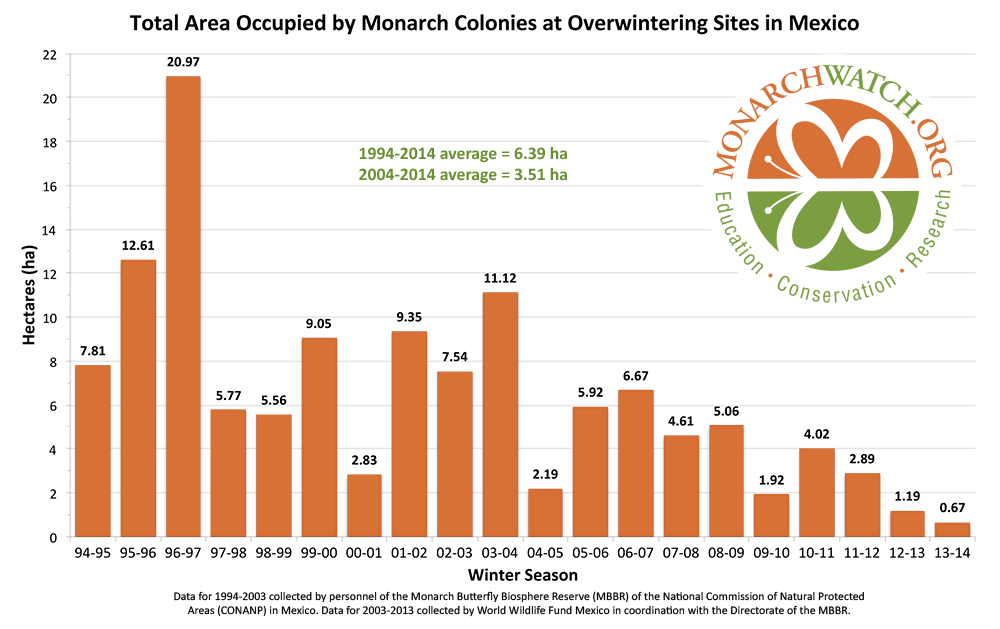
Monarch Decline Blamed on Changing US Agriculture


Graph of returning migration Monarch Butterflies from MonarchWatch.org


CBS quoted entymologist Lincoln Brower: "The main culprit," he wrote in an email, is now genetically modified "herbicide-resistant corn and soybean crops and herbicides in the USA," which "leads to the wholesale killing of the monarch's principal food plant, common milkweed."

The website MonarchWatch.org has the best in-depth analysis of the triple threat of habitat loss.  What to do?  Plant milkweed!

Thursday, May 19, 2011

Ohio Agricultural Production

Ohio agricultural production has declined, so why hasn't fertilizer pollution?


Thursday, January 20, 2011

Economic Incentives and Water Quality in Ohio

Brent Sohngen, a professor in Ohio State University’s Department of Agricultural, Environmental and Development Economics, presented “Economic Incentives and Water Quality in Ohio”, an interesting talk about paying farmers for the reductions in runoff pollution they deliver. This economics-inspired approach differs from that typical of Soil and Water Conservation grants that pays for specific installations like riparian buffer strips, containment ponds for sewage, and conservation research program fallow fields.

Dr. Sohngen experimentally signed a contract that would pay farmers for pollution reductions in a small watershed in West Ohio. Unfortunately pollution increased when one of the farmers in the watershed decided to double his hog production. Still, Dr. Sohngen thinks the technique has promise, given that the farmers were responsible for more pollution than a nearby town's wastewater treatment plant. Given what we are willing to pay to upgrade the plant, shouldn't we be willing to pay a similar amount to the farmers?

I like the idea, but the economic logic seems to falter because it is based only on what society is willing to pay, not the cost to the farmer. I would have liked to ask about how much money, given the farmer's decision to invest in additional hogs, it would actually take for the farmer to pollute less. What is the opportunity cost of reduced pollution?

Sunday, October 31, 2010

Intensive farming may ease climate change

"Land saved from cultivation offsets carbon emissions" Nature 465, 853 (2010)

This Nature News item reviews a paper published by Burney et al in PNAS entitled "Greenhouse gas mitigation by agricultural intensification." The article shows that agriculture today is more land-efficient than in 1960. Yet it has been interpreted to say that modern intensive industrial agriculture is better than organic. The authors should write a statement clarifying their work but they may not. The reason? The study, as written, is trivial, and only with the added implication is it interesting. But the implication is not true.

In addition to commiting the unforgivable sin of reasoning based on historical counterfactuals, the article presents a myopic and simplistic either-or argument rather than a systematic analysis of factors contributing to agricultural land use. The fact that 50% of all food produced is wasted strikes me as one area where adding efficiency could reduce the overall footprint of agriculture. Certainly the choice of which land to pave over (usually the most fertile agricultural land) and which land to convert to agriculture (eg primeval Amazonian rainforest) has been especially perverse and unnecessary. Furthermore, our society's choice of food is also not a given "quality of life" as the article assumes; rather, it is a socially constructed and contigent demand on land use. If Americans consumed more primary production (plants) and less secondary production (animals) we could vastly decrease our agricultural footprint.

Other issues could be raised, but these points show some of the many analytical failings of this article. Despite, or perhaps because of its unsupported thesis, it has also been extensively commented upon; the authoritative review of responses in here.

Monday, June 21, 2010

Tropical Agroecosystems

Tropical Agroecosystems: These habitats are misunderstood by the temperate zones, mismanaged by the tropics. Janzen 1973. Science.

What tropical countries so rarely grasp is the fact that agriculture in the temperate zone countries evolved (and is still evolving) from short-term exploitation to sustained-yield agriculture while operating off a much larger natural capital than the tropical countries possess.

...social rather than technological environment is at fault...(because of side-by-side comparisons)

The plea for technological advance gives the scientific community a perfect excuse to continue their reductionist and esoteric approaches rather than to put their efforts into the far more frustrating task of generating sustained-yield tropical agroecosystems...

...tropical people are no more interested in spending all their waking hours picking beetles of bean bushes and transplanting rice by hand than they are. High-yield tropical agriculture requires immense amounts of very accurate hand care or tremendous amounts of fossil fuel, or both...

Most of the lowland tropics would be classified as marginal farmland...there is no biological reason that the capacity to support human life should be evenly distributed over the earth's surface, nor why is should be correlated with the primary productivity of natural ecosystems or with the biomass (standing crop) of these ecosystems.

If one wishes a high yield from a particular site, year-0round warmth necessitates complex fallow systems to deal with the weeds and insects. However, it is possible that over large areas, a much lower yield per acre in fields under continuous cultivation could produce the same average yield per acre as fallow systems.

The complex biological systems of the tropical lowlands are very easily perturbed and cannot be easily reconstituted from roadside and woodlot plants and animals, as could many North American habitats.
A great variety of horticultural practices and strains of common tropical food plants have accumulated over the centuries. They are closely adjusted to local farming conditions and coevolved with the other dietary resources of the area. When high-yield hybrids are introduced, the local strains and practices are quickly abandoned. This later lead to (i) expensive and complex programs to reevolve these strains when adjusting hybrid monocultures to sustained yield tropical agriculture, (ii) increased dependence on pesticides and complex breeding programs to keep abreast of the pest problem in single-strain monocultures, and (iii) increased imbalance in the distribution of wealth among farmers.

Tropical insects appear to develop resistance to pesticides much quicker than temperate insects.

Argues that population has increased as a result of increased cash cropping, which rewards larger families and eliminates the feedback associated with subsistence agriculture.


Well-meaning persons are constantly injecting fragments of temperate zone agricultural technology into the tropics without realizing that much of the value of these fragments is intrinsic not to the technology, but rather to the society in which that technology evolved...That the tropical country "cannot resist" these gratuities is hardly justification for giving them. [as a consequence of "development"] the land deteriorates, deserts spread or become more barren, and a greater number of people end up worse off than they were before development of the area took place.

When an experiment station is centered around a major food crop, such as rice or maize, the goal becomes one of maximizing production per acre rather than per unit of resource spent...

Friday, June 04, 2010

Growing Season


"The growing season has begun throughout the Northeast and the Growing Degree Days (GDD) are accumulating. This is a tool that farmers and gardeners use to track crop progress and to manage pest infestations. As the map above indicates, as of May 23, 2010, the GDD accumulation in most of the Northeast is 1 to 2 weeks ahead of normal. Reports from the National Agricultural Statistic Services show that the impacts of an advanced season are varied. Most states in the region reported that field crop and fruit progress is ahead of normal. While it's beneficial to get the field crops in early so the crop has time to mature, the early fruit bloom and emerging vegetables were damaged by the frost that occurred during the second week in May. The frost was considered a late frost in southern parts of the region, but well within the normal range for the northern states." from NRCC.

Sunday, May 23, 2010

Can biotechnology feed the world?


Some discussions recently have been inspired by the recent visit of Ms. Revathi, a schoolteacher-turned-organic farming advocate from India. Ms. Revathi visited the School of Environment and Natural Resources at OSU last week, bringing stories of widespread suffering from the Green Revolution and ongoing injustices from free trade, industrialization, capitalism, and corporations. She argues that ecologically- and traditionally-minded development can create healthy, prosperous farmers, while the American model has brought environmental, social, and economic ruination.

from Diaz, Robert J. and Rosenberg, Rutger. Spreading Dead Zones and Consequences for Marine Ecosystems. Science 15 August 2008: Vol. 321. no. 5891, pp. 926 - 929

Her viewpoint is uniquely different from that of main-stream American discourse about globalization, free markets, and the benefits of technology. Her years of experience growing sustainable farms in India seems similar to the experience of independent American local organic farmers, but leads her to make conclusions almost opposite to beliefs so accepted they are almost obvious to most Americans; for example, that the world has become better: wealthier, healthier, happier, etc because of technology, corporations, and development.

In some ways, the arguments of those who speak for the establishment, pass right through and do not apply to those who see the world differently. One of the best examples of this is a Congressional meeting held almost exactly 10 years ago. For the most part, these issues about biotechnology and aid, are still unresolved. This meeting was notable because it brought together some of the biggest hitters from both camps, who proceeded to talk right past each other, thoroughly confusing the moderater. Can there be a middle ground?

Friday, May 21, 2010

Sustaining Lives through Organic Farming

Association for India's Development, Columbus, along with the EARTH Center and Students for Food Sovereignty welcomes AID Fellow and organic farming expert, Ms. Revathi.

Revathi has worked with more than 32,000 farmers in the organic movement in Tamil Nadu and her work has been recognized by the governments of India, Sri Lanka and Indonesia. She has hands-on knowledge in the importance of rejuvenating the soil using a holistic approach towards soil restoration, seed selection techniques, methods to create organic pest repellent and herbicides. She described the use of Sesbania ("dhaincha") to reclaim soils made saline by the tsunami as well as conventional agriculture.

More info.