A talk presented at the 2015 Tamarisk Coalition Conference in Albuquerque, New Mexico.
Showing posts with label tamarisk. Show all posts
Showing posts with label tamarisk. Show all posts
Wednesday, February 11, 2015

Wednesday, December 17, 2014
Tamarisk Beetles Continue To Spread
Tamarisk beetles defoliate the invasive tree throughout its range:

Monday, November 16, 2009
Tamarix ramosissima survey on White Sands National Monument
White Sands National Monument is located in the Tularosa Basin and surrounded by White Sands Missile Range, the site of the first atomic bomb test. The area is desolate and remote and still used for target practice. The dunes are composed of gypsum, a salt that accumulates in the dry lakes and playas of this closed basin.
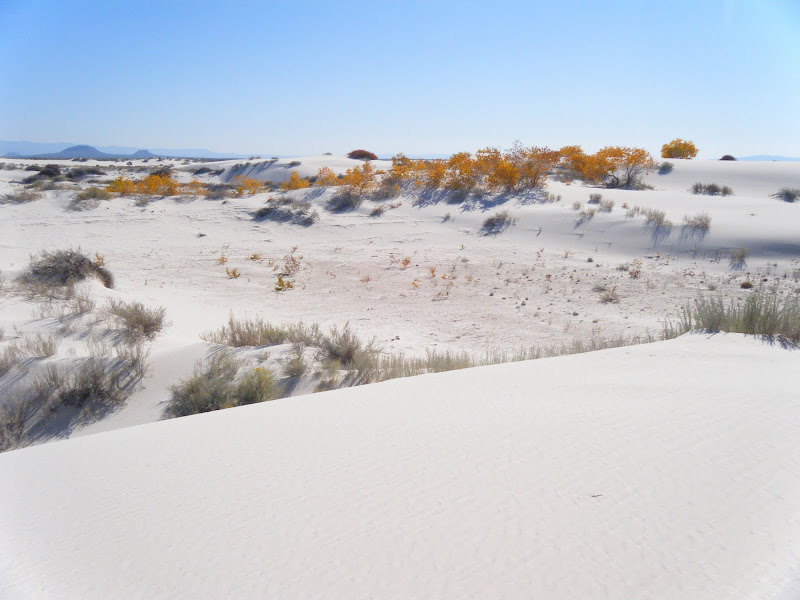
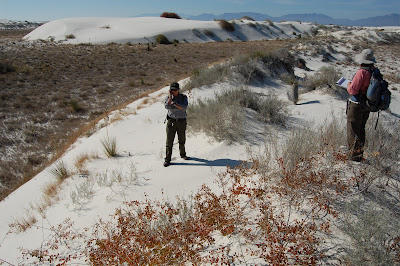
Our Mission: Vegetation mapping plus Search & Destroy Tamarix ramosissima AKA Russian Salt Cedar. Our goal was to ground-truth vegetation maps and locate populations of this invasive species for possible future air strikes.
Cottonwoods grow in the dunes because of the shallow water table.
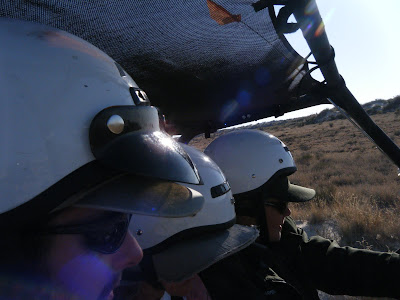
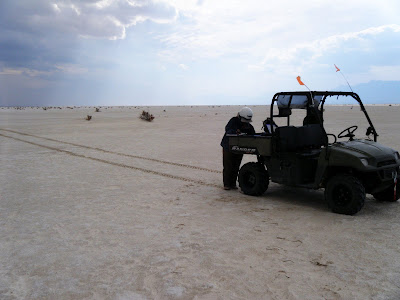
We traveled by sand buggy.
Many dunes are stabalized by Rhus Trilobata (Skunkbush Sumac), Poliomentha (Rosemary Mint Bush), Chrysothamnus (Rabbitbrush, Chamisa), and Yucca.
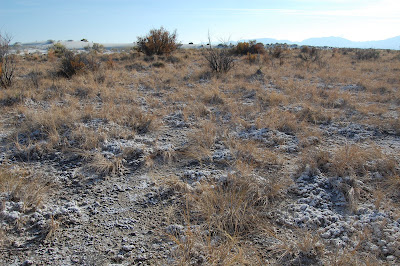
Tamarix ramosissima visible in the background. The foreground is covered by a thick salt crust.
 |
| From White Sands National Monument |
Our Mission: Vegetation mapping plus Search & Destroy Tamarix ramosissima AKA Russian Salt Cedar. Our goal was to ground-truth vegetation maps and locate populations of this invasive species for possible future air strikes.
 |
| From White Sands National Monument |
Cottonwoods grow in the dunes because of the shallow water table.
 |
| From White Sands National Monument |
We traveled by sand buggy.
 |
| From White Sands National Monument |
 |
| From White Sands National Monument |
 |
| From White Sands National Monument |
Monday, November 17, 2008
Aravaipa Canyon: Search and Destroy the Mother Tamarix

The objective of this project was to survey and map the extent of the invasive genus Tamarix (Salt Cedar, Tamarisk) in Aravaipa Canyon, a federally-designated wilderness area in AZ managed by BLM. Aravaipa canyon, if it were not a wilderness area, would make a great National Park, with its lush riparian forest surrounded by pinon-juniper woodland grading to Saguaro cacti. After a large flood in 2002, the streambed morphology and vegetation structure of the canyon were radically altered, opening room for recruitment of non-native Tamarix, in addition to naturally occuring cottonwood and willow.

Building upon previous volunteer efforts, I spent a week in the canyon taking notes on the prevalence, preferred-habitat, age-class, and GPS location of Tamarix colonies. I was able to identify pre-flood "mother" Tamarix that were responsible for seeding in new colonies. Based upon the distribution of old and new individuals, it is possible to get some idea of the rate and extent of this invasion. These data are arailable upon request.
 A mother Tamarix.
Wednesday, February 20, 2008
What are we doing out here?
"Forests are the lungs of our land, purifying the air and giving fresh strength to our people."
-Franklin D. Roosevelt

What are we doing out here? We come in with big yellow machinery, excavators and bulldozers and trucks, and lay waste to what we call unnatural and bad, to create a new ecosystem that we call good and natural. The alternative is accepting ecosystem "replacement" AKA ecological succession. Who can weigh all the ramifications of change to decide what is good and bad? How can we attempt to control what we don't understand? Is invasive species removal worth it?

For most of the riparian areas in the Southwest, the invasive species of focus is tamarisk:
"Tamarisk can usually out-compete native plants for water. A single, large tamarisk can transpire up to 300 gallons of water per day. In many areas where watercourses are small or intermittent and tamarisk has taken hold, it can severely limit the available water, or even dry up a water source.
Tamarisk can grow in salty soil because it can eliminate excess salt from the tips of its leaves. When the leaves are shed, this salt increases the salinity of the soil, further reducing the ability of native plants to compete. Because of its ability to spread, its hardiness, its high water consumption, and its tendency to increase the salinity of the soil around it, the tamarisk has often completely displaced native plants in wetland areas.
From a wildlife point of view, the tamarisk has little value and is usually considered detrimental to native animals. The leaves, twigs and seeds are extremely low in nutrients, and, as a result, very few insects or wildlife will use them. In one study along the lower Colorado River, tamarisk stands supported less than 1% of the winter bird life that would be found in a native plant stand. Because of the tamarisk's ability to eliminate competition and form single-species thickets, wildlife populations have dropped dramatically." Source: White Sands National Monument
So is invasive species removal worth it? It seems that, in the case of tamarisk, the best available science says yes. So we come in with the big yellow machinery.
We're not against natural change but we are against destructive change, change that impoverishes rather than re-invigorates. According to David Brower, restoration is the opposite of trying to stop the hands of time; it is an effort to keep the clock running: "The business of making something better, getting something back in shape--helping Nature heal--should make us feel good. And it will probably make our children feel better about us if we spent more time trying." David Brower Wild Earth Interview, Spring 1998.
Subscribe to:
Posts (Atom)