Showing posts with label drugs. Show all posts

Friday, August 15, 2025

An Alzheimer's Bet Based on Biology

Alzheimer's research has been accused of being hijacked by a misleading hypothesis that only survives to enrich drug companies.  The amyloid hypothesis has been extensively critiqued, including by this essay on the blog Astral Codex Ten that looked at problems with the original paper that started (by some accounts) 30 years of misguided research.  

In response to a call for counter-arguments, David Schneider-Joseph, presented a compelling argument in favor of the amyloid hypothesis.  He even went so far as to propose a bet; that a drug targeting amyloid would achieve at least a 75% slowdown in Alzheimer's in the next 12 years.

I wouldn’t take David’s proposed bet, because I’m sure some company will find a way to gerrymander clinical endpoints to get to 75% “slowdown”.  Probably with a drug that has horrible side effects and costs north of $100,000/year.  

I would bet on the following:  the leading* therapy in 12 years will not be one whose sole intended mechanism involves amyloid production or clearance, e.g. monoclonal antibodies, small molecules, or gene editing that work directly on amyloid.  

    * “Leading” means some combination of efficacious and most widely used.

This is the important sense in which the amyloid hypothesis is wrong: it may be “correct” in some narrow biochemical sense, but it is a dead end.

In a way this is an easy bet on the status quo continuing indefinitely, because the current drugs used to treat Alzheimer's do not target amyloid.  However, I’m also bullish on emerging therapies such as creatine, lithium, calcium channels, and mitochondrial therapies including far infrared, ketones, and other ways to generally affect metabolism and autophagy/mitophagy.  Some of these might be shown to improve clearance of amyloid, but the amyloid hypothesis is not necessary or very helpful in the development of these “general" therapies.  

My prediction is based on a general model of how biology works.  Simple infectious and traumatic medical conditions seem most amenable to targeted therapies, while general conditions like mental illness, cancer, and Alzheimer’s are so complicated and depend on so many general health processes that targeted therapies tend to miss the mark.  

Ideally, we would pursue both lines of treatment, but our pharma system is biased toward patentable targeted treatments to the exclusion of all else.  The “Amyloid Mafia” is shorthand for this trend in Alzheimer’s research.  

However, even given the funding disparity between amyloid research and other treatments, non-amyloid treatments are arguably already more efficacious.  As a good Bayesian, I predict this will continue, and so this seems like a safe bet to me!


Tuesday, February 06, 2024

A Health Supplement Dosed Incorrectly

A supplement with promising anti-aging results* is dosed too low by all supplement companies.  This review article by Life Extension (LE), contains lots of good information and citations about a fisetin.  

Source: https://www.lifeextension.com/magazine/2021/2/fisetin-senolytic-benefits

Fisetin is a promising senolytic that is found in low concentrations in strawberries.  It would be necessary to eat several pounds of strawberries to achieve an effective dose.  Life Exention (LE) is a reputable supplement company dedicated to anti-aging support.  However, even LE failed to select the right dose for their supplement.

The study cited in the review above showed effects in mice at 60 to 100mg/kg body weight per day (Yousefzadeh et al, 2018).  For humans, this would be more than 4 to 6 grams of Fisetin. Using a standard mouse to human conversion factor for effective dose, that would still be more than 325-550mg of Fisetin.  

Assuming the LE supplement is 25x as bioavailable (as claimed), it would still need to be dosed at 13-22mg (1 pill is only 8mg, so 2-3 pills/day). BUT: Yousefzadeh et al already dosed Fisetin in phospholipids (liposomes), so it is not clear that the LE supplement really is more bioavailable or if it would be the same. If it isn’t more available, a consumer would need to take 40 to 70 pills per day to match the dose in the mouse study. 

Although there are unknowns in translating animal doses to humans and determining bioavailability, in this case LE has human pharmacokinetics from the Akay study (Krishnakumar et al, 2022). That study used 192mg of Fisetin per dose, and measured peak plasma concentrations (Fig.5) around 250ng/mL. The LE supplement dose of 8mg is less than 5% of the tested dose, and is probably equivalent to the unformulated (ie insoluble) Fisetin in that study. 

So, in conclusion, LE developed a more bioavailable Fisetin. But they then dosed it to be as equally ineffective as non-bioavailable Fisetin.


References

Yousefzadeh MJ, Zhu Y, McGowan SJ, et al. Fisetin is a senotherapeutic that extends health and lifespan. EBioMedicine. 2018 Oct;36:18-28.

Krishnakumar IM, Jaja-Chimedza A, Joseph A, Balakrishnan A, Maliakel B, Swick A. Enhanced bioavailability and pharmacokinetics of a novel hybrid-hydrogel formulation of fisetin orally administered in healthy individuals: a randomised double-blinded comparative crossover study. J Nutr Sci. 2022 Sep 9;11:e74. doi: 10.1017/jns.2022.72. PMID: 36304817; PMCID: PMC9574875.   https://www.ncbi.nlm.nih.gov/pmc/articles/PMC9574875/


*However, recent results from mouse study did not find any benefit:  Harrison, D.E., Strong, R., Reifsnyder, P. et al. Astaxanthin and meclizine extend lifespan in UM-HET3 male mice; fisetin, SG1002 (hydrogen sulfide donor), dimethyl fumarate, mycophenolic acid, and 4-phenylbutyrate do not significantly affect lifespan in either sex at the doses and schedules used. GeroScience (2023).  https://link.springer.com/article/10.1007/s11357-023-01011-0

Friday, December 10, 2010

Pharmaceutical names

Every pharmaceutical drug has at least three names: a chemical name based on the compound's structure; a generic (or nonproprietary) name that is the drug's official name throughout its lifetime and a trade (or proprietary) name used by the pharmaceutical company for a 17-year period in which it has the exclusive rights to make and sell the drug.

Pharmaceutical brand names are designed to connote meaning, while generic names are designed to denote specific chemical structures. For example, brand names often use linguistic tricks, such as plosive letters (P, T or D) to convey power, or fricative letters (X, F, S or Z) to imply speed. The FDA's Office of Postmarketing Drug Risk Assessment does not allow brand names that sound too much like what they are supposed to do, or sound too much like other drugs. Generic (nonproprietary) pharmaceutical names are assigned by the United States Adopted Name Council to denote the chemical structure of the compound. Examples include drugs that end with -mab, which stands for monoclonal antibody, and drugs that end with -tocin, which are oxytoxin derivatives.

Wednesday, October 13, 2010

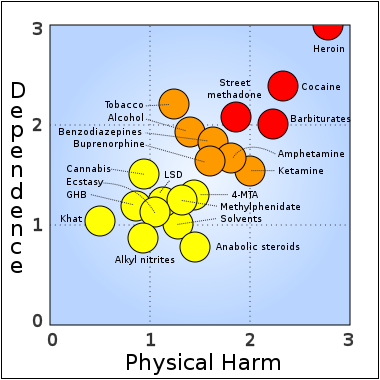
A rational scale to assess the harm of drugs.

A rational scale to assess the harm of drugs. Data source is the March 24, 2007 article: Nutt, David, Leslie A King, William Saulsbury, Colin Blakemore. "Development of a rational scale to assess the harm of drugs of potential misuse" The Lancet 2007; 369:1047-1053. (PMID 17382831; doi:10.1016/S0140-6736(07)60464-4) The data was first reported in appendix 14 of "Drug classification: making a hash of it?"