Showing posts with label biology. Show all posts

Friday, January 15, 2016

Why I Plan to Get the Seasonal Flu Vaccine Next Year

Introducing The Virus

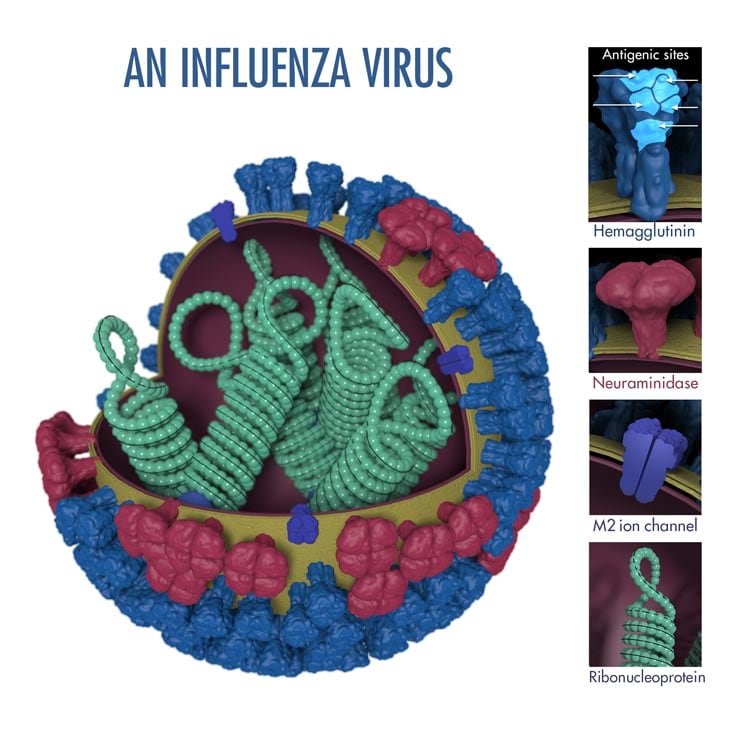
Image of flu virus with antigen proteins on phospholipid(?) surface and RNA in the middle. From. http://www.cdc.gov/flu/professionals/laboratory/antigenic.htm. Tamiflu works by binding the purple neurominadse proteins. Tamiflu was developed from shikimic acid, which was originally available only as an extract of Chinese star anise but by 2006 30% of the supply was manufactured recombinantly in E. coli.[54][55]

Vaccine viruses are chosen (i.e., February for the Northern Hemisphere flu vaccine) because it takes 6-8 months to grow them in chicken eggs. Health officials would like to grow them in human(?) cell culture, but that it not currently allowed. Eggs are problematic because viruses may adapt to the egg.

"As a result, Immunologically naïve ferrets) are the most sensitive method available for detecting antigenic differences between influenza viruses."(from http://www.cdc.gov/flu/professionals/laboratory/antigenic.htm)

Evolution and Types of Virus

H3N2 (swine) flu and H1N1 (avian) flu are main lineages. Major outbreaks occur suddenly and unpredictably through transmission of new varieties from animal hosts. Seasonal (common) flus are derived from the same lineage, but generally evolve slowly and predictably. Each year, novel viruses make the leap from animal to human. For example, during the 2013–14 influenza season, one case of human infection with an new strain of H3N2v virus occurred in a child from Iowa with known direct exposure to swine. Birds seem to have co-evolved with the flu virus and do not mount an immune response to it. Therefore (luckily!) it appears to evolve much more slowly in resevoir species than in humans. This has important implications for the dynamics of seasonal and epidemic flu outbreaks.
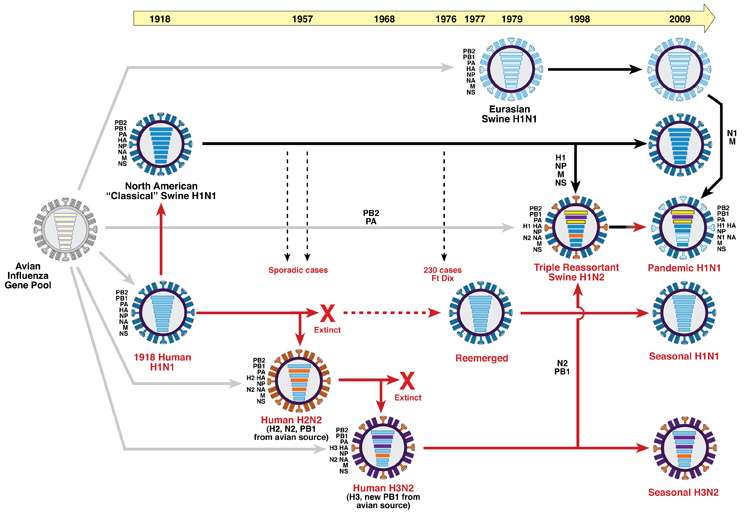

Influenza A is the most common. It is highly likely that of all the seasonal influenza strains circulating at the present, one of them will multiply and give rise to the entire seasonal influenza populations in around 5 years. The descendants of all other viruses will most likely be extinct.


For example, the 2014–15 influenza vaccines used in the United States have the same antigenic composition as those used in 2013–14. The trivalent vaccines should contain an A/California/7/2009-like (2009 H1N1) virus, an A/Texas/50/2012-like (H3N2) virus, and a B/Massachusetts/2/2012-like (B/Yamagata lineage) virus. (http://www.medscape.com/viewarticle/826572_6)

The lineage of evolutionarily successful viruses is usually termed the trunk of H3N2 influenza’s evolutionary treea:


The tree is based on hemagluttin protein sequence evolution, colored according to estimated geographic location, indicating high permanence of the trunk in China and Southeast Asia. The genetic changes occur on the neuroamidase and hemoagglutin virus surface proteins, causing antigenic drift. The truck of the H3N3 tree with a single dominant lineage contrasts with more branching trees of other flu types where different varieties often co-circulate, such as H1N1, and Influenza B and C. This graph and these findings are complicated by whole-genome sequencing: a new graph shows overall viral genome evolution in The evolution of epidemic influenza by Martha I. Nelson and Edward C. Holmes Nature Reviews.
Figure courtesy of Lemey P, Rambaut A, Bedford T, Faria N, Bielejec F, et al. http://theglobalscientist.com/2014/11/03/what-can-data-science-tell-us-about-influenza/


Current Trends - CDC FluNet

http://www.cdc.gov/flu/weekly/


Is flu increasing...
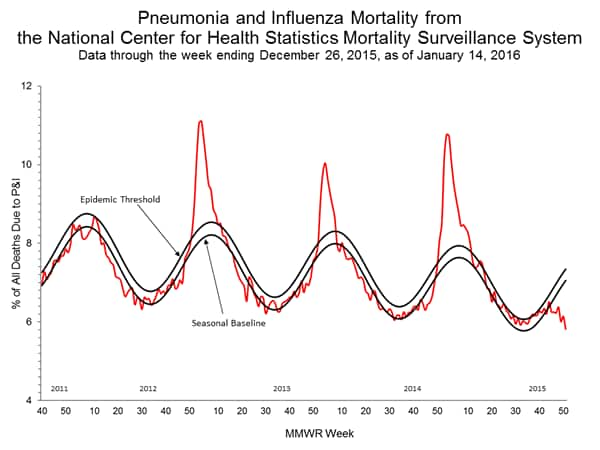
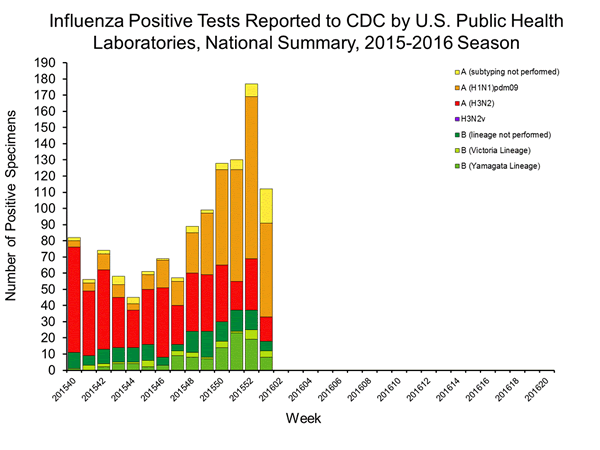
This chart is from the same page....http://www.cdc.gov/flu/weekly/. The periodicity of flu seasons and epidemics is still being studied. Peaks occur during the winter in northern latitudes at ~2–5 year intervals, usually during H3N2-dominant seasons, since the 1968 pandemic. Recent phylogenetic analysis of viruses from single populations has shown that the virus does not ‘over-summer’, but dies out at the end of each seasonal epidemic, and that subsequent seasonal viral re-emergence is ignited by imported genetic variation.

Or decreasing?

Weekly Map

http://www.cdc.gov/flu/weekly/usmap.htm

Wednesday, October 22, 2014

New Theories in Evolution and Ecology

Sometimes it can be hard to see progress in biology the way we hear about physics discovering new particles or proposing Grand Unified Theories that explain the entire universe.  It is tempting to believe biology is just too diverse, variable, and multitudinous to be tractable, and that we should content ourselves with Nature-special documentary anecdotes.

But recent research has uncovered at least three major advances toward predicting evolution, social altruism, and a universal explanation of biodiversity. We may soon be able to predict short-term (9-12 month) evolution of the flu virus, rigorously describe conditions necessary for social altruism, and extrapolate biodiversity estimates using insights from thermodynamics.

The complexity, idiosyncracy, and exceptions-to-the-rule in biology are still important, but so too are these simplifying general explanations.  The stories of new "universal laws" linked below are perhaps best thought of as null-theories; jumping-off places rather than destinations in themselves:


1) Predicting Evolution ... Testable Fitness Values (link to article by Carl Zimmer)

Simple selective pressures yield relatively simple predictions: fitness increases linearly at first, but in the long run, weird mutations may diverge populations along novel and unpredictable trajectories.  The tractable problem, then, is short-term evolution, which can still be incredibly important when it is applied to, say, the next 12 months of evolution in the flu virus.  The breakthrough came with the ability to quantify fitness to predict evolvability.

One of the biggest problems of evolutionary theory has been a lack of predictive power, because fitness could only be defined tautologically, post hoc based on survival and reproduction.  If biologists are able to assign fitness ranking with any skill (link) then we may finally be able to understand evolutionary ecology -- the rise and fall of species in their environment.  Will most threatened and endangered species prove to be genetic weaklings, as suggested by this correlational study?

2) Predicting Social Altruism ... What Makes A Good Theory

This is an insightful philosophy paper that deconstructs a long-standing debate about whether altruism is predicted by fundamental evolutionary pressures.  The important step forward here is a robust definition of key terms and a searching analysis of what we should expect from abstract mathematical theories.

3)  Predicting Biodiversity .... Metabolic Scaling Laws to the Rescue

The tractable problem is to estimate the number of species in a given area when ecologists can only count species in relatively small plots.  The breakthrough came by realizing that only two additional variables (population density and total number of species) are necessary to "collapse" idiosyncratic species-area curves into a single universal curve.

The discoverer, Dr. John Harte, explains:

"If you look at all the known species-area (S-A) curves in the world, of everyplace where somebody’s gathered species-area data, and you plot them all on one big piece of graph paper- log species vs. log area, you will find that the data points fill the graph almost completely. You get every possible behavior when you just do a plot of log S vs log A. There’s no regularity. I didn’t really think that had to be the case. What I learned from developing the theory of macroecology based on the maximum-information entropy principle, is that the theory makes a very startling testable prediction about the shape of the species-area relationship. It says that if you take any species-area curve and you plot the local slope of the log-log plot, what we call ‘z’, at any scale against a certain scaling variable that the theory identifies, namely, the number of individuals at that scale divided by the number of species at that scale, all species-area curves should collapse onto a single universal curve. And it turns out that they do"

(Quoted here.)

Sunday, March 17, 2013

Biogenic VOC emissions

Trees and natural vegetation release air pollutants (biogenic), just like people (anthropogenic).


Figure from a great website by Dr. Wilson from Duke University, with lots of information.

The overall amount of this pollution can be modelled:

Its important to put this into perspective: human (anthropogenic) emissions of VOCs can be 40 times greater than the highest modelled biogenic emissions.  But the compounds plants produce may be more effective in generating hazardous compound Ozone.  Atmospheric chemistry is complex, and it is ironic that the highest biogenic pollution emissions occur in the same areas that high anthropogenic pollution also occurs, compounding the problem.  

Thursday, December 02, 2010

Malaria vector population ranges


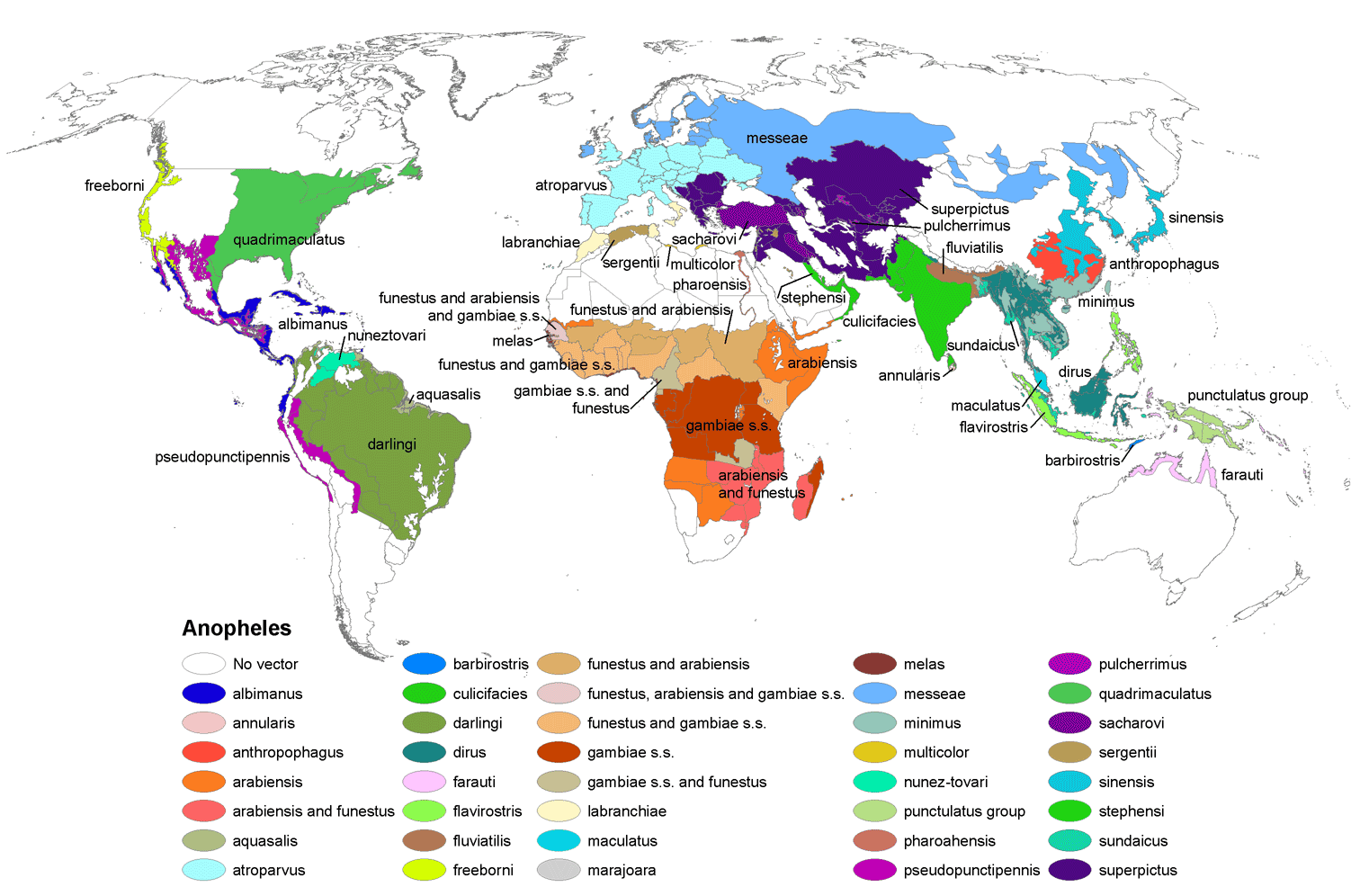
This map shows the current distribution of the species in the genus Anopheles, the vector for malaria. While malaria has been eradicated from many regions of the world, the vector has not, leaving the potential for malaria resurgence in the absence of vigilant public health campaigns. This map also shows why global warming will probably not expand the range of malaria: malaria is not constrained by the range of its mosquito vector. Pesticide campaigns to eradicate Anopheles mosquitoes are not the best way to control malaria. Instead, intervening in the transmission of malaria is the most effective approach.

The equation for the transmission of malaria is

R = (ma^2bp^n) / -r ln(p)

where R is the virulence of malaria, defined as the number of infections subsequent to an initial infection. If R is greater than 1, malarial incidence will increase; if R is less than 1 malaria will not be sustained in the human population.
m is the ratio of mosquitoes to people (# mosquitoes/ # humans)
a is the number of people bitten by a single mosquito per day
b is the proportion of infectious bites
r is the recovery rate (how long malarial parasites remain in the human)
n is the intrinsic incubation period for malaria in mosquitoes. Usually, malaria needs to incubate in mosquitoes for 10-14 days before that mosquito can transmit the infection
p is the daily probability of survival for a mosquito

Thursday, June 11, 2009

Can you name this Bug?

beetle on rush in alpine Colorado fen
From Flora and Fauna


beetle found on gravel bar, middle Verde River, AZ
From Verde River


caterpillar found in Sonoita Valley grass/mesquite woodland
From Sonoita Valley Grasslands


dragonfly found in Sonoita Valley grass/mesquite woodland
From Sonoita Valley Grasslands


mating "space cadet" grasshoppers, found in Sonoita Valley grass/mesquite woodland
From Sonoita Valley Grasslands


cool spider in saguaro east
From Saguaro National Park


butterfly and spider, Gila national forest, NM (ponderosa pine forest)
From Gila National Forest

Thursday, April 05, 2007

Molecular Biology is either ahead of its time...

...or full of BS.

I just quit my graduate "genetics" course because it was just shape-filling protein models with a prof waving his hands at a Plato's Cave Powerpoint screen. He's a genetics guy but genetics isn't pretty enough for Powerpoint so he spent the whole semester talking about molecular genetics, which either a) he doesn't understand or b) nobody understands. Probably both, and they definitely don't know that they don't understand it. I have better things to do with my time than listen to Just So Stories (and then Regurgitate them on the midterms). I want to go on record pointing this out, so that when the Revolution comes I'll have bragging rights.

Wednesday, April 04, 2007

Cognitive dissonance...in a fly?

[diagram from Kravitz lab "boxing flies" work]

A couple hours phenology
on top of the mountain
cumquat in a plastic bag
white butterfly
after half an hour
some bees two? three?
above the valley
two eagles circled and cried
spit out cumquat seed
phenology? or phenomenology
threw the banana peel and i could almost see it
the I almost disappears --> goal

then a pair of big flies, then a pair of small flies
17 chia seeds drying on a pair of trousers
the gel does its job; hardens stuck to the cloth
cotton cloth is also gel
tug-of-war between them (like heat, electricity)
the actual neural decision-making logic of a fly -- scratch scratch it goes
strobe light-like
to investigate the cumquat seed
then shies away behind the bush

nothing here is human-sized
I won't be Ostrich-sized.
A spent caccoon hangs from a dead branch on a live bush
inches above the rocks
ALL life uses DNA. ALL countries trade with dollars.

should i follow the white butterfly? write her down?
if cities are a good thing than free trade is a good thing.
as i leave in the mid afternoon
two butterflies fight or dance
above

Wednesday, January 17, 2007

Aspirin, tinnitus, and OAEs

Otoacoustic emissions (or OAEs) are sounds that your ear makes on its own and as a response to environmental sounds. It appears to be some sort of active resonance or tuning and is different from tinnitus, the ringing sometimes heard in quiet rooms. OAEs provide a non-invasive way of evaluating the health of the ear; OAEs disappear almost immediately upon onset of deafness or death (it was only recently that scientists realized that live ears respond differently from dead ones). Interestingly, aspirin also abolishes OAEs. This is a whole new field of research.

Wednesday, November 29, 2006

Orwellian Cognitive Science

The scariest thing about cognitive science is its discovery and quantization of human behavior -- raising the specter of controlling human behavior. Behaviorism is dormant, not dead, and at casual luncheons graduate students and their advisers wonder aloud if that wasn't the ghost of BF Skinner they saw over near the punch bowl. Advertisers already correlate our unconscious (evolutionarily-based?) color biases to make us think orange and blue detergent is cheap and powerful.

[insert more examples]

If you're not scared by biology, the science of understanding the secret underpinnings of life, you don't understand it. And if you're not scared of neuroscience, the science of understanding the secret foundations of the human mind, you don't understand it. Our only hope is that it may prove impossible to understand.