Showing posts with label conservation. Show all posts

Wednesday, May 15, 2024

The Biggest Problem in Conservation: Taxonomy

One of the interesting unspoken secrets of the conservation world is that taxonomists are in charge.  More specifically, what taxonomists consider interesting enough to name as a species or a subspecies determines what can be protected.  After all, it is the Endangered Species Act.  But what if the taxonomists can't agree on what a species is?

This excellent short article in the Atlantic provides examples form hawthorn trees, which, depending on who you talk to, are either in decline and in need of conservation, or so widely distributed and common that it would be like trying to preserve Kentucky Bluegrass.

"A few years ago, conservation groups were gearing up to assign the [balsam-mountain hawthorn] tree the rarest rank a species can receive, which would imply an urgent necessity to conserve it. But [a botanist] decided it was probably a hybrid of two other hawthorns. He still believed the tree should be protected, but instantly, the species went from critically rare to nonexistent, from a conservation point of view."

"A prominent evolutionary biologist, wrote in 1976,  that perhaps no true hawthorn species exist at all—that they make up a sort of genetic continuum that doesn’t allow for coherent species classification."

"[another] botanist... told me the biggest threat to the trees is not land-use changes but botanists themselves, who are unwilling to meet the taxonomic challenge. If no one takes on the task of categorizing hawthorns, then no conservation group can take any measures to save them."

"Now whatever solution [the botanists] come to will determine what we try to save."

Tuesday, July 11, 2023

Xeriscaping or Zero-scaping?

 Xeriscaping is a low-water user landscaping practice in the desert Southwest.  Typically gravel or rock is used as the major groundcover, with desert-adapted plants interspersed.  Herbicides are generally used to control unsightly weeds in the gravel areas. 

Zero-scaping is when landowners skip all of the landscaping and just use herbicides to maintain dirt lots.  Unsurprisingly, the result is often phenomenally ugly.  However, this technique is extremely popular.  Why?

Herbicide-maintained zero-scaping.  The property is listed on one of the popular home-rental websites, so it has to look "presentable"!


Property line contrast.  The owner on the right has elected to let their grass grow tall, creating habitat for wildflowers and pollinators.  They usually mow it once or twice a year.

Close-up of herbicide area.  Not what I would call "presentable".


Another property owner trying to make their yard look nice.  The lush growth on the right shows what they are fighting against.

Some zero-scaping is counter-productive.  Here coir logs were used to try to control erosion.  The slope may even have been seeded.  But the over-zealous (or under-caring) landscaping company tasked with controlling weeds on the property has been very thorough in killing everything.  The result is continuing erosion into the waterway.


Wednesday, January 01, 2020

Top 2019 conservation news

Multiple stories of widespread wild animal population declines:

From 10 billion down to 7 billion birds.
The population of birds in North American has fallen by a third in 50 years. Science.


Statistic of the decade: amount of rainforest lost in Amazon.


"Insect apocalypse" in the New York Times Magazine garnered widespread attention. 
In the United States, scientists recently found the population of monarch butterflies fell by 90 percent in the last 20 years, a loss of 900 million individuals; the rusty-patched bumblebee, which once lived in 28 states, dropped by 87 percent over the same period.

the overall abundance of flying insects in German nature reserves had decreased by 75 percent over just 27 years. If you looked at midsummer population peaks, the drop was 82 percent.

It is estimated that, since 1970, Earth’s various populations of wild land animals have lost, on average, 60 percent of their members.

What we’re losing is not just the diversity part of biodiversity, but the bio part: life in sheer quantity....Finding reassurance in the survival of a few symbolic standard-bearers ignores the value of abundance, of a natural world that thrives on richness and complexity and interaction.

Scientists have begun to speak of functional extinction (as opposed to the more familiar kind, numerical extinction). Functionally extinct animals and plants are still present but no longer prevalent enough to affect how an ecosystem works. Some phrase this as the extinction not of a species but of all its former interactions with its environment — an extinction of seed dispersal and predation and pollination and all the other ecological functions an animal once had...

Other News  (Link)
Last female Yangzte Giant Softshell Turtle died
Last Sumatran Rhino in Malaysia died
Jaguar and Koala populations hit by wildfires in Brazil and Australia

Sunday, January 01, 2017

Natural Resource Management Stories


Conservation - Collaboration Success Story: Nature Conservancy and Nutrient Stewardship Council in Western Lake Eire Watershed.  Accreditation of fertilizer merchants (term?) to educate farmers in the 4Rs:   Right amount, right time, right place, right ....  These are complicated decisions; fertilizer reps and farmers understand better all of the details of each decision, while scientists and Nature Conservancy have ideas about solutions.  By working together (also motivated by Ohio Law) they are innovating solutions, like using liquid fertilizer to furrow-apply salt-free fertilizer directly on seeds of side-dressing or foliar applications


Monarch voluntary conservation agreements.  Monarch butterfly has been in steep decline and the iconic insect is the subject of a successful citizen science campaign to document migration patterns and encourage milkweed host plant cultivation.  Now Monarch is being considered for listing as endangered species. Voluntary conservation agreements and memorandum of understanding between the USFWS and private companies and individuals are being encouraged as a way to avoid ESA listing.

The recent decision to de-list the lesser prairie chicken was based on the existence of a voluntary conservation agreement whose possible beneficial effects on the species were not considered by USFWS.
Now power companies and Midwestern farmers seem to think a voluntary conservation agreement is a good insurance policy against a possible listing decision.  If the monarch is listed, the government could require landowners across the country to be pollinator friendly.  Monarchs need us to manage for milkweeds.


Don't mess with Iowa.  Agricultural misperceptions of the 2015 proposed Clean Water Act rule led to lawsuits that forced the EPA and Army Corps to halt the implementation of the rule.  Coal states were able to obtain a supreme court ruling halting implementation of the 2015 CO2 rule for the "Clean Air Act".  And now Iowa (and other midwestern farmers) are against the EPA's proposed strengthened standards for atrazine, a popular herbicide.  Midwestern farmers argue that lowering the allowed concentration of the popular herbicide would impair their ability to grow food for the country.  Farmers also point out that the proposed standards might lead to more water pollution, not less, due to the reliance of no-till farmers on broad-spectrum "burn down" herbicides to clear the fields for planting.  Without these herbicides, farmers would be forced to go back to tilling their land in order to mechanically disrupt existing weeds.  

Thursday, February 11, 2016

The Problem with Ecosystem Services

There is a controversy in the conservation community about monetary valuations.  A recent podcast on Freakanomics looked at rational altruism using a Consequentialist cost/benefit analysis.

The example was between treating HIV and malaria.  A person infected with HIV might cost $100,000, while a person dying of malaria might only cost $1,000 to cure.  Since we can help 100 people with malaria for every one with HIV, shouldn't we focus first on malaria, and only turn to HIV once we've helped everyone we can with malaria?

The logic is sound, but try telling that to a doctor working on HIV (let alone a patient with HIV).  But how else could we decide?

The big idea seems to be to add up the (monetary) costs of charities and look at some simple metric (like lives saved) to pick and choose the best charities.(link to bjorn lomberg's thinktank)  But do we only care about a single metric, a single value?  And how compare education to disease, senile dementia to juvenile delinquency?

The same problems bedevil conservation...

I think the simple answer is that there are no simple answers, and every approach has a place.  If some government minister will only listen to economic arguments, use them... but others will listen to other values, and those also matter.  Whether people care about the scariest diseases (terminal diarhea) or the cuddliest endangered animals (link to cockapo), these interests are meaningful.
There is a long tradition in decision science and economics of critiquing irrational human preoccupation with infrequent, but salient/scary crises (link to risk diagram disasters axis) as opposed to rational actors (link to behavioral economics discussion, maybe wikipedia) dispassionately evaluating statistics.  I try to avoid news sources because of our (link) well-demonstrated cognitive biases, but I don't think we can (or should) "fix" every element of human thinking.

Yes, every decision is a choice to focus on one priority over another, and yes it is not rational to make that decision without comparing and ranking all choices.  But pure rationality doesn't take account of the full richness of human life.  We care about many values, not just The Most Important. Is it absurd to try to save endangered species when many people don't have adequate nutrition?  (link to weird conservation stories, nature conservancy).

Friday, January 01, 2016

Top Conservation of Stories of 2015

Looking back on the year, I feel that victories and gained ground made good News:  US Congress acting(!) to ban microbeads,  Supreme court upheld Clean Power Plan to reduce emissions of  mercury by 1,000 million tonnes and thereby save more than 1,200 lives/year.  CO2 reduction plans from the 2015 Paris COP 16.  Administrative action to create a new office of ecosystem service financing (read: more support for restoration) and to standardize and promote mitigation banking.

However, there were some problems.  The gargantuan natural gas leak in S. Ca. highlighted the fact that natural gas leaks way too much to be a clean bridge fuel.  We either need to clean up natural gas or resolve to skip over it altogether.


Wednesday, September 16, 2015

Roadsides Provide Critical Habitat for Pollinators


"Over the past 18 months, support for pollinators has undergone a seismic shift, led by President Obama, who called for a national Pollinator Task Force in the spring of 2014. Less than a year later, in a book-length "Strategy to Protect the Health of Honey Bees and Other Pollinators," the federal government set ambitious goals that include the restoration or enhancement of 7 million acres of land for pollinator habitat over the next five years. Roadsides will comprise a significant portion of that acreage..."
Read the rest of the article.

Monday, May 11, 2015

San Diego T & E Species

The U.S. Fish and Wildlife Service has a new website to identify species of conservation concern.  This system is easy enough that anyone can search for and learn about the Threatened and Endangered species in their county.

 For example, here is the list for San Diego County, California:


Monday, January 19, 2015

Top Conservation Stories of 2014

Here are a few of the most important conservation stories from 2014:

--Gila River Proposed Diversion approved by ISC

--Mexican Gray Wolf critical habitat expanded to include most of NM and AZ south of I-40

Zone 1 is where Mexican wolves may be initially released or translocated.  Zone 2 is where Mexican wolves will be allowed to naturally disperse into and occupy, and where Mexican wolves may be translocated.  Zone 3 is where neither initial releases nor translocations will occur, but Mexican wolves will be allowed to disperse into and occupy....where Mexican wolves will be more actively managed...to reduce conflict with the potentially affected public.  However, in AZ east of Highway 87 there will be a "phased approach" to managing wolf populations.

--U.S. Congress Omnibus spending bill approves the Resolution mine landswap in AZ, grazing lease terms expanded to 20 years, and Valles Caldera becomes newest National Park

--Drought in CA (7% snowpack) ... and NM.  (e.g. Heron Lake resevoir levels fall, fail to make San Juan-Chame deliveries to Rio Grande)

-- US EPA and NRCS try to regulate agriculture under CWA....and fail.  The problem of increasing toxic algae problem in Ohio lakes came to a head in 2014 when Cleveland had to turn off their city water intake from Lake Eerie due to a toxic algal bloom. The proposed rule would have allowed EPA to regulate "non-point source" water pollution from farms that did not have a NRCS-approved conservation practices in place.  But apparently the outcry was too much, and early in 2015 the rule was amended.  Note that the final rule, even though it no longer contained this provision, was still vehemently protested in 2015.

--  Gunnison Sage Grouse listed as "Threatened" under the ESA, Colorado appeals.

-- Colorado River Pulse....mostly just grows more tamarisk.

--  Pleistocene megafauna extinction due to meteor impact, new study finds.  

-- Wilderness turns 50 years old

-- New "stacked trait" GMO potatoes and soybeans approved in the U.S.

And a random tidbit:  rabbits eat more forage in utah than bison...leading ranchers to question the state's continued bounty for coyote skins.

Sunday, November 23, 2014

"Fewer than 5,000 remain"

The U.S. Fish and Wildlife Service recently listed the Gunnison Sage Grouse as "Threatened" under the Endangered Species, act, one step shy of being actually "Endangered".  The ESA specifically prohibits killing a species listed as Threatened or Endangered.


The outcry has been significant, to the point that the Colorado Governor (a Democrat) is preparing a lawsuit in opposition. (Durango Herald)

Only a few scattered subpopulations currently remain out of the historic vast swath of occupied habitat.  Source: WildEarth Guardians Species Fact Sheet


The largest population, in the Gunnisun Basin, appears to be stable and not at risk, but many of the subpopulations continue to shrink.  Source:  USFWS Fact Sheet.


A chart of the small subpopulations showing overall decline since the late 1990's.  Since 2011 there appears to be a promising increase.

However, because the Gunnison population has increased since the 1990's and makes up the largest share of the total population, the total population has increased since 1996.

Monday, February 03, 2014

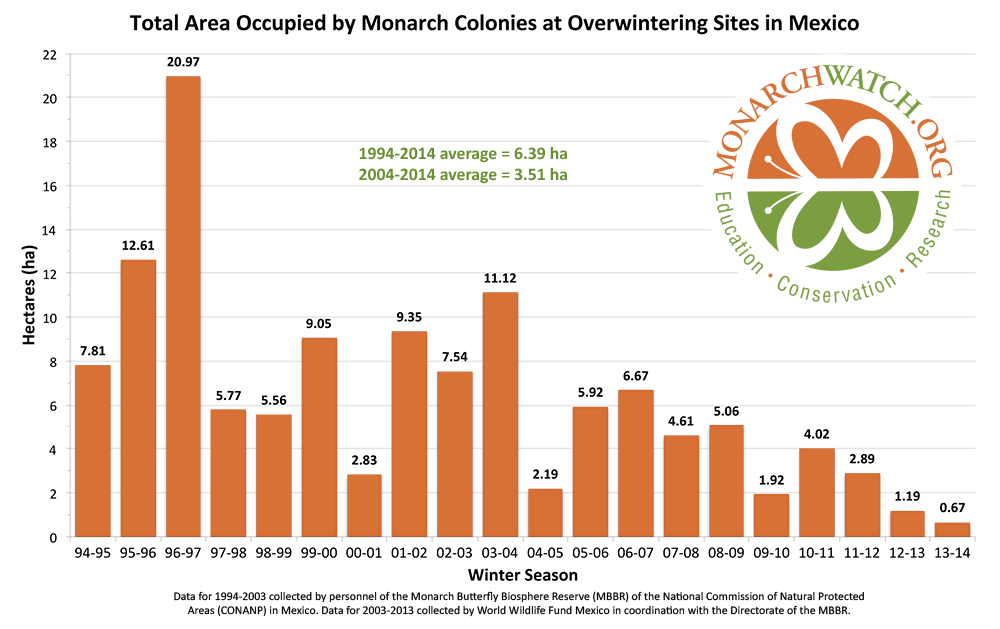
Monarch Decline Blamed on Changing US Agriculture


Graph of returning migration Monarch Butterflies from MonarchWatch.org


CBS quoted entymologist Lincoln Brower: "The main culprit," he wrote in an email, is now genetically modified "herbicide-resistant corn and soybean crops and herbicides in the USA," which "leads to the wholesale killing of the monarch's principal food plant, common milkweed."

The website MonarchWatch.org has the best in-depth analysis of the triple threat of habitat loss.  What to do?  Plant milkweed!

Wednesday, January 15, 2014

And then there was 1....

AZ Star Article: Jaguar Tracks found at Site of Proposed Rosemont Mine
Possibly the only jaguar in the US.
The newspaper came out in favor of the mine several days later.  Many people think that Endangered Species on Federal lands are protected.  But the USFWS has decided that the mine would not significantly affect the overall population of jaguars throughout the Americas.  Even though it would make a lake out of the mountain whereupon resides the only (last) known jaguar in the US.   Many development or land management projects impact Threatened and Endangered species, with management plans written to address incidental take and to make a decision of No Significant Impact.  For example, the caves of several thousand Mexican Long-Nosed Bats (also Endangered) would be destroyed, but because this particular population of bats represents less than 10% of the remaining bats in AZ, the mine will be allowed to go ahead.

Wednesday, November 20, 2013

Rosemont Mine and the Scientific Method

In today's Arizona Star Opinion Section, Dr. Ostercamp discusses recent hydrologic research about whether the proposed Rosemont Mine would affect surrounding groundwater levels, and how much.

The upshot?  "More research is needed."  A classic scientific result that, in this case, sides with environmentalists' opposition to the proposed copper mine.  I was interested that this result shows how science often works differently from how most people think. Instead of generating facts to aid society's decisions, normal science (and scientists) thrive on ambiguity, controversy, and the unknowability of the world.

I believe that science, as a human institution, should work this way.  I am deeply suspicious of any scientific field with easy answers and a "97% consensus".  Scientific culture harnesses the creativity, jealousy, and competition inherent in human nature when it is most controversial, when there are a plurality of opinions and accusations.  When I hear that, for example, climate change researchers are united behind the IPCC report, I worry that the incentive structure of that field of science has become corrupted; instead of working to prove each other wrong in order to gain fame and fortune, they have all jumped on the same bandwagon to champion their cause.

In the same way that monopolies are bad for capitalism, unified "consensus statements" are bad for science.  This is not to say that I disagree with the IPCC's conclusions.  In the same way that a monopoly might act in society's interest, the IPCC may well be acting in our best interests.  But without dissent and opposing voices there is no guarantee.  Of course, one might argue that monopolies can be efficient; scientific consensus is necessary to accept what we know and move on.  I agree that arguments and democracy are very inefficient and often only result in stalemate, acrimony, and confusion.  Perhaps the "best" way of running an economy or the scientific method is ultimately a political decision?  

Politically, science (as I have described it in the first and second paragraphs) often argues for the status quo, because any change is inherently unknowable and the amount or "further research" needed is infinite; we can never comprehend everything.  So, in its current manifestation, science plays into the hands of industry when industrial processes are already ongoing: this is why Monsanto's fight for GMOs to be labelled "generally recognized as safe" and widely disseminated is so important.  Science would have argued for limitless further testing if GMOs were acknowledged to be a legitimately novel subject of study.  Conversely, science plays into the hands of environmentalists whenever new industrial projects are proposed.  In the case of the proposed Rosemont Mine, scientists would need to comprehensively understand the geology, hydrology, ecology, and meteorology of the entire Santa Rita mountains, if not the county and beyond, before being able to pass judgement on the effects of the mine.

But what about situations where environmentalists and industry would like to work together to advance some project for the good of society?  For example, thinning projects on national forests are badly needed prevent continuing damage to watersheds and ecosystems, as well as human life and property.  But what can science say about the best way to thin forests?  "Further research is needed..."

Tuesday, November 19, 2013

As reported in the Arizona Daily Star, desert Bighorn sheep were reintroduced to the Catalina Mountains yesterday after a nearly 15 year absence. The Catalina Bighorn Advisory Committee has been working on the project for a number of years and has conducted public outreach to explain and defend the program. This is one of dozens of projects conducted across the state and the southwest.  Habitat structures are built by the Arizona Desert Bighorn Sheep Society Volunteers:
   While some have questioned whether the project will be a success, there are many who think it is worth a try.

Wednesday, October 02, 2013

What does a natural forest fire look like in the Southwest?

What is "natural"?  Ecologists use the range of natural variability to define proper functioning condition (PFC) or minimally disturbed condition (MDC), etc (in the jargon of ecologists -- basically, what was it like before we mucked it up?)  The question is surprisingly hard to answer.

Tom Swetnam has been quoted drawing a distinction between burn severity (high-intensity burns are natural) and extent (but high-severity burns across large landscapes are not natural).  These statements are part of an ongoing debate that, like many debates in ecology, may be dependent on local factors.  

In Arizona, Dr. Wally Covington became famous for championing open park-like Ponderosa forests.  Indeed, many landscapes are dominated by frequent low-intensity grass fires that clear out underbrush and young trees.  But at longer time scales it seems equally clear that these same forests can catastrophically burn.  This has been pointed out by Dr. Baker's work in Arizona, and by Dr. Grant Meyer in Sacramento Mountains of New Mexico.  More evidence is not hard to find.  For example, a study of the geomorphology of the Rio Cebolla river in the Jemez Mountains noted extensive sediments with large burned logs indicative of high severity fire in what must have been extensive headwater areas. 

Dendrochronologists  often focus on the last 1,000 years, whereas geomorphologists have a much larger picture, often spanning not just this interglacial, but also the last several ice ages.  (CF Great Basin Riparian Ecosystems by Miller and Chambers et al)

Fires are transformative, but both more and less impactful than commonly thought.  They accelerate and are accelerated by climate change.  Most large fires are not as bad as news reports indicate -- they are bananzas for wildlife and fire-dependent trees and shrubs like aspen and oak.

Most "megafires" aren't really managed with a full suppression strategy, but a containment strategy -- still not 'let-burn' but pretty close.  Unfortunately, suppression and containment efforts can be as damaging as fire.  

Whether or not fires are natural, the inevitable question is raised as to whether humans can restore the environment better or faster than natural succession would?  This is a loaded question, because of the salvage logging controversy.  One logger expressed confusion about why thinning before a fire is justified, but salvage logging after isn't.  But either may be ineffective in preventing the next conflagration.  If ERC is high enough and there is enough ventilation, anything will burn, even the Olympic Peninsula rainforest! (Cf Dr. Gavin's ESA talk)

Friday, February 01, 2013

Do endemic taxa correlate?

One of the main assumptions of many biodiversity assessments and conservation efforts is that biodiversity correlates across taxa. In other words, an ecosystem with high plant diversity might be expected to also harbor high lichen diversity, high arthropod diversity, and a great many birds, bees, and bloomin' confusion. 

If this assumption is true, than scientists could study one taxa, say lichen, and use the results as a surrogate for studying all of the other possible taxa. But a new study by Dr. Che-Castaldo questions this "surrogacy" assumption:

"Testing Surrogacy Assumptions: Can Threatened and Endangered Plants Be 
Grouped by Biological Similarity and Abundances?"

Abstract:

"There is renewed interest in implementing surrogate species approaches in 
conservation planning due to the large number of species in need of 
management but limited resources and data. One type of surrogate approach 
involves selection of one or a few species to represent a larger group of 
species requiring similar management actions, so that protection and 
persistence of the selected species would result in conservation of the 
group of species. However, among the criticisms of surrogate approaches is 
the need to test underlying assumptions, which remain rarely examined. In 
this study, we tested one of the fundamental assumptions underlying use of 
surrogate species in recovery planning: that there exist groups of 
threatened and endangered species that are sufficiently similar to warrant 
similar management or recovery criteria. Using a comprehensive database of 
all plant species listed under the U.S. Endangered Species Act and 
tree-based random forest analysis, we found no evidence of species groups 
based on a set of distributional and biological traits or by abundances 
and patterns of decline. Our results suggested that application of 
surrogate approaches for endangered species recovery would be unjustified. 
Thus, conservation planning focused on individual species and their 
patterns of decline will likely be required to recover listed species."


Similar conclusions have been reached by a other studies.  For example, Erhlich et. al. 2002 found that in subalpine meadows in Colorado, indicator taxa show no skill in predicting diversity of other taxa, even among phylogenetically related species (in this case, butterflies and moths).

Monday, April 30, 2012

The Future of Forests...is People

 David Wear, USFS, predicts large declines in forest area in the US as more and more land is developed for housing.  Over the next 50 years the US population is forecast to double again to 500 million, mostly along the coasts. 
 

Most of the RPA interval projections by the USFS are driven by economic analyses.  Increased wealth greatly increases the impact of any increase in human population, because wealthier people build bigger houses, shop more, and need more roads.  More people will need more food, leading to higher food prices that threaten to undo the conservation reserve program, putting reforested land back into food production.  But higher prices for timber or biomass would actually increase forested area!  With a higher value on trees, timbered lands might be worth too much to develop....

I conclude that the US needs a healthy forest products (including, somehow, forest biomass) industry to push back against the teeming urban hordes.