Showing posts with label biochemistry. Show all posts

Wednesday, November 27, 2024

Acid-Base Balance: Foods and Supplements

I previously wrote about the role lactic acid can play in disease.  This raised the question of whether foods and supplements can buffer metabolic acidity.  If so, which foods or supplements are most beneficial?  Does pH correlate to the effect on the acid-base balance of the body?

This is important because:

After researching this, I concluded that a food's pH does not directly correlate with its impact on overall acid base balance.  Potential Renal Acid Load (PRAL) is determined by mineral and protein composition, not its inherent acidity.  

For example:

  • Lemons taste acidic due to citric acid, but have a negative PRAL (alkaline-forming) because they're rich in potassium and other compounds that generate bicarbonate when metabolized
  • Animal proteins may not taste acidic but have a high positive PRAL (acid-forming) due to sulfur-containing amino acids that get metabolized to sulfuric acid.

The key biochemical factors that determine a food's PRAL include:

  1. Protein content (especially sulfur amino acids) - metabolized to produce acids
  2. Mineral content: 
    1. Potassium, calcium, magnesium - metabolized to produce bicarbonate (alkaline)
    2. Phosphorus, chloride - contribute to acid load
  3. Organic acid content - intermediates in the citric acid cycle (Krebs cycle), their oxidation generates bicarbonate. Each molecule of malate or citrate metabolized can generate multiple bicarbonate molecules.

Details

The pH of urine is influenced by the body's metabolic acid load and the kidney's ability to regulate hydrogen ion (H⁺) excretion.  The kidneys play a crucial role in maintaining acid-base balance by adjusting the amount of hydrogen ions eliminated or retained.  When the body experiences a metabolic acid load, the kidneys respond by increasing H⁺ excretion. This lowers urine pH, reflecting the increased acid load on the body.  However, positive cations can also stimulate renal acid-base regulation, leading to increased hydrogen ion excretion (and bicarbonate (HCO₃⁻) regeneration).  This results in a decrease in urine pH, even as the body experiences a reduced metabolic acid load.

Cations can also activate enzymes that convert metabolic acids to bicarbonate.  The more positively charged the cation, the more efficiently it can displace hydrogen ions.

Organic acid conjugation to cations enhances alkalinization.  For example, citrate enters the citric acid cycle directly and generates multiple bicarbonate (HCO₃⁻) upon oxidation.


Table of Common Supplements and Food Additives; their pH and effect on acid-base balance.  

This data shows how solution pH and PRAL effects don't always correlate. For example, while KCl has a neutral pH in solution, it has a slightly negative PRAL due to the potassium content. However, extreme pH (either acid or base) can correlate with PRAL effect.


Categories of Supplements

  1. Neutral pH, Alkalizing Effect: 
    1. Potassium citrate
    2. Calcium lactate
    3. Potassium gluconate
    4. These demonstrate the pH vs. physiological effect paradox
  2. Mineral-Organic Complexes: 
    1. Magnesium citrate and malate show slightly acidic pH but strong alkalizing effects
    2. Zinc citrate has less alkalizing effect despite similar pH
  3. Simple Salts: 
    1. KCl shows neutral pH with mild alkalizing effect
    2. NaCl shows neutral pH and neutral physiological effect
  4. Strong Acids/Bases: 
    1. HCl, KOH, NaOH show correlation between pH and physiological effect
    2. These are exceptions to the general trend of pH not predicting physiological impact

Alkalinizing Potential Ranking

The formula for PRAL (mEq/100g) is: PRAL = 0.49 × protein (g) + 0.037 × phosphorus (mg) - 0.021 × potassium (mg) - 0.026 × magnesium (mg) - 0.013 × calcium (mg).  

Negative PRAL indicates an alkalizing effect on the body.


Example:  mice

Mice diets were compared using Dietary Cation Anion Balance (DCAB), a similar metric to PRAL.  DCAB is calculated by adding the weighted amount of acidifying anions and alkalizing cations in the diet. 

It has been shown in many species that the dietary cation anion balance (DCAB) influences acid base homeostasis and urine pH.  With the DCAB, the resulting urinary pH can be predicted with species-specific equations. 

DCAB [mmol/kg DM] = 49.9 · Ca + 82.3 · Mg + 43.5 · Na + 25.6 · K − 59.0 · P − 62.4 · S − 28.2 · Cl; mineral content in g/kg DM.  (Negative DCAB indicates an acidifying effect on the body.)

The paper found that a negative DCAB results in metabolic acidosis, and "Fed long-term, this can contribute to the reduction of bone mineral density due to a PTH-mediated increase in renal calcium excretion. Metabolic acidosis also induces renal phosphorus excretion, resulting in hypophosphatemia."

Citation: https://www.mdpi.com/2076-2615/11/3/702 

Böswald, L.F.; Matzek, D.; Kienzle, E.; Popper, B. Influence of Strain and Diet on Urinary pH in Laboratory Mice. Animals 2021, 11, 702. https://doi.org/10.3390/ani11030702


Example:  human athletes

Alkaline water has demonstrated its effectiveness as an alkalizing agent in the treatment of metabolic acidosis in both animal and human research. Past studies have shown that daily intake of 2.5–4 L of alkaline water for 3~6 weeks has significant impacts on anaerobic performance and acid–base balance in athletes.  This study showed that alkaline water co-ingested with glutamine led to decreased stress markers in athletes.  Masterjohn hypothesizes that glutamine is converted to glutamate to buffer lactic acid in muscles, and that decreasing PRAL contributes to more available glutamine for other metabolic functions..  

Citation: https://www.mdpi.com/2072-6643/16/3/454

Lu, T.-L.; He, C.-S.; Suzuki, K.; Lu, C.-C.; Wang, C.-Y.; Fang, S.-H. Concurrent Ingestion of Alkaline Water and L-Glutamine Enhanced Salivary α-Amylase Activity and Testosterone Concentration in Boxing Athletes. Nutrients 2024, 16, 454. https://doi.org/10.3390/nu16030454


Thanks to Claude Sonnet for back-and-forth conversation, and for creating the table and figure above.  

Wednesday, March 23, 2016

Complex Science: The Role of Vitamin D Receptor (VDR) Genotype Polymorphisms (SNPs)

Vitamin D regulates the expression of hundreds of genes, with widespread hormonal and immune effects.  But whether vitamin D is good for you may depend on your genes.  According to one hypothesis, supplemental vitamin D causes allergies and asthma.  [1]

But the biochemistry is complex.  The main circulating metabolite is 25-hydroxyvitamin D or 25(OH)D, a biomarker of vitamin D status.  The active vitamin D metabolite 1,25(OH)2D3 binds to nuclear vitamin D receptor (VDR), which exists from under 500 to over 25,000 copies per cell in many human tissues including thymus, bone marrow, B and T cells and lung alveolar cells.  Gene expression can be varied over a 100-fold range by subtle modifications of introns and promoter regions outside of the gene[1]

The SNPs that seem to affect VDR are not in the exon; they may affect RNA production in the promoter region. It is unlikely that increased or decreased vitamin D sensitivity is simply mediated by a genetic variation in the VDR. Vitamin D requires several enzymatic steps to be activated, transported and degraded; receptor signalling requires several co-factors and all of these may contribute additive or multiplicative effects on vitamin D sensitivity.

Possibly because of this complexity, progress in this field has been slow.  I reviewed several papers, most of which found very small or no effects from common SNPs.  For example, although most papers found insufficient or deficient levels of vitamin D throughout the population, a case-control study only found a small effect on circulating 25(OH)D from one of the SNPs tested. [2].  A randomized controlled trial found effects from more SNPs, but each contributed very small effect sizes. All SNPs tested had, at most, +/-5% effect on circulating 25(OH)D. : "Three SNPs had statistically significant interactions: rs10766197 near CYP2R1, rs6013897 near CYP24A1, and rs7968585 near VDR, with per allele effect sizes ranging from −4% to +3% differences in [25(OH)]."[3]

These complex and unimpressive results are representative of the difficulties inherent in assaying SNPs for clinically-relevant phenotypes.  Most SNPs slightly modify expression or binding of a protein, such that it takes the combination of dozens or hundreds of different SNPs to create any significant phenotype.  Biochemistry is complex, and it is always possible that other gene or protein interactions can ameliorate or exacerbate any small perturbation from any given SNP.

Citations:
[1] Variants in the vitamin D receptor gene and asthma.  2005.  

[2] Vitamin D levels and vitamin D receptor gene polymorphisms in asthmatic children: a case–control study.


Wednesday, February 04, 2015

H2S: A Toxic Gas, and an Important Metabolic Neurotransmitter!

Hydrogen sulfide, in addition to being a poisonous gas associated with oil and gas wells, plays a huge number of critical metabolic and neurotransmitting roles in the human body.

Source.  Hydrogen sulfide-based therapeutics and gastrointestinal diseases: translating physiology to treatments
Melissa V. Chan , John L. WallaceAmerican Journal of Physiology - Gastrointestinal and Liver PhysiologyPublished 1 October 2013Vol. 305no. 7, G467-G473DOI: 10.1152/ajpgi.00169.2013

Source.

Source.  Physiological Implications of Hydrogen Sulfide: A Whiff Exploration That BlossomedRui WangPhysiological ReviewsPublished 1 April 2012Vol. 92no. 2, 791-896DOI: 10.1152/physrev.00017.2011


Different signaling pathways in cardiovascular system modulated by H2S. AC, adenylyl cyclase; sGC, soluble guanylyl cyclase; PDEs, phosphodiesterases. The inhibitory effect is denoted with (−), and the stimulatory effect is denoted with (+).  Source: 


To research about a specific enzyme, the Human Metabolome Database HMDB works well.  To view maps of enzyme reactions, I recommend this interface:

Thursday, January 29, 2015

Can Patients Understand their Own Genome?

I just ran my 23andme SNP data (Single Nucleotide Polymorphism: basically, the distinct mutations that make my DNA unique) through geneticgenie.com, a website that puts the number and type of mutation in a handy table.  The website also provides nutritional recommendations based on the presumbed metabolic impact of my particular mutations.

However, after feverishly researching biochemistry I have some concerns with Dr. Yasko's conclusions cited on that site and others. These websites appear to make a number of biochemistry mistakes, and I'm not seeing a lot of citations to original research, just a lot of unpublished "physician observations".


A selection of results from G enetic Genie. There are two copies of most genes in our genomes (one from our father, one from our mother) and one or both may be mutated. The color-coded results show that I have two mutated copies of several important genes (colored red) involved in neurotransmitter metabolism and other core biochemical processes. I also have two genes with one bad copy (yellow),


Some of the statements about, for example, BH4, appear to be incorrect. Genetic Genie states that impaired BH4 production or increased BH4 utilization can impact ammonia detoxification in the urea cycle, but BH4 is not directly involved as a cofactor in ammonia to urea conversion. Instead, BH4 is involved in one of at least two pathways for generating citrulline. (Citrulline is regenerated in the urea cycle to turn ammonia into urea.)


Not to say they're not doing good work, but you have to interpret biochemistry in context. For example, I am homozygous for a mutation in CBS, which they say would upregulate CBS activity and lead to increased cystathione, cysteine, and eventually to increased taurine and sulfite. But I also have a heterozygous mutation in CTH, which would limit the amount of cystathione converted into cysteine, effectively stopping that cascade at the starting line.

I hope we're just a short ways off from a website or interface that can actually map all of our unique (SNP-dependent) metabolic pathways, but I think we're still in the dark ages when it comes to interpretting SNP genome results. Promethease is the online tool that has replaced 23andme's health-specific genetic information, but the website only summarizes Pubmed results:


The Promethease website is great, but is based on observational studies with tiny effect sizes. Trying to infer causation from those correlational studies is a textbook example of how not to interpret statistics.

Faced with the complexity of ~20,000 SNPs and less-than-user-friendly professional tools like ENSEMBL, I don't think it is possible for individuals to understand how SNPs influence protein function to the extent necessary to make informed decisions about our biochemsitry.

Sunday, January 25, 2015

Core biochemical methylation pathways.

Two common mutations can cause decreased levels of BH4. The first mutation increases the activity of CBS, which converts Homocysteine to Cystathione and eventually to cysteine and then taurine.  The second mutation is directly involved in the regeneration of BH4 in the methylation pathway.

But before I get ahead of myself, why is BH4 so important?

Tetrahydrobiopterin (BH4) has five major responsibilities as a cofactor.  It is needed to work with:

Tryptophan hydroxylase (TPH) for the conversion of L-tryptophan (TRP) to 5-hydroxytryptophan (5-HTP)
Phenylalanine hydroxylase (PAH) for conversion of L-phenylalanine (PHE) to L-tyrosine (TYR)
Tyrosine hydroxylase (TH) for the conversion of L-tyrosine to L-DOPA (DOPA)
Nitric oxide synthase (NOS) for conversion of a guanidino nitrogen of L-arginine (L-Arg) to nitric oxide (NO) in the Urea Cycle
and
Alkylglycerol monooxygenase (AGMO) for the conversion of 1-alkyl-sn-glycerol to 1-hydroxyalkyl-sn-glycerol

The first three reactions are critical to producing adequate levels of serotonin and dopamine. Low levels of BH4 can impair neurotransmitter production and lead to the build up of toxic intermediates, like phenylalanine.


This chart shows that without BH4 phenylalanine (found in all foods) is not converted to tyrosine. Tyrosine one of the 22 amino acids used to build protein and is normally non-essential. It is found in most foods.


BH4 is synthesized in four ways:


BH4 is involved in the major biochemical cycles:


Methionine is a major source of sulfur groups in the diet, so limiting methionine-rich foods helps limit problems from an overactive transulfuration pathway (i.e. overactive CBS enzyme). Other sulfur rich foods include crucifer vegetables and onions and garlic.

BH4 is tangentially involved in both the urea cycle and the folate cycle.

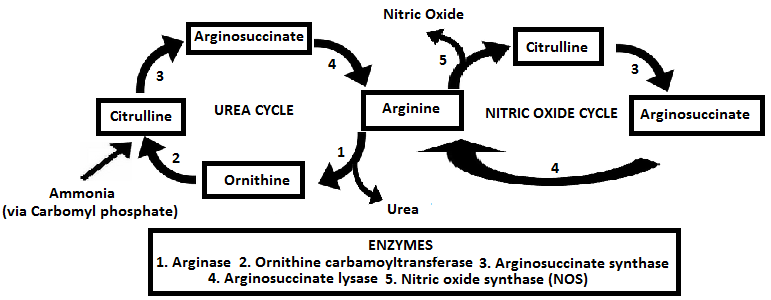
The urea cycle in detail: Arginine from our diet or from protein metabolism is converted to ornithine and urea by the enzyme Arginase. Ornithine is then converted to citrulline by ornithine transcabamoylase (OTC). Citrulline is converted back to arginine. This cycling of Arginine through the various intermediates is what converts ammonia to urea. (More info)


Source.

Arginine is also required for the production of Nitric Oxide (NO) by the enzyme nitric oxide synthase (NOS or eNOS). This reaction is dependent on the levels of BH4 available from the BH4 cycle. Remember two molecules of BH4 are needed to generate Citrulline and NO. One molecule of BH4 will in turn generate peroxynitrite and if there is no BH4, super oxide is formed. (Source. )

The Urea Cycle and the Nitric Oxide Cycle are interconnected by arginine as follows: Citrulline, made from ammonia (and ornithine), is recycled to arginine in the Urea Cycle. That arginine can then enter the Nitric Oxide Cycle where it is converted to nitric oxide by nitric oxide synthase using tetrahydrobiopterin (BH4). (Note that citrulline is also generated during the formation of nitric oxide from arginine.)

From this we can conclude that a deficiency in BH4 does not impact ammonia detoxification in the urea cycle.

Sunday, March 17, 2013

Biogenic VOC emissions

Trees and natural vegetation release air pollutants (biogenic), just like people (anthropogenic).


Figure from a great website by Dr. Wilson from Duke University, with lots of information.

The overall amount of this pollution can be modelled:

Its important to put this into perspective: human (anthropogenic) emissions of VOCs can be 40 times greater than the highest modelled biogenic emissions.  But the compounds plants produce may be more effective in generating hazardous compound Ozone.  Atmospheric chemistry is complex, and it is ironic that the highest biogenic pollution emissions occur in the same areas that high anthropogenic pollution also occurs, compounding the problem.  

Thursday, June 10, 2010

More work needed: Omege-3 fatty acids and antioxidants


In the past, I have argued that antioxidants aren't necessarily good for you, since some level of oxidation is required to support metabolism. As with many areas of public health research, there are contradictions. An example is the role of poly unsaturated fatty acids (PUFAs) in health. Many studies of human and animal populations have shown a health enhancing effect, but biochemists worry about the potential for these highly reactive molecules to oxidize and form free radicals. Perhaps they can be good in some cases, and bad in others?

Seeing the Forest for the Trees
The problem of scaling up from biochemical and molecular biology to whole organism physiology is seems to be a classic example of research at different levels yielding different results. For example, studies of the amount of food waste Americans throw away come to very different conclusions about food waste compared to studies that sum total food produced and imported and subtract food consumed in this country. Another example are national estimates of CO2 production by industry versus measurements of actual CO2 increases in the atmosphere. A third example is the classic mismatch between single-leaf gas exchange measurements and whole forest flux readings. The effort to reconcile differing conclusions from different levels of inquiry seems especially productive.

Evidence of scale-dependent mismatch in Omega-3 fatty acid research
One issue, of course, are the many different kinds of omega-3 fatty acids. One kind in particular, DHA (EPA, also) seems especially important for health benefits. But even this specific molecule is controversial:

"Docosahexaenoic acid (DHA) has a significant role in neural membrane phospholipid metabolism, immune responses and the aging process. The difference in antioxidant testing results between animal and human studies and between in vitro and in vivo effects is discussed in terms of different end-points of oxidation. This chapter concludes with seven important unsettled nutritional questions that need future research. With so many unanswered questions, the conclusion is drawn that it would be imprudent to make dietary recommendations to the public before the mechanisms of polyunsaturated lipid nutrition, in vivo activity of antioxidants, and in vivo lipid peroxidation are better understood." LIPID OXIDATION — SECOND EDITION. Edwin N. Frankel. 2005.

"Free radicals and reactive oxygen species produced in cells may attack PUFAs resulting in the formation of more free radicals, specifically hydroperoxides. The hydroperoxides, in turn, may damage DNA ultimately leading to cancer. These effects have indeed been observed in some in vitro experiments, but not in actual human beings. Many studies have shown that fish oils actually retard aging and suppress so- called free radical diseases such as atherosclerosis and cancer. Other studies have shown that a daily EPA + DHA intake in excess of 2.3 grams decreases the production of superoxide, a potent cancer promoter. At least one in vitro and one animal experiment have observed that EPA + DHA kill human breast cancer cells via the formation of hydroperoxides, but that this effect is strongly inhibited by vitamin E. Thus, at this point, it is not entirely clear whether EPA + DHA exert part of their beneficial effect through an increase or a decrease in the production of free radicals and reactive oxygen species. The researchers recommend more work in this area, but emphasize that the major benefits of fish oils probably are associated with their ability to inhibit the synthesis of arachidonic acid-derived, pro-inflammatory eicosanoids."
Larsson, SC, et al. Dietary long-chain n-3 fatty acids for the prevention of cancer: a review of potential mechanisms. American Journal of Clinical Nutrition, Vol. 79, June 2004, pp. 935-45


It seems that omega-3s may actually increase oxidative stress, but possibly only in the right areas: "In mammary tumours, it is observed that long-chain fatty acids not only increase apoptosis, but also increase lipid peroxidation, and the apoptotic effect can be reversed by antioxidants. The rationale for use of n-3 FA dietary supplements in counteracting BC progression needs to be tested... while at the same time, the effect on whole-body lipid peroxidation needs to be monitored. "
British Journal of Nutrition (2002), 87:193-198 Cambridge University Press Review article n-3 Fatty acids and lipid peroxidation in breast cancer inhibition Basil A. Stoll

There is some evidence that antioxidants can protect against unwanted damage from reactive PUFAs, but also some evidence that PUFAs are inherently dangerous: "DHA enhances the susceptibility of the liver and kidney to lipid peroxidation concomitant with higher levels of DHA in these tissues, as shown by the fatty acid composition. In addition, Vitamin E is unable to protect membranes of the liver and kidney rich in DHA from lipid peroxidation, even after ingestion of the highest level of Vitamin E. "
British Journal of Nutrition (1997), 78:655-669 Cambridge University Press
General Nutrition. Changes in susceptibility of tissues to lipid peroxidation after ingestion of various levels of docosahexaenoic acid and vitamin E. Kazuhiro Kubo, Morio Saito, Tadahiro Tadokoro and Akio Maekawa

In conclusion, "The arachidonic acid cascade is arguably the most elaborate signaling system neurobiologists have to deal with." Piomelli, Daniele (2000). "Arachidonic Acid". Neuropsychopharmacology: The Fifth Generation of Progress.