Showing posts with label thoughts. Show all posts

Sunday, January 05, 2020

Climate Change Belief Tree


An article in Nautilus magazine analogizes beliefs about climate change to branches on a tree.  I like that the tree diagram emphasizes the unity of thinking about climate change, even if we may be on different branches.  Also, I think it is OK for one person's beliefs to span different branches: belief about the future does not need to be certain but can be probabilistic and can change from one day to the next. 
Diagram and original article by Summer Praetorius.


The article concludes: "What if instead of feeling threatened by differences in opinion, we were to reconceptualize them in much the same way a tree will distribute a canopy to collect as much sunlight as possible—as a multi-pronged approach to getting the job done? In the same sense that both fast and slow processes contribute to Earth change, both steady progress and immediate local action will contribute to climate solutions. Let’s take stock of our pace and work together, thankful there is someone else to fill the space we can’t. After all, we are not lone trees, but a living, connected forest, and balance is essential for stability."

Tuesday, October 07, 2014

Harvest Reflections on Growing Food

"When does the keen knife edge of human ambition dull into a mere quest for survival?  Perhaps it relates somehow to those "lives of quiet desperation" that Thoreau was always harping about as he often expressed opinions on the futility of the agricultural lifestyle.  I can relate, perfectly."
--Joe Hutto, Touching the Wild


General Thoughts

Agriculture is hard, necessary, and always just-in-time.  Whatever you may think about agricultural policy exceptionalism (i.e. exemption from the Clean Water Act (this is changing), tariff protections and subsidies), the truth is that farming is hard and food is a miracle.

While I support organic agriculture and believe we must find holistic solutions to meet our nutritional needs, I don't begrudge any farmer who chooses to use every tool available... whether that means artificially-bred chickens that grow 4x faster than heirloom breeds, or GMO crops (still no scientifically-documented health risks), to the use of chemical fertilizers, herbicides, pesticides, and fungicides.

I have some personal experience with organic and Permaculture farming; enough to know I'm lucky that my ability to get food on the table isn't dependent on my success in the garden.  Whether its trying to keep crops alive in 110 degree heat of a Tucson June, or trying to defend my pumpkins this summer in Albuquerque from squash bugs, I haven't always been successful!

It seems amazing that it would take less time, energy, and money to produce chemical pesticides in a factory somewhere, ship cross-country, and spray on my pumpkins -- then it is for my wife and me to spend an hour each and every morning picking bugs off our plants.  In the Big Argument whether organic food can feed the world, its important to weigh the individual microeconomic decisions of farmers; how much  time they're willing to devote to organic agriculture.  In Albuquerque, I would argue that almost no one has the time to grow organic pumpkins and squash: either you don't grow them, or get ready to rain down chemical death on your adversaries.  (I've also heard that planting very late, i.e. after monsoons begin in July, may mean missing peak squash bug season.)

Gardening is slow knowledge that takes time to build.  Next year I think I'll try planting late -- but I'm also going to keep a chemical arsenal ready.  Just as I try to eat healthy and avoid antibiotics (in soap, etc), I won't refuse antibiotics if I get really sick or my pumpkins get infested with squash bugs again.  Every tool should be on the table.   This is one issue some organic consumers run into when they shop at local farmers markets  -- many local farmers try to grow organic, but don't certify as such because 1) certification is expensive, and 2) they don't want to give up tools they might need if their crops are sick.  So supporting local agriculture means coming to terms with a world that isn't black-and-white, where there is a place for local knowledge, building the soil, complementary planting AND chemical pesticides.


Post-Mortem on our Garden

Our corn was lackluster this year -- either because we bought the local variety, or maybe a lack of fertilizer and poor soil quality.  We let morning glories climb over everything because they have pretty flowers , but they really are pernicious weeds w/out many redeeming qualities.


Three Sisters Agriculture seems like bullshit.  Pests hide in dense vegetation, and we've found that well-spaced plants are healthier and easier to maintain with fewer insects and mold problems.

Native Wildflower Mix + Straw = Tons of Weeds
Native wildflowers grew slowly, if at all, and were easily overwhelmed by look-alike weeds that grew quite well on little precipitation and bad soils.  The fact is that weeds grow amazingly well in New Mexico (as any botanist will observe) -- in a land where not much else can survive.

Tried to grow (again) Chia seeds but the tall mint-like plants never flower.  We also tried growing quinoa, which is supposed to grow robustly in arid regions -- it is in the same family as some of the most successful weeds in New Mexico, so it might have a chance...!


Tuesday, February 07, 2012

Looking into the void: the Wilderness of Dreams

When I sleep, I dream, and when I dream I wander the wildernesses I've visited in Arizona, New Mexico, Colorado, and beyond. There are never any trails or roads, but just undulating space, pocketed with adventures. I like thinking that my feet somehow read terrain directly into my subconscious. Understanding the land is somehow different from looking at GIS or Google Earth 3D, or studying Landscape Ecology or Watershed Analysis. I like thinking that maybe mountains and streams fit together in ways only dreams can really fathom. I don't know, but I do enjoy looking down from dreamlit summits across verdant acres of potential adventure.

Thursday, June 10, 2010

Wiggle-Room

Changes are occurring in our climate and in our vegetative communities, but the links between abiotic drivers-and-constraints of ecosystem stability-and-dynamics are not well understood. How much wiggle-room we have in choosing our ecosystems might be important. I'm intrigued by evidence showing that some ecosystems are more "efficient", "productive" or "stable" than other ecosystems. I'm interested in the processes that control bimodal grass-shrub community choices -- middle down (fire, herbivore) or bottom up (temperature, rainfall timing/amount). So far the evidence seems to suggest that fire or grazing can only fudge (speed up?) natural changes based mainly on precipitation. When it doesn't rain the grass dies and there's not much you can do about that. Do disturbances transform ecosystems or are slow changes stochastically-mediated saltational discrete disturbances?

These changes create opportunities for research to understand fundamental processes and attributes of ecosystem science.

Friday, January 01, 2010

observations of a future world


there are apartment complexes (eg Columbus, OH) that have no recycling options, and people do not care. recycling programs have more potential for growth (people throw out enormous amounts of usuable goods and material), but will only increase if there is more incentive to do so.

Currently, it is cheaper to battle environmentalists, dig giant mines in the ground, mash up the rock, and smelt it than it is to pay people for used cans.

people value material goods and conveniences. Any meaningful climate change bill would have to increase the cost of energy and curtail some conveniences, hence it will not be pleasant.

our government will continue to walk the line between coercion and co-option. the tools at the disposal of institutions will continue to outstrip those of the individual. Our society will become more hegemonic, while at the same time providing just enough benefits to convince a plurality of people to cooperate. "just barely good enough, but also the best of many bad choices". meaningful constitutional reform is unlikely: we're stuck with the system and the contingent choices that built it.

some drugs will be legalized, challenges like restoring watersheds may be realized through hard work, schools will be reformed and optimized, health care will have to become more efficient (and cooptive), climate change will continue, aquafers will dry up, forests will burn, new dustbowls will form, money will not always be available to fix the mounting landscape and society-wide environmental woes. toxic pollutants will still be regulated. Species will go extinct, ecosystems will be transformed and homogenized to early-successional, weed-dominated. Opportunities to nip these problems in the bud will be ignored in favor of after-the-fact amelioration. Instead of cutting emisions, we will build levies and canals.

Ecosystem carbon calculus will be used, and ignored. [move beyond shock despair mourning] People will react to the destruction of the saguaro forest with emotion and quick fixes or lines in the sand will be attempted, but what I want to know is what these changes really mean for ecosystems. Will we have to introduce cows to lower the risk of catastrophic fire?

rivers in the southwest will dry up. The Rio Grande's cottonwood Bosque will burn, and the hillsides will be converted to creosote. More people will utilize rain catchment and solar panels. Water may be privatized. (??whatever that means. everyone will buy it at the store)

What are the important issues in restoring watersheds? The science is already known. The difficulties involve marshaling multiple stakeholders (herding cats) to make individually-small, collectively-large actions. Groups like quivira will be important in articulating a positive vision, as will reactive groups like EarthJustice in protecting basic decency. Groups like the Wildlands network also articulate a positive vision, but it is harder to see how humans fit into their landscape.

the future world will be messier, with more going on in a complex matrix. Reality and Virtual will become harder to tell apart, even as more and more make the switch from the former to the latter. How could it get more virtual? when people don't know where paper comes from, or the water from their tap?? Cell phones were a big step, the ability to not see "the clown in the plaza" or the gorilla on the steps. We are already trained by civilization to read signs (signals) rather than observe the world directly. This continuous "reading" will undermine our ability to appreciate the given world and confine us to a new screen-lit virtual, which will rapidly expand in complexity and intrigue to accomodate us.

Genetic engineering will not be contained in time, and weird mutant Sphynx will wander a quasi-post-apocalyptic world.

Tuesday, December 29, 2009

A VIEW FROM THE MOUNTAINS

-"Think like a mountain" Aldo Leopold

"Blue mountains endlessly walking" -- Tao

2009 marks the 100th anniversary of Aldo Leopold's tenure in the southwest, a stay that resulted in the invention of Wilderness, the formulation of a Land Ethic to treat that land as a value in itself and the realization, in "the dying green fire eyes of a wolf" that nonhuman nature might have purpose beyond us. This past year I, too, have been privileged to walk the southwest on the government's dime, but the dying green light I saw was not that of a wolf but of our biosphere. I look down from the mountains and into the future and see shadows, flames, and an end to innocence.

When Leopold encountered the Southwest, he was struck by the contrast of unspoiled wilderness and massive ecological degradation caused by cattle grazing and drought in the 1880's. His ecological awakening engendered a search for the causes of the anthropogenic changes he observed in the beautiful and fragile Southwestern ecosystems. Today, I am confronted by a second wave of anthropogenic changes. Instead of sifting the dust after the event, I am one of the cattle, raising dust, drying rivers. My first reaction was to try to stop or reverse these changes, and I spent two years pulling on that lever, knee deep in mud, with all my strength, determination, stamina and desperation. That era is over now, and this year, with help from my new girlfriend, Alexandra, I have moved past denial and anger to accept the changes that are taking place. My job now is to watch those changes, with the SW on the vanguard, and tell the story of this place, the weather-vane of the world.
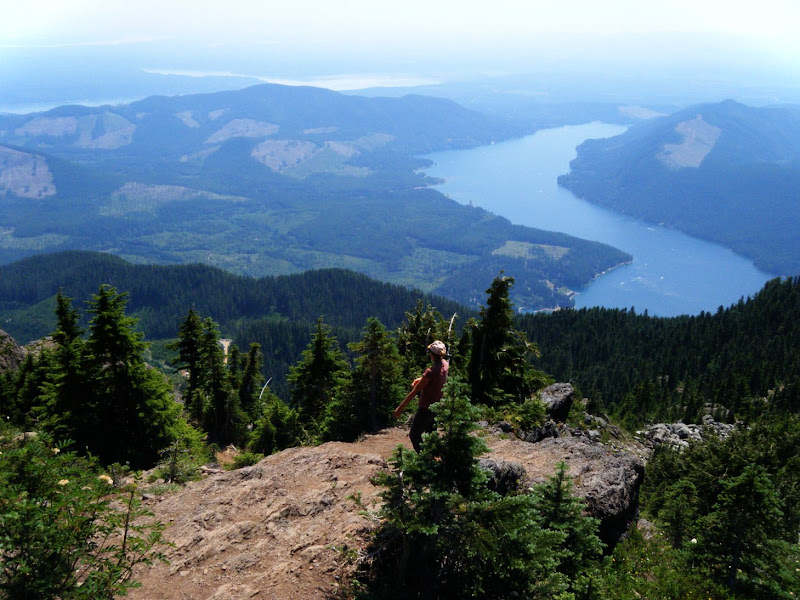
My favorite places to hang a hammock are burned in stand-replacement forest fires, the pinyon nuts are harder to come by amongst the blight, and.. While it may be tempting to read the end of the world in these portents, the fact is that the world will go on, weirder and wilder than before. To those who would resist, or rest comfortably, or postpone, I say: Change is Coming. Change is the only constant. What we take to be ordinary is, in fact, extraordinary. But I also came to accept, through my studies of paleoecology and climatology, that no normal ever existed.

I met farmers who are outpacing the state to privatize water, who are resisting privatizing water, who have ranched and lived a way of life for 100 years and whose families probably will for another 100. Ranchers who are distrustful of the government and environmental groups, who love environmental groups but build their houses on the river's active floodplain, who watch tv to fall asleep, who realize the impact of their shopping at walmart to global justice and poverty, and who are, perhaps, more ineluctably tied to thieir cultural practices and our shared economy than they are to the land.

I've looked down on the glowing jewel cities sitting tethered and throbbing from tall mountains and thought about their future and my own. As a human it can be difficult to think of humans as a force of nature like the wind and the sun, but as a scientist the evidence is clear. More people live in large cities and interconnected suburbia than on farms and ranches, and more people are alive today than ever before. Where people live in high concentrations they have completely transformed ecosystems from grasslands or forests into asphalt, houses, and watered trees. To survive from one meal to the next, to make the water run from the faucet, heat, light, all require vast subsidies from the country, which is systematically transformed (though still not to the same degree as the city) to pump services from afar into the city.

Therefore, we create environments that are constantly disturbed, and increasingly homogeneous. Another term for the anthropocene would be the homogocene, when everything is mixed up so much that place ceases to matter. The same species will be found everywhere, the same structures of concrete, metal, plastic, glass, symbols, Virtual.

Disturbance will continue to reset the clock on ecosystems, making oldgrowth ecosystems increasingly rare. Instead, we will become even more accustomed to bland, early-successional weedy eocsystems adapted to high (human) disturbance. I have walked the gradient from unimpacted ecosystems to totally impacted human ecosystems, and the changes are systematic and predictable. Usually, the ecosystem becomes more weedy or barren, and eventually entirely nonfunctional. However, even at the extreme cities can support some species of wildlife, and perform some ecosystem functions, depending on how they are built. Cities are not inherently cancerous on the surface of the earth, although they are metastatizing.

The ecological role of humans, tho, is not as organizers of energy, or even to change functioning ecosystems to nonfunctional ones, but, rather, as "seed dispersers and agents of disturbance (change)". Thus the ecologist diagnoses the humans.

Sunday, April 05, 2009

Conceptual Alternatives in Classifying Ecosystems

Different descriptors used to classify ecosystems can be thought of as Venn Diagrams within a conceptual field, with e.g. playas and closed basins overlapping for those sites that are both, while acknowledging that not all closed basins are playas and not all playas are in closed basins. Under this framework, playas could be thought of as a subset of "Herbacious Vegetation" (although some playas may not be vegetated at all)

From Rio Puerco

Another way of thinking about ecosystem classifiers is as a rainbow of alternative systems. Each system, such as that developed by the Nature Conservancy, Roccio, or HGM, entails a complete and comprehensive analysis of any given field site. In other words, choosing to describe ecosystems using HGM entails that each ecosystem will be given an HGM classifier. The strength of this perspective is that it acknowledges the classifier is system-dependent, while the weakness is that it does not conceptually relate one system to another.
From Rio Puerco

Saturday, August 02, 2008

Canonical Seasons

How many seasons are there?
Where does our myth of these canonical seasons come from?
When do the seasons start and end?

"Thailand lies within the humid tropics and remains hot throughout the year. The annual average temperatures is from 28-35 °C, ranging in Bangkok from 35°C in April to 17°C in December. There are three seasons: cool season (November to February), hot season (April to May), and rainy season (June to October). During the month of August, there might be rains and the weather is not too warm, with temperatures from 24 to 35 degrees Celsius."


the five seasons of the sonoran desert


Or is it 8?

Wednesday, April 04, 2007

Cognitive dissonance...in a fly?

[diagram from Kravitz lab "boxing flies" work]

A couple hours phenology
on top of the mountain
cumquat in a plastic bag
white butterfly
after half an hour
some bees two? three?
above the valley
two eagles circled and cried
spit out cumquat seed
phenology? or phenomenology
threw the banana peel and i could almost see it
the I almost disappears --> goal

then a pair of big flies, then a pair of small flies
17 chia seeds drying on a pair of trousers
the gel does its job; hardens stuck to the cloth
cotton cloth is also gel
tug-of-war between them (like heat, electricity)
the actual neural decision-making logic of a fly -- scratch scratch it goes
strobe light-like
to investigate the cumquat seed
then shies away behind the bush

nothing here is human-sized
I won't be Ostrich-sized.
A spent caccoon hangs from a dead branch on a live bush
inches above the rocks
ALL life uses DNA. ALL countries trade with dollars.

should i follow the white butterfly? write her down?
if cities are a good thing than free trade is a good thing.
as i leave in the mid afternoon
two butterflies fight or dance
above

Tuesday, February 27, 2007

Nuclear solutions?

Stewart Brand is a great visionary and thinker. But how did the inventor of the Clock of the Long Now become convinced that GMOs and nuclear power are a good thing? The main problem I have with his reasoning about technology is the premise he starts with; that we must maintain our current profligate and wasteful use of energy and natural resources.

If we are locked into such a zero-sum game then yes, nuclear and GMOs may be the best of many bad options. But if we can instead optimize our whole economic system we may find that designed efficiency improvements can completely eliminate our imagined need for more power plants. (I refer the reader who wants to learn more about market-based efficiency solutions to the ample work of Amory Lovins)

Unfortunately the real problem is not a lack of energy or resources (if anything, we produce too much) but a lack of price signals that would tend to optimize the current system. If the market reflects the true cost of energy (instead of reflecting subsidies and missed externalities) these efficiency improvements would already have happened and we would not be forced to choose between pollution today or pollution 10,000 years from now.

Brand argues based on the premise of the lesser of two evils, but when it comes to big, hard questions about adopting new technologies we have an obligation to do much better. Brand is at his best when he puts his faith in the emergent properties of complex systems. Unfortunately our current economic system is not perfect. The solutions do exist and it is the hope of our generation that we can implement them before we are scared into a future of increasingly hazardous big-technology fixes.

Monday, January 08, 2007

Industrialism vs Natural Agriculture

You see a system that runs on sun and rain, year after year, with no one to cultivate the soil or plant the seeds. (Benyus)

Wendell Berry:
THE WAY OF INDUSTRIALISM is the way of the machine. To the industrial mind, a machine is not merely an instrument for doing work or amusing ourselves or making war; it is an explanation of the world and of life. Because industrialism cannot understand living things except as machines, and can grant them no value that is not utilitarian, it conceives of farming and forestry as forms of mining; it cannot use the land without abusing it.

I hold the most archaic values on earth, they go back to the Paleolithic; I try to hold history and the wilderness in mind that I may approach the true nature of things, and stand against the unbalance and ignorance of our times.

Identification with that other totally alien, nonhuman can be experienced in tilling the soil, shaping word or stone, the lust and ecstasy of the dance, or the power-vision in solitude.

Gary Snyder:
"Wild mind means elegantly self-disciplined, self-regulating. That's what wilderness is. Nobody has a management plan for it."


Notes
45,000 sq ft to feed a person, 10,000 vegetarian

biointensive minifarming
deep cultivation to aid root growth
compost crops
closely spaced palnts in widebeds to optimize microclimates
interplanting of mixed species to foil pests
bioneer kenny ausubel
the land institute
ecology action
masanobu fukuoka
ecoagriculture
Natural Systems Agriculture
Wes Jackson


wallace stevens
gary snyder's essays on the wild.