Showing posts with label Santa Fe. Show all posts

Tuesday, May 19, 2009

Big Tesuque Creek Hike -- Spring Wildflowers!


As one of the Southernmost perennial streams in the Sangre de Christo Range, Big Tesuque Creek, just minutes outside Santa Fe, is a hotspot of biodiversity and a popular hike/bike/equestrian trail. We visited the area a week ago, on the 12th, but came back again this week because we ran out of daylight last time. On a 3.5 mile hike along the Rosgen Class "B" (controlled by colluvial processes) we crossed the creek almost a dozen times and identified more than 40 species. There are several we could not identify, and photos of these are included first. Click on the images to view the full size.


From Big Tesuque Creek Hike -- Spring Wildflowers!


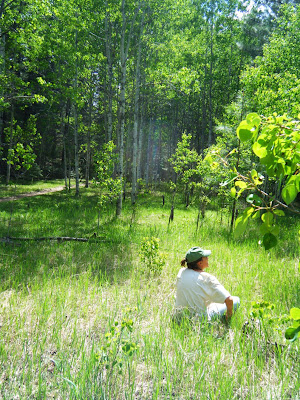
Enjoying the meadow at the upper trail junction. Since there was not much more than a couple violets, Thermopsis, Dandylions, and Mertensia (Chiming Bells), we decided to head down.
From Big Tesuque Creek Hike -- Spring Wildflowers!

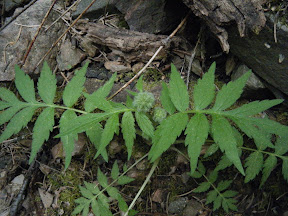
Hydrophyllum.

From Big Tesuque Creek Hike -- Spring Wildflowers!

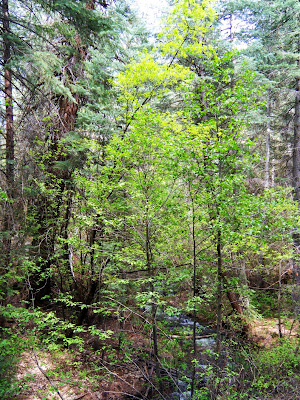
Habitat, showing mid canopy of Alder under Douglas Fir overstory.
From Big Tesuque Creek Hike -- Spring Wildflowers!
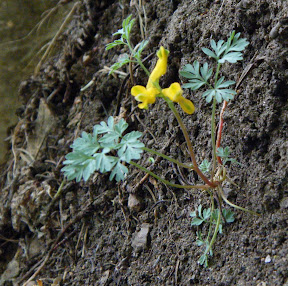
Corydalis.

From Big Tesuque Creek Hike -- Spring Wildflowers!
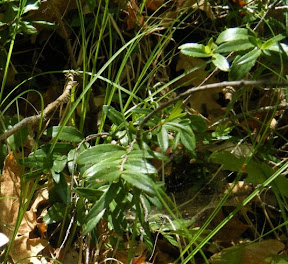
Mountain lover.


Species List

Ponderosa upland -- alder and box elder are prominent, Douglas Fir more so further up the canyon. We counted more than 40 species in flower (designated by an *)

*Tragopogon pratensis - Yellow Salsify
*Clematis columbiana - Rocky Mountain Clematis
*Lathyrus eucosmus - Wild Sweetpea
*Lupinus caudatus ssp. argophyllus - Spurred Lupine
*Many daisies
*Ash??
*Cherry
*Mertensia lanceolata - Lanceleaf Bluebells (some with white, some with blue flowers)
Heracleum maximum - Cow Parsnip
*Viola canadensis - Canada Violet
*Viola nephrophylla - Kidney-leaved Violet
*Cardamine cordifolia - Bittercress
*Valeriana arizonica
*Verbena spp?
*Androsace septentrionalis - Northern Rock Jasmine
*Aquilegia elegantula - Elegant Columbine
*Sambucus recemosa - Red Elderberry
*Actaea rubra - Baneberry
Cercocarpous montanus - Mountain Mahogany
Potentilla anserina
*Geum macrophyllum - Cut-leaves Avens
Geranium spp.
*Erysimum capitatum - Western Wallflower
*Fragaria vesca ssp. americana - Wild Strawberry
*Moehringia/Stellaria spp?
*Maianthemum racemosum - False Solomon's Seal
*Quercus spp.
*Besseya plantaginea - Kitttentails
Vaccinium myrtillus(?)
*Berberis fenleri - Fendler Barberry or Mahonia
*Acer glabrum - Rocky Mountain Maple
Plantago major - Common Plantain
*Taraxacum officinale - Dandylion
*Trollius laxus (?) Globe flower, Ranunculaceae
*Ranunculus ssp. - Buttercup
*Utah Serviceberry
*Alder
Thalictrum
*Several kinds of carrot
Gallium
*Oregon Grape
*Astragalus
*Penstemon
*Indian Paintbrush
Delphinium spp.
*Thermopsis
Wax currant
Gooseberry
*Antennaria spp.
Equisetum spp.
Box elder

I would write more but I am completely exhausted from hiking and botanizing all day.

Saturday, April 18, 2009

Santa Fe River Stream Team 2009

We had a great turnout of volunteers to help us plant native willow and cottonwood in the Santa Fe River. This planting continued a 10-year Wild Earth Guardian project to restore continuously linked habitat from the Santa Fe River's confluence with the Rio Grande 50 miles up to its headwaters in the Santa Fe National Forest.

From Santa Fe River Stream Team 2009


The SNOW:
From Santa Fe River Stream Team 2009


The FLOOD:
From Santa Fe River Stream Team 2009


Looking upstream BEFORE:
From Santa Fe River Stream Team 2009


Looking upstream AFTER:
From Santa Fe River Stream Team 2009


On to the NEXT Stream Team:
From Santa Fe River Stream Team 2009

Monday, September 15, 2008

Impact of Summer Rains on Santa Fe River Restoration Project

Heavy rains in Santa Fe impacted erosion control restoration structures but most of the Guardian's plantings survived. This image shows the severe scouring around behind the post vanes which were designed to deflect floodwaters. Because of heavy rains draining off the compacted surface of the city of Santa Fe, flash floods came through here hard and fast, only months after the Wild Earth Guardian's Stream Team finished pole planting willows and cottonwoods along this stretch of the Santa Fe river just south of San Ysidro crossing.

From Santa Fe River update after the summer rains


The holes we augered in sandstone for the pole plantings are now clearly visible.
From Santa Fe River update after the summer rains


The trees held and look beautifully green now in late summer. In a few years this dry wash will be a lush riparian forest.

From Santa Fe River update after the summer rains

Wednesday, April 09, 2008

Jobsite Santa Fe River at San Ysidro Crossing

Aqua Fria park is on a well-chosen site on a hill at the edge of town, the (dry) Santa Fe river flows along one edge. The park is also dry in both the literal and metaphorical sense. There is not a lot of creative energy here, besides the wind. It could be beautiful, but it is deserted, devoid of people and trees.

Could a cottonwood bosque bloom here? Our site is bordered on the north (upstream) by San Ysidro road and on the south by Caja del Oro Grant road. Between these two overpasses the Santa Fe is "natural".
In this case "natural" means "hammered shitless". You know when you've been beat so hard you can't even shit afterward? That's shitless. The "river" has been farmed and irrigated away, grazed to stubble and weeds, mined for gravel and concrete powder, littered and poisoned and polluted with septic runoff. The "river" is now dry, as many in the Southwest are.
So they called in the stream team, in collaboration again with Bill Zedyk and Steve Carson.
Zedyk and Carson had installed post or rock vanes and we worked to further stabilized these erosion control structures with plantings.
The riverbed/floodplane is too wide and continues to erode its banks, so most of the work is focused on narrowing and stabilizing, as opposed to inducing meanders.

Thanks to all of the volunteers. See you at the Puerco!

Tuesday, April 08, 2008

Jobsite Santa Fe River: Successful Restorat

What the Santa Fe river can look like (reference reach):
Wetlands overview, with winter sunset colors. These trees are about 14 years old.
Trees planted about 10 years ago.
Some have become beaver lunch.
Other have become part of a beaver's dam (note overflow waterfal)l.

Dams create lakes.
And wetlands. Note the beaver trail.

Wetlands create the right conditions for new trees to grow, completing a sustainable cycle.
More information on beavers.

Note: some of these photos are from the Randall Davey Audubon Center and Nature Conservancy Preserve upstream of our current restoration site at San Ysidro Crossing, others are from the Forest Guardian Preserve downstream of our current restoration site.

Tuesday, March 25, 2008

Santa Fe: Land of the Prius and Suburu


How long after sunset does the Green Flash occur?

Have you seen the shimmering ghost clouds that effervesce in the black sky an hour or more after sunset?

Some say they are a hundred, a thousand miles up.

The sky definitely shades in every color of the rainbow, red sunsets fade to green and then to blue and black.

Stars cover more than their 180 degree share of the heavens.

The Jemez and the Ortiz and the Sandia and the Sangre de Cristo.

The mountains here create their own weather; each ranch has its own weather.

Quiet city of polite dogs and narrow walled streets; enclosed or exclosed? You can't tell if you're inside or outside the brown adobe walls.
The billboards all advertise watches and jewelry, while cows chew cholla for miles around.
In Santa Fe.

Tuesday, February 12, 2008

Tucson


0.
Even the great amoeba cities, clutching each other, skewered on their endless myopic highways, shrink in comparison to the vastness of the landscape in the West. These desert cities, surmounted and circumscribed by wondrous mountains wink small and lonely in the dark night, lost in all-encompassing wilderness. We live that we may be worthy of this landscape.


I.
Tucson, loud city of impolite dogs and cars, planted with inedible fruit and painted with bland colors, at least you are ringed by mountains for every mood. The humble-yet-graceful hump of the Rincons, huge on the Eastern horizon. The jagged charismatic physiognomy of the Santa Catalinas looming in the North, dominant, heroic, common. The austerely lush, picturesque Tucson mountains, dry yet creative, flowering along the West. And finally the distant-beyond-estimation Santa Ritas, spooky at a distance, foreign and strange and Southerly.


II.
Santa fe, quiet city of streamlined roads twisting past close-set fences...[unfinished]

Friday, February 08, 2008

Winter Wildlife Tracking

Feline tracks, probably Bobcat.

Canine Tracks, probably Coyote.


Human tracks, definitely Homo sapiens