Showing posts with label citizen science. Show all posts

Thursday, November 10, 2022

Is measuring biodiversity possible for non-experts?

I’m trying to measure pollinator biodiversity using iNaturalist, but I’m having doubts as to whether this is even possible for a non-expert.

Over the last five years I’ve photographed insects on flowers in my area, with the goal of creating a summary of total pollinator species per plant species per month. I'm using an Observation Field to associate the plant species with the insect Observation:  https://www.inaturalist.org/observations?place_id=1823&user_id=conorflynn&verifiable=any&field:Nectar%20%2F%20Pollen%20delivering%20plant=

I knew from the beginning that this would not be a perfect research study because I’m not systematically sampling the flowers with equal effort and equal time, and I knew I wouldn’t be able to ID every insect, due to the quality of my photographs.

But I hadn’t considered that the level of taxonomic ID could bias the total species counts. Even if I could ID every photograph to Genus, some Genera have dozens of species while others only have a few. Even worse, some taxa have more people helping ID and therefore have more detailed IDs, whereas other taxa have less interest and are stuck at Family level IDs.  

I think this makes comparing pollinator diversity difficult or impossible on iNaturalist. At best I could say something about how many different Genera or Families visit a particular species of plant --  but I’m not sure how important genera- of family-level biodiversity is...

iNaturalist is a great platform for documenting species observations, but now I think the utility of the data is taxa-specific.  For example, I recently went to a talk about rare talussnails and springsnails in AZ, and the speaker advocated using iNaturalist to document observations.  But how could he ID the rare species from iNat photos?  He just does it based on geography.  There’s no way to discover new snail species or new locations on iNat; DNA studies are needed for new populations to ID whether they are a new or existing species. 

I’d also hoped that I might be able to document new specialist pollinator-plant interactions, but I learned in The Bees in Your Backyard (the definitive bee ID book for North America) that even pollen specialists can be nectar generalists, so I don’t know how one would discover specialist interactions from photographs?  Do researchers have to analyze pollen grains on collected bee specimens??

Wednesday, November 02, 2022

Arizona Monarchs Visit California and Mexico

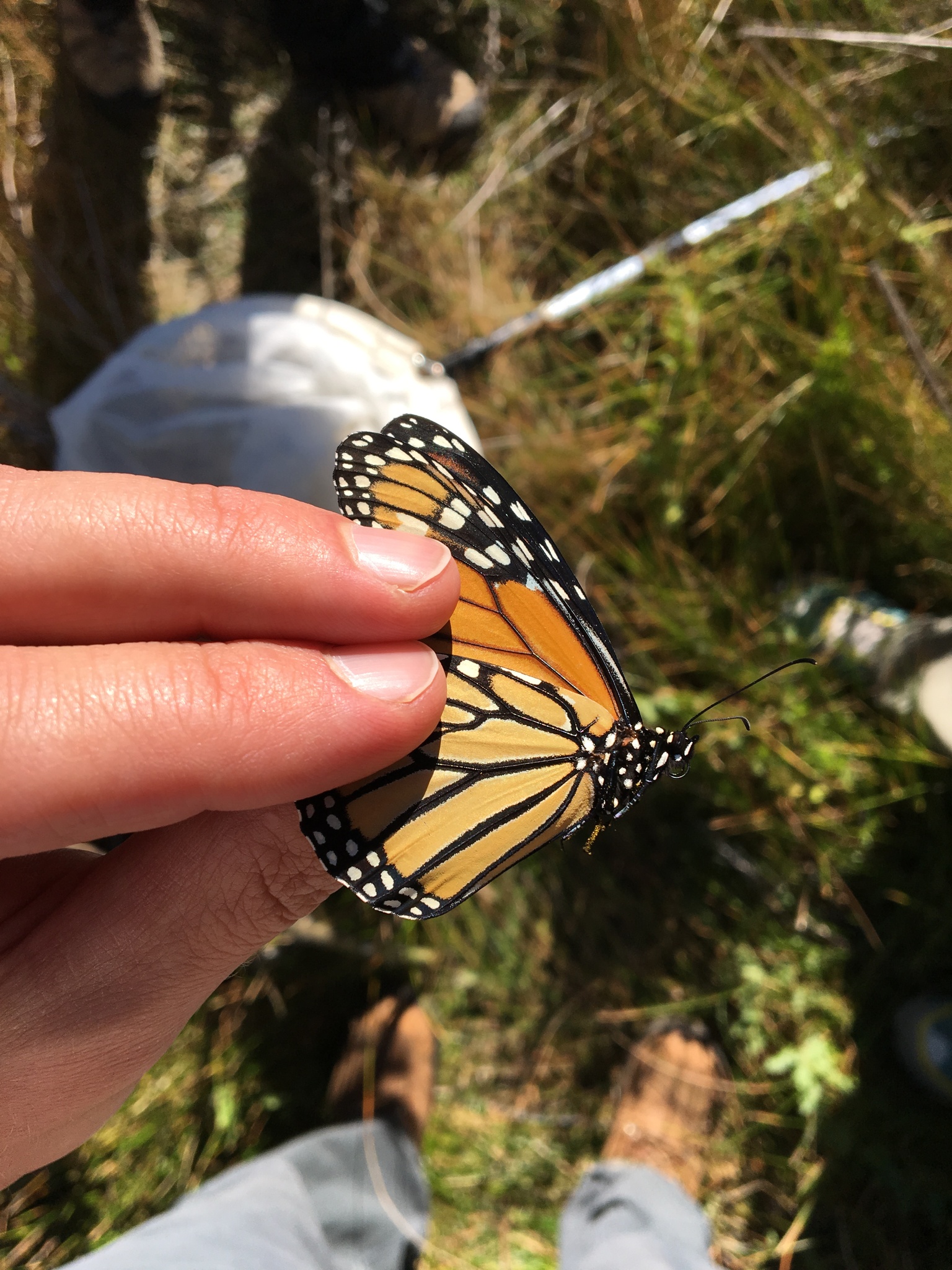
 Five years ago my wife and I joined other local citizen scientists at Willow Lake for an enjoyable afternoon catching and tagging monarch butterflies.  The tags are small stickers with ID numbers.  They  don't impair the butterfly's ability to fly, but they do let us humans track where they fly to!


A monarch in the hand.

 The Southwest Monarch Study group recently updated their map showing the location of recovered tags.  The straight lines indicate starting and ending locations, not necessarily the meandering paths monarchs take to migrate across the landscape. 

Image from Southwest Monarch Study.  

  Over the ensuing years, those tagged butterflies have turned up as far away as the monarch's overwintering grounds in Mexico. Interestingly, they also visit California overwintering sites.  Most monarch populations can be neatly divided into Eastern and Western populations based on where they spend the winter; Eastern go to Mexico and Western go to California.  But it seems AZ monarchs can go to either, which raises the fascinating question: how do they decide where to go?  Is AZ a meeting spot for different populations, and each return to their home wintering sites, or is AZ a melting pot, a single population where individuals decide each year where to overwinter?

Hopefully this citizen science research will help resolve some of the question marks on monarch migration maps.

Monarch migration map from Xerces.


Monarch migration map from Monarch Watch. 


Thursday, February 06, 2020

Missing Mammals?


 Animal population distributions can be assessed using iNaturalist.  The website is used by citizen scientists to report animal and plant observations.  Rare animals may not be mapped well, but my hypothesis is that large mammals are well mapped because humans tend to make note of them.  This may be less true for nocturnal animals, and it also depends on the presence of humans.

Raccoon observation from iNaturalist.


The map above of raccoons and the map below of coyote observations shows that both species are well-distributed across the U.S.  Clusters of observations are probably more likely due to sampling bias around large cities rather than actual differences in population density. 

Therefore, these maps can show overall distribution but may not be as useful for determining densities.

Coyote observations from iNaturalist.

The next map shows that moles do not occur in the central arid and mountainous part of the U.S.  It appears that these animals need mesic conditions and rich soil.

Mole (family) observations from iNaturalist.

In contrast, Pocket Gophers, a similar group of burrowing animals, are found throughout the arid West as well as along the Pacific coast and in Florida.
Pocket Gophers

But another burrowing mammal, the Prairie Dog, is restricted to the arid West:

Prairie Dogs

While the Prairie Dog distribution makes sense at the continental scale, zooming in reveals interesting patterns.  In northern AZ, Prairie Dogs are mainly restricted to the I-40 corridor, despite extensive grassland habitat in, for example, the Chino and Prescott valley area. The data for this zoomed-in view is much sparser than the national map and it is likely that there are many areas with missing observations. 

However, I am confident that any highly-visible Prairie Dog colonies in the Prescott area would have been photographed at some point.  Given the presence of suitable habitat surrounding occupied habitat in AZ, it may be that Prairie Dogs populations have been extirpated and fragmented across northern AZ.

Prairie Dog observations in northern AZ.


Each of the above species distributions can be related to environmental variables, but other mammal distributions are more complex.  Porcupines feed on the growing tips of conifer and deciduous trees, but apparently do not occur in much of the Midwest and southeastern parts of the U.S.  I'm not sure why this would be, as there is plenty of what looks like suitable habitat in these regions, and the presence of the species in the southwest and the northeast spans a large environmental gradient.

Porcupine distribution

Porcupine observations are quite scattered across much of the West, despite the fact that they are fairly visible in trees; birders looking for birds would be very likely to see them. There are large areas of suitable habitat in AZ, for example along the Verde river in Cottonwood.  I'm not sure why this species hasn't been observed anywhere on the Verde river.  Perhaps it has been extirpated from these areas.  Or, the two observations around Prescott may have been of dispersing animals and the population is only reproducing in the higher elevations around Flagstaff.

Porcupines in northern AZ.


Badgers also show a predominantly Western and great-plains distribution.  They need large areas of open space.

Badger distribution
However, in Northern AZ few animals have been observed.  This nocturnal burrowing animal may simply escape frequent detection, or it may be very infrequent on the landscape.  Supporting the idea that humans rarely encounter this animal, many of these observations are road kill.  Interestingly, badgers are found in AZ both in high-elevation mountain habitats and in low-elevation Sonoran desert habitat!
Badgers observations in AZ.

 Another animal with a strange distribution is the Opossum.  It seems to avoid most of the interior arid West, except for southern AZ.  The observations in Tucson would seem to be environmental outliers compared to the populations along the West coast and in the Eastern U.S.


Opossum distribution.  

Much can be learned by studying species distributions and noting where animals have been observed as well as where they have not.  Trying to explain the observed distributions raises many questions. The mysteries surrounding animal distributions are fertile ground for theorizing about animal behavior, history, and habitat needs.

Wednesday, January 27, 2016

Why Are You Interested in EDF's Chemical Wristband Study?


I'm interested in science and the environment. I think we need more science, more data, more documentation.

I've looked into the quantified self movement for personal health improvement and think that a similar focus could transform all of our environments -- especially the indoor spaces we spend most of our time in.

 I recently ordered a Air Quality Meter  to attempt to look at chemicals in the environment.

So I'm also interested in EDF's Chemical Detection Initiative, that recently documented our exposure to hundreds of chemicals in the environment.

The graphic above describes how this technology works.

I'm hoping to learn the identity, industrial use, and possible harm of chemicals from my environment. It would be a great opportunity to learn chemistry! I took the 23andme test last year for my wife and I -- and it was a great opportunity to learn about state-of-the-art genomics.

I'm also interested to connect with others who have similar chemical exposure patterns and join a growing community of people interested in improving their own health and become agents of change to all of society.


Level of Concern pre-test:

Pesticides -4

Air Pollution -3


Chemicals in cosmetics/skin care products - 2


Chemicals in cleaning products - 2


Chemicals in furniture and building materials - 4


Pharmaceuticals - 4

Wednesday, May 25, 2011

Coal-tar sealants contain PAH

source: "Pollution Prevention and Management Strategies for Polycyclic Aromatic Hydrocarbons in the New York/New Jersey Harbor" by the New York Academy of Sciences

An interesting debate has arisen over an emerging contaminant of concern, PolyAromatic Hydrocarbons, or PAHs. These compounds are produced whenever organic materials are heated in the absence of oxygen and water. This can occur whenever combustion is incomplete, such as smoky campfires, flickering candles, incense sticks, cigarettes, poorly functioning gasoline and diesel combustion engines, forest fires, and charcoal and tar production. PAHs form a large and diverse family of compounds, some of which are known to be potent genotoxic carcinogens.

Regulators are cracking down, but they don't know where to turn first, because these compounds are ubiquitous in modern, industrialized, civilization. Washington State and Washington DC have become two of the first areas in the US to begin taking action by banning coal-tar sealants. These sealants are typically applied to parking lots and driveways to make them black and pretty, and they also contain high levels of PAHs.

But are driveway sealants really the culprit? The coal-tar sealant industry points out that some shampoo bottles contain as much PAH as 100 acres of sealed parking lot. Indeed, a basic understanding of aromatic chemistry indicates that these compounds should be extremely water insoluble; they are most hazardous when they are volatilized in fires and the soot is inhaled. So the debate continues, with both industry, government, and citizen action groups trying to make sense of the science.

Sunday, February 13, 2011

"Substance X causes cancer in animals...."

Consider two statements, S1 and S2: S1: ‘‘Would you agree or disagree that the way an animal reacts to a chemical is a reliable predictor of how a human would react to it?’’

The second statement, S2, is a little more specific: ‘‘If a scientific study produces evidence that a chemical causes cancer in animals, then we can be reasonably sure that the chemical will cause cancer in humans.’’

How did you respond? How would a scientist respond?

from P. Slovic, ‘‘Trust, Emotion, Sex, Politics, and Science: Surveying the Risk-Assessment Battlefield,’’ in Environment, Ethics, and Behavior, M. H. Bazerman, D. M. Messick, A. E. Tenbrunsel, and K. A. Wade-Benzoni (eds.) (San Francisco, New Lexington, 1997), pp. 277–313.


Wednesday, February 02, 2011

Open-source, DIY genomics

"You can't rely on the model of running everything through the historic, traditional research channels.” “..the locus of control is different and distributed. There are no principal investigators and subjects. Instead, there are organizers and participants, and both of those are collaborators.”
http://www.nature.com/nm/journal/v16/n9/full/nm0910-953.html

Tuesday, February 01, 2011

Weather vs Climate


First, an editorial by a scientist (Dr. Judah Cohen), advertising his work:
http://www.nytimes.com/2010/12/26/opinion/26cohen.html
The next day, a series of responses from other scientists on the dot earth blog (by Andrew Revkin):
http://dotearth.blogs.nytimes.com/2010/12/27/wintry-weather-and-global-warming/
Day after that, a question-and-answer session between Revkin and Cohen:
http://dotearth.blogs.nytimes.com/2010/12/28/putting-a-siberian-snow-connection-to-the-test/
A month later, a wrap-up piece by climate journalist Justin Gillis, exploring the historical background of seasonal weather predictions.
http://www.nytimes.com/2011/01/25/science/earth/25cold.html?pagewanted=all

Saturday, January 22, 2011

Microbiome and Disease: Experimentation, Gulf War Syndrome, and Mycoplasma


Humans are host to a large number of bacteria which may influence health and disease. Whether or not any given microorganism, such as E coli, becomes pathogenic is not understood. What is becoming increasingly clear is that, in addition to exogenous influences such as diet and exercise, endogenous factors such as bacteria (and genetics!) are crucial determinants of human health. Carl Zimmer, science writer, has proclaimed: "I, for one, welcome our microbial overlords!" after reviewing recent research establishing that certain bacteria can lead to obesity. His famous New York Times fecal transplant article is here.

In the absence of scientific certainty, groups of concerned citizens have begun moving forward, experimenting with antibiotics and probiotics to try to nudge the population dynamics of their microbiome toward healthier states. This emerging field, combined with the failure of the medical community to communicate and collaborate with patients who are sick and aren't being helped by currently available diagnosis or treatment has created fertile ground for web-based DIY experimentation. The community of Chronic Fatigue Syndrome sufferers in particular have latched onto research examining possible links between a tiny gram-negative bacterium called Mycoplasma fermentans and Gulf War Syndrome. The bacteria, which can apparently be a member of normal human microbial flora, is implicated in the vague symptoms of GWS, and by extension, CFS. A definitive book on GWS found little evidence to suggest such a link, but the initiator the research, Dr. Nicholson, has forged ahead nonetheless, starting a nonprofit research lab to investigate and link between Mycoplasma fermentans and health problems.

It is unfortunate that so much of the information available online is anecdotal. If these types of alternative medical practices could keep better data it may be possible to scientifically evaluate them. However, in the absence of peer-reviewed double blind trials, it appears many people are simply grasping for any treatment that offers hope, no matter how unsupported. Indeed, the scientific jury is still out, and this developing field may see fringe transformed into mainstream.

Research into M. fermentans is certainly controversial, but continuing: see, for example:


Kawahito et al. Mycoplasma fermentans glycolipid-antigen as a pathogen of rheumatoid arthritis. Biochemical and Biophysical Research Communications. 2008;369(2):561-566.

Wednesday, November 03, 2010

Accountability, Transparency, Scientists and Government

The FDA has promulgated a series of Recommended Daily Allowances (RDA) based on the proprietary review of scientists in the National Academies. The justification for these RDA values are not even available at a large institution such as Ohio State University. Because of this opacity, a large number of people have gravitated to interesting or promising parascientific ideas about the role of vitamins in nutrition. For example, many question the food pyramid's focus on carbohydrates. (Westin A Price) Others argue that the RDA for Vitamin C should be increased by a factor of 10. (Linus Pauling) Or that many health problems can be explained by a deficiency in, for example, iodine. Other groups question whether too much cholesterol is bad, whether too much salt is unhealthy. Much of the creative critiques of establishment medicine is based on rigorous research and reasonably open communication, although usually not entirely peer-reviewed. This gray literature is, however, limited compared to scientific publications. Yet when the scientific process is not transparent, it looses the inherent advantage of demonstrative accountability.

In 1998 Congress broadened the Freedom of Information Act (FOIA) to specify that all government funded science should be shared and freely available to the public. Dr. Sheila Jasanoff, a professor of Science, Technology, and Policy at Harvard University, has recently written an excellent primer in the May 7 2010 issue of Science on her perspective of how climate science measures up; "Policy Forum: Science and Society: Testing Time for Climate Science."

She describes the "Three-Body Problem" as consisting of individuals, reliable bodies of knowledge, and procedures. The individual scientist or expert must be held to high standards of honesty and integrity. In science, peer review partly serves this purpose. Reliable bodies of knowledge create scientific knowledge. Scientific advisory committees translate scientific findings into policy-relevant forms: individual members' impartiality and sound judgment is critical. Under the Federal Advisory Committee Act (FACA) (Public Law 92–463), scientific advisory committees must be fairly balanced and, in the absence of special circumstances, committee meetings and records are presumed to be open to the public.

science policy blogs
http://bigthink.com/blogs/age-of-engagement
http://climateprogress.org/2010/04/28/im-speaking-at-harvard-friday-on-science-blogging/

Sunday, February 15, 2009

Project Budburst


Today is the first day of Project Budburst for 2008. If you have native
plants growing in your yard or anywhere close enough to your daily
rounds that you can observe them every day, you might want to register
with the project and record your phenological observations along with
other "citizen scientists" across the country. The idea is to gather
quantities of data about budburst/first leaf and first flower for
certain targeted species (listed on the site http://www.budburst.org).
This data is being collected in order to track the effects of climate
change.
Check out the website for more information and to register sites and
plants you would like to monitor.

Saturday, August 02, 2008

20 Years' Phenology, Santa Catalina Mountains, Tucson


"One remarkable legacy dataset...is the record of plant species in bloom along the Finger Rock trail in the Catalina Mountains north of Tucson, Arizona, collected by Dave Bertelsen. The data represent an enormous effort. Covering a major elevation gradient, a 20-year period, and a comprehensive record of all species in bloom, they contribute invaluable information at a scale very few individuals would ever attempt."

Using this dataset, scientists demonstrated clear patterns in the seasonality of alpha diversity (species richness) of species in bloom across an elevation gradient (Crimmins et al. 2008). This diversity was strongly influenced by precipitation at lower elevations and by temperature at upper elevations. In addition, over the course of the study, average summer temperature showed an upward trend, as did the number of species in bloom in summer at the highest elevations."

A discussion of the importance of "citizen scientists".