Showing posts with label news. Show all posts

Monday, January 20, 2020

Australian Wildfires

Extremely large pyrocumulus clouds tower over bushfires in New South Wales and spread over the Pacific Ocean. Sentinel-2A image, December 31, 2019, processed by @andrewmiskelly.  Source.
A pyrocumulus cloud is produced by the intense heating of the air over a fire. This induces convection, which causes the air mass to rise to a point of stability, where condensation occurs. If the fire is large enough, the cloud may continue to grow, becoming a cumulonimbus flammagenitus which may produce lightning and start another fire.  Source.


"Fuels management cannot prevent fires but can change their behavior" but fuels management is limited by budgets and time to burn, especially in droughts." Source.

The BBC has a good overview:


"We’re seeing recurrent fires in tall, wet eucalypt forests, which normally only burn very rarely. A swamp dried out near Port Macquarie, and organic sediments in the ground caught on fire. When you drop the water table, the soil is so rich in organic matter it will burn. We’ve seen swamps burning all around."

"Even Australia’s fire-adapted forest ecosystems are struggling because they are facing increasingly frequent events. In Tasmania, over the past few years we have seen environments burning that historically see fires very rarely, perhaps every 1000 years. The increasing tempo, spatial scale, and frequency of fires could see ecosystems extinguished." Source.


More Info.
Australian Fire Center
Case Study / Educational Info

Wednesday, January 01, 2020

Top 2019 conservation news

Multiple stories of widespread wild animal population declines:

From 10 billion down to 7 billion birds.
The population of birds in North American has fallen by a third in 50 years. Science.


Statistic of the decade: amount of rainforest lost in Amazon.


"Insect apocalypse" in the New York Times Magazine garnered widespread attention. 
In the United States, scientists recently found the population of monarch butterflies fell by 90 percent in the last 20 years, a loss of 900 million individuals; the rusty-patched bumblebee, which once lived in 28 states, dropped by 87 percent over the same period.

the overall abundance of flying insects in German nature reserves had decreased by 75 percent over just 27 years. If you looked at midsummer population peaks, the drop was 82 percent.

It is estimated that, since 1970, Earth’s various populations of wild land animals have lost, on average, 60 percent of their members.

What we’re losing is not just the diversity part of biodiversity, but the bio part: life in sheer quantity....Finding reassurance in the survival of a few symbolic standard-bearers ignores the value of abundance, of a natural world that thrives on richness and complexity and interaction.

Scientists have begun to speak of functional extinction (as opposed to the more familiar kind, numerical extinction). Functionally extinct animals and plants are still present but no longer prevalent enough to affect how an ecosystem works. Some phrase this as the extinction not of a species but of all its former interactions with its environment — an extinction of seed dispersal and predation and pollination and all the other ecological functions an animal once had...

Other News  (Link)
Last female Yangzte Giant Softshell Turtle died
Last Sumatran Rhino in Malaysia died
Jaguar and Koala populations hit by wildfires in Brazil and Australia

Sunday, January 01, 2017

Natural Resource Management Stories


Conservation - Collaboration Success Story: Nature Conservancy and Nutrient Stewardship Council in Western Lake Eire Watershed.  Accreditation of fertilizer merchants (term?) to educate farmers in the 4Rs:   Right amount, right time, right place, right ....  These are complicated decisions; fertilizer reps and farmers understand better all of the details of each decision, while scientists and Nature Conservancy have ideas about solutions.  By working together (also motivated by Ohio Law) they are innovating solutions, like using liquid fertilizer to furrow-apply salt-free fertilizer directly on seeds of side-dressing or foliar applications


Monarch voluntary conservation agreements.  Monarch butterfly has been in steep decline and the iconic insect is the subject of a successful citizen science campaign to document migration patterns and encourage milkweed host plant cultivation.  Now Monarch is being considered for listing as endangered species. Voluntary conservation agreements and memorandum of understanding between the USFWS and private companies and individuals are being encouraged as a way to avoid ESA listing.

The recent decision to de-list the lesser prairie chicken was based on the existence of a voluntary conservation agreement whose possible beneficial effects on the species were not considered by USFWS.
Now power companies and Midwestern farmers seem to think a voluntary conservation agreement is a good insurance policy against a possible listing decision.  If the monarch is listed, the government could require landowners across the country to be pollinator friendly.  Monarchs need us to manage for milkweeds.


Don't mess with Iowa.  Agricultural misperceptions of the 2015 proposed Clean Water Act rule led to lawsuits that forced the EPA and Army Corps to halt the implementation of the rule.  Coal states were able to obtain a supreme court ruling halting implementation of the 2015 CO2 rule for the "Clean Air Act".  And now Iowa (and other midwestern farmers) are against the EPA's proposed strengthened standards for atrazine, a popular herbicide.  Midwestern farmers argue that lowering the allowed concentration of the popular herbicide would impair their ability to grow food for the country.  Farmers also point out that the proposed standards might lead to more water pollution, not less, due to the reliance of no-till farmers on broad-spectrum "burn down" herbicides to clear the fields for planting.  Without these herbicides, farmers would be forced to go back to tilling their land in order to mechanically disrupt existing weeds.  

Friday, January 01, 2016

Top Conservation of Stories of 2015

Looking back on the year, I feel that victories and gained ground made good News:  US Congress acting(!) to ban microbeads,  Supreme court upheld Clean Power Plan to reduce emissions of  mercury by 1,000 million tonnes and thereby save more than 1,200 lives/year.  CO2 reduction plans from the 2015 Paris COP 16.  Administrative action to create a new office of ecosystem service financing (read: more support for restoration) and to standardize and promote mitigation banking.

However, there were some problems.  The gargantuan natural gas leak in S. Ca. highlighted the fact that natural gas leaks way too much to be a clean bridge fuel.  We either need to clean up natural gas or resolve to skip over it altogether.


Monday, January 19, 2015

Top Conservation Stories of 2014

Here are a few of the most important conservation stories from 2014:

--Gila River Proposed Diversion approved by ISC

--Mexican Gray Wolf critical habitat expanded to include most of NM and AZ south of I-40

Zone 1 is where Mexican wolves may be initially released or translocated.  Zone 2 is where Mexican wolves will be allowed to naturally disperse into and occupy, and where Mexican wolves may be translocated.  Zone 3 is where neither initial releases nor translocations will occur, but Mexican wolves will be allowed to disperse into and occupy....where Mexican wolves will be more actively managed...to reduce conflict with the potentially affected public.  However, in AZ east of Highway 87 there will be a "phased approach" to managing wolf populations.

--U.S. Congress Omnibus spending bill approves the Resolution mine landswap in AZ, grazing lease terms expanded to 20 years, and Valles Caldera becomes newest National Park

--Drought in CA (7% snowpack) ... and NM.  (e.g. Heron Lake resevoir levels fall, fail to make San Juan-Chame deliveries to Rio Grande)

-- US EPA and NRCS try to regulate agriculture under CWA....and fail.  The problem of increasing toxic algae problem in Ohio lakes came to a head in 2014 when Cleveland had to turn off their city water intake from Lake Eerie due to a toxic algal bloom. The proposed rule would have allowed EPA to regulate "non-point source" water pollution from farms that did not have a NRCS-approved conservation practices in place.  But apparently the outcry was too much, and early in 2015 the rule was amended.  Note that the final rule, even though it no longer contained this provision, was still vehemently protested in 2015.

--  Gunnison Sage Grouse listed as "Threatened" under the ESA, Colorado appeals.

-- Colorado River Pulse....mostly just grows more tamarisk.

--  Pleistocene megafauna extinction due to meteor impact, new study finds.  

-- Wilderness turns 50 years old

-- New "stacked trait" GMO potatoes and soybeans approved in the U.S.

And a random tidbit:  rabbits eat more forage in utah than bison...leading ranchers to question the state's continued bounty for coyote skins.

Monday, December 01, 2014

Don't Spike Your Blood Sugar


There have been a number of scientific papers in the last couple years, and now a number of high-profile articles (like last week's Time Magazine article "Ending the War on Fat") that have found no correlation between fat -- even saturated fat -- and Alzheimer's, diabetes, cancer, or heart disease. The idea that cholesterol and saturated fat are the cause of heart disease is no longer supported by the best available science.

However, there is still broad consensus among health professionals that we need to avoid processed, sugary, and high-glycemic foods. High-glycemic foods are energizing for an hour or two but then cause sleepiness and craving for more (usually high-glycemic) snack foods. These foods are dangerous because they raise blood sugar, leading to a crash afterwards, a "roller-coaster" blood sugar dynamic that promotes over-eating and a variety of diseases.

Gary Taubes, in Good Caloreis Bad Calories, explains how sugar metabolism makes you fat:

"Glycerol phosphate is produced from glucose when it is used for fuel in the fat calls and the liver, and it, too, can be burned as fuel in the cells. But glycerol phosphate is also an essential component of the process that binds three fatty acids into a triglyceride. It provides the glycerol molecule that links the fatty acids together. In other words, a product of carbohydrate metabolism --i.e. burning glucose for fuel-- is an essential component in the regulation of fat metabolism: storing fat in the fat tissue. In fact, the rate at which fatty acids are assembled into triglycerides, and so the rate at which fat accumulates in the fat tissue, depend primarily on the availability of glycerol phosphate. The more glucose that is transported into the fat cells and used to generate energy, the more glycerol phosphate will be produced. The the more glycerol phosphate produced, the more fatty acids will be assembled into triglycerides. Thus, anything that works to transport more glucose in the fat cells -- insulin, for example or rising blood sugar, will lead to the conversion of more fatty acids into triglycerides, and the storage of more calories as fat."

"So yes, dietary fat is responsible for fat accumulation, but it is carbohydrates that mediate the accumulation, and the energy balance of the body as a whole. Don't spike your blood sugar, and your body will continue burning fat, not storing it."

Sunday, November 23, 2014

"Fewer than 5,000 remain"

The U.S. Fish and Wildlife Service recently listed the Gunnison Sage Grouse as "Threatened" under the Endangered Species, act, one step shy of being actually "Endangered".  The ESA specifically prohibits killing a species listed as Threatened or Endangered.


The outcry has been significant, to the point that the Colorado Governor (a Democrat) is preparing a lawsuit in opposition. (Durango Herald)

Only a few scattered subpopulations currently remain out of the historic vast swath of occupied habitat.  Source: WildEarth Guardians Species Fact Sheet


The largest population, in the Gunnisun Basin, appears to be stable and not at risk, but many of the subpopulations continue to shrink.  Source:  USFWS Fact Sheet.


A chart of the small subpopulations showing overall decline since the late 1990's.  Since 2011 there appears to be a promising increase.

However, because the Gunnison population has increased since the 1990's and makes up the largest share of the total population, the total population has increased since 1996.

Tuesday, October 07, 2014

Food Stamps in New Mexico: No Whole Milk,

Whole and 2% Milk is only allowed for infants age 1-2 years, all others can only buy 1% and skim milk.  No organic foods of course...what about meat?  Not covered!


Here are some resources describing the list of approved foods.

Scientific Statements Made by a Climate Change Skeptic

A recent op-ed in the Wall Street Journal concludes that "Climate Science Is Not Settled", contrary to activists' and scientists' claims that there is no longer even a debate.

The article, written by Steven Koonin, includes a number of interesting statements and is worth a read in its entirety. Unfortunately, responses to the article have not addressed many of his factual claims, so I wanted to list a few of them here.

Please feel free to comment or link to research that addresses or refutes these statements:

1) "For example, human additions to carbon dioxide in the atmosphere by the middle of the 21st century are expected to directly shift the atmosphere's natural greenhouse effect by only 1% to 2%. Since the climate system is highly variable on its own, that smallness sets a very high bar for confidently projecting the consequences of human influences."

2) "But feedbacks are uncertain. They depend on the details of processes such as evaporation and the flow of radiation through clouds. They cannot be determined confidently from the basic laws of physics and chemistry, so they must be verified by precise, detailed observations that are, in many cases, not yet available."

3) "Although the Earth's average surface temperature rose sharply by 0.9 degree Fahrenheit during the last quarter of the 20th century, it has increased much more slowly for the past 16 years, even as the human contribution to atmospheric carbon dioxide has risen by some 25%. This surprising fact demonstrates directly that natural influences and variability are powerful enough to counteract the present warming influence exerted by human activity."

4) "Even though the human influence on climate was much smaller in the past, the models do not account for the fact that the rate of global sea-level rise 70 years ago was as large as what we observe today—about one foot per century."

5) "[these model discrepancies] are not "minor" issues to be "cleaned up" by further research. Rather, they are deficiencies that erode confidence in the computer projections."

Wednesday, September 03, 2014

Smoke from Jemez Mountains Controlled Burn Impacts Albuquerque

The fire was caused by lightening in the foothills of the Jemez Mountains more than two weeks ago. Instead of suppressing the fire, managers have used the smoldering blaze to burn out undergrowth and unhealthy Ponderosa thickets. While the forest is moist enough to preclude any danger of catastrophic fire, that moisture may also increase the amount of smoke.


Last night smoke from the fire drained down the Jemez River valley and into the Albuquerque metro area. By this morning the smog was visible as a distinct haze in the valley. Clear skies and dry air probably helped establish an inversion that contained the smoke within the valley. The smoke quickly dissipated once daytime convection began.

ABQ Journal Photo
The Albuquerque branch of the National Weather Service noted that the "smoke event" this morning was "dense" and "impactful".  Some politicians have used the smoke to argue against this type of forest restoration.

 The NWS does not expect smoke to be as bad today as it was yesterday. But on a recent update to Inciweb, fire managers note that "hand and aerial ignitions will be used again today to direct the wildfire over an area similar in size to yesterday’s activity. Large columns of smoke from this ignition will be visible..."

Current air quality information can be found at http://www.nmenv.state.nm.us/aqb/PinoFireInformation.htm.


Monday, February 03, 2014

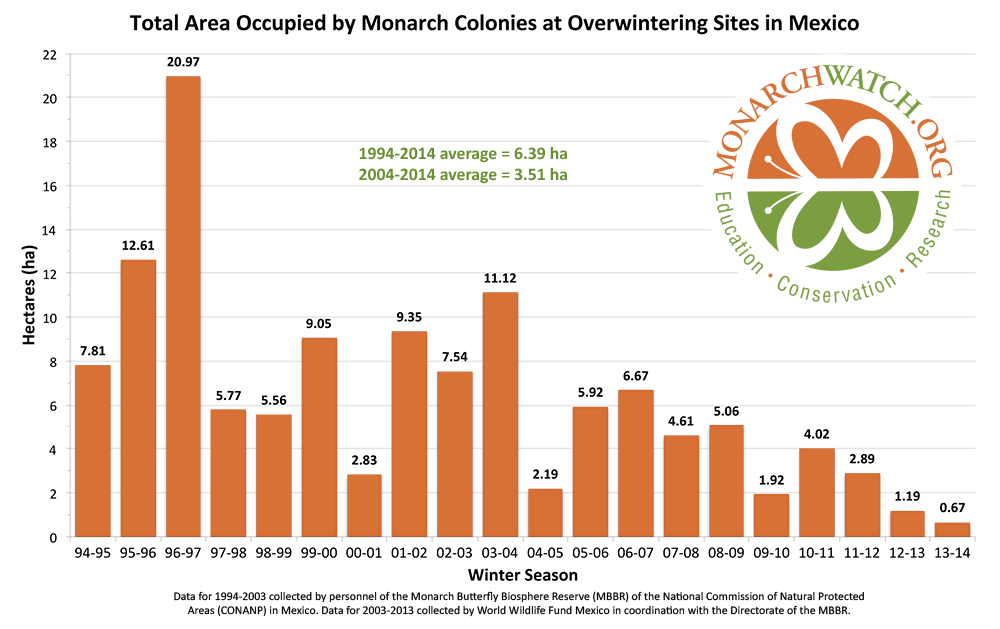
Monarch Decline Blamed on Changing US Agriculture


Graph of returning migration Monarch Butterflies from MonarchWatch.org


CBS quoted entymologist Lincoln Brower: "The main culprit," he wrote in an email, is now genetically modified "herbicide-resistant corn and soybean crops and herbicides in the USA," which "leads to the wholesale killing of the monarch's principal food plant, common milkweed."

The website MonarchWatch.org has the best in-depth analysis of the triple threat of habitat loss.  What to do?  Plant milkweed!

Wednesday, November 20, 2013

Rosemont Mine and the Scientific Method

In today's Arizona Star Opinion Section, Dr. Ostercamp discusses recent hydrologic research about whether the proposed Rosemont Mine would affect surrounding groundwater levels, and how much.

The upshot?  "More research is needed."  A classic scientific result that, in this case, sides with environmentalists' opposition to the proposed copper mine.  I was interested that this result shows how science often works differently from how most people think. Instead of generating facts to aid society's decisions, normal science (and scientists) thrive on ambiguity, controversy, and the unknowability of the world.

I believe that science, as a human institution, should work this way.  I am deeply suspicious of any scientific field with easy answers and a "97% consensus".  Scientific culture harnesses the creativity, jealousy, and competition inherent in human nature when it is most controversial, when there are a plurality of opinions and accusations.  When I hear that, for example, climate change researchers are united behind the IPCC report, I worry that the incentive structure of that field of science has become corrupted; instead of working to prove each other wrong in order to gain fame and fortune, they have all jumped on the same bandwagon to champion their cause.

In the same way that monopolies are bad for capitalism, unified "consensus statements" are bad for science.  This is not to say that I disagree with the IPCC's conclusions.  In the same way that a monopoly might act in society's interest, the IPCC may well be acting in our best interests.  But without dissent and opposing voices there is no guarantee.  Of course, one might argue that monopolies can be efficient; scientific consensus is necessary to accept what we know and move on.  I agree that arguments and democracy are very inefficient and often only result in stalemate, acrimony, and confusion.  Perhaps the "best" way of running an economy or the scientific method is ultimately a political decision?  

Politically, science (as I have described it in the first and second paragraphs) often argues for the status quo, because any change is inherently unknowable and the amount or "further research" needed is infinite; we can never comprehend everything.  So, in its current manifestation, science plays into the hands of industry when industrial processes are already ongoing: this is why Monsanto's fight for GMOs to be labelled "generally recognized as safe" and widely disseminated is so important.  Science would have argued for limitless further testing if GMOs were acknowledged to be a legitimately novel subject of study.  Conversely, science plays into the hands of environmentalists whenever new industrial projects are proposed.  In the case of the proposed Rosemont Mine, scientists would need to comprehensively understand the geology, hydrology, ecology, and meteorology of the entire Santa Rita mountains, if not the county and beyond, before being able to pass judgement on the effects of the mine.

But what about situations where environmentalists and industry would like to work together to advance some project for the good of society?  For example, thinning projects on national forests are badly needed prevent continuing damage to watersheds and ecosystems, as well as human life and property.  But what can science say about the best way to thin forests?  "Further research is needed..."

Tuesday, November 19, 2013

As reported in the Arizona Daily Star, desert Bighorn sheep were reintroduced to the Catalina Mountains yesterday after a nearly 15 year absence. The Catalina Bighorn Advisory Committee has been working on the project for a number of years and has conducted public outreach to explain and defend the program. This is one of dozens of projects conducted across the state and the southwest.  Habitat structures are built by the Arizona Desert Bighorn Sheep Society Volunteers:
   While some have questioned whether the project will be a success, there are many who think it is worth a try.

Monday, November 11, 2013

New Yorker article fails to fact-check

A recent article in the New Yorker magazine features a profile of a the Climate Company, which offers individualized weather prediction services to farmers.  Unfortunately, the article makes a number of unfounded or vague assertions, and in some places is so boosterish of the new company that it veers into puff piece journalism.

A balanced review of the company's claims would better serve readers, and a more in-depth review of the science might help explain why.

For example, the article by Michael Specter, claims that

"If you are trying to decide whether to take an umbrella to work, the National Weather Service provides the kind of information you need. But the data, often taken from readings at local airports, are nearly useless for anyone who needs to gauge constantly changing conditions in the soil and the atmosphere."

But the NWS does offer zip-code specific weather readings and predictions.   While it would be great to have even better location-specific data, such a monitoring system is yet to be implemented.

"One of the company’s principal sources is Nexrad, or Next Generation Radar, a network of a hundred and fifty-nine Doppler radar stations operated by the National Weather Service. Using data from the system, the Climate Corporation creates moisture and precipitation maps so precise that in some cases a farmer can determine whether the field on one side of a road is wetter than the field on the other side. "

All private companies use NWS radar and satellite information, and are limited by the resolution of this data.  The highest resolution data available is 4 km grid boxes.  

According to local meteorologists, it is not possible to distinguish accumulating precipitation at smaller scales without installing individual weather stations on either side of the road.

"Soil type and quality can vary widely within a county, and even within a single farm field."

This quote is used to imply that the Climate Company has such intra-field soil data, but Climate.com cannot account for every possible difference in soil texture.  It uses NRCS soil survey data compiled in the 1960's and 1970's for every county in the U.S.  

On their webpage, Climate.com requests farmers fill in their specific soil type.  There is no high-tech substitute for good old-fashioned soil testing.  

The article also features such gee-whiz promotional quotes as "the algorithm divides the country into nearly half a million plots, then generates ten thousand daily weather scenarios for each of them... It matched that information with reports from two million locations that the National Weather Service scans regularly with Doppler radar."

Again, I spoke to several practicing meteorologists who were not sure how these absurdly large and contradictory numbers were computed.  Their best guess was that Climate.com is counting the same location more than once, for each radar beam, or that they are counting different layers in the atmosphere as different "locations."  

Alternately, these discrepancies may be misquotes on the part of the author that were not picked up by New Yorker fact checkers.   

Wednesday, November 10, 2010

A Question of Trust

The comments section at the bottom of this July 1 Nature Editorial "A Question of Trust" speak more eloquently to the problem of public perception of climate change science than the editorial itself. Even here, now, at this citadel of learning and knowledge, evidence and peer-review falter before the teeming comment section questioners.

My favorite comment is from the "graduate student" who claims to have an algorithm that, when applied to climate models, disproves every one he's tried it on. And he's even shown it to his advisor, who agrees that this secret algorithm is right, and all peer-reviewed published climate models are hogwash. Genius. Pure, rhetorical genius. What possible response can there be to this kind of nugatory argument?

Sunday, April 18, 2010

Consensus, Controversy, and Deviance

The national press, despite its power and occasional hobbyhorses, sees its role as “witnessing,” as serving up a “daily diary of debate,” as offering “a platform for independent inquiry and investigation” — but not as setting the terms of public discussion.

But, is it really possible for the media to be objective?


"A long-term focus on shifting the Overton window allows a think tank to follow its ideals and perform a genuinely positive public service, instead of being constrained to merely advocating those policies that are currently possible. When the window of political possibilities is moved along the political spectrum, the impossible becomes desirable and the simply desirable becomes imperative. This is the true influence of a think tank — shaping the political climate of future legislative and legal debates by researching, educating, involving and inspiring."

Ideas and topics can shift up and down the scale of acceptability:
  • Unthinkable
  • Radical
  • Acceptable
  • Sensible
  • Popular
  • Policy

Sunday, January 25, 2009

Stream Team Biography

Conor Flynn first moved to the Southwest to work as a seasonal park ranger at the Petrified Forest National Park and stayed to pursue a graduate degree in Neurobiology at the University of Arizona. But the Southwest had other plans for the incorrigible hiking enthusiast and he soon progressed from volunteering with Sky Island Alliance to full-time conservation work with Wild Earth Guardians. "Conservation biology is much more difficult than neuroscience", says Conor, who now "performs open-heart surgery on the landscape" as a member of WEG's restoration Stream Team. "At the end of the day I'm usually so tired I can barely crawl into my sleeping bag...the drama of restoring the environment is what inspires me; its not easy, but the rewards are very tangible. We're working as hard as we can to save the remaining ecosystems by restoring important-but-degraded habitat. I'd like to thank all the volunteers and donors who make this work possible: everyone has an important part to play in guarding the wild earth."

Saturday, January 03, 2009

2008 Top Conservation Stories

Grand Canyon Controlled Flood
Grand Canyon Wildlands Council Senior Ecologist Larry Stevens, PhD, says that this was the "first planned flood that resulted in widespread resource benefits," restoring sandbars without propagating invasive tamarisk. More than 300,000 gallons of water per second were released from Lake Powell above the dam near the Arizona-Utah border. That's enough water to fill the Empire State Building in 20 minutes, said Interior Secretary Dirk Kempthorne.

Klamath River Dam Removal
A plan was formed between Oregon, California, local tribes and farmers, activists, and the Federal Government to "commit to talk about a dam removal deal. It would be the biggest dam removal project of our time, and shifts the conversation from "if" to "when". However, skeptics doubt the specifics of the deal.


Western Governors' Association adopts Freedom To Roam plan
The Governors of every Western State voted unanimously, after hearing presentations by Tom Brokaw and Rick Ridgeway, to develop and conduct a process to “identify key wildlife migration corridors and crucial wildlife habitats in the West and make recommendations on needed policy options and tools for preserving those landscapes.” This is the culmination of years of science and activism by the Wildlands Project's Spine of the Continent Campaign.

Crown of the Continent Land Conservation
The Nature Conservancy, in partnership with the Trust for Public Land, organized one of the largest conservation deals ever in Montana. Plans call for phased purchases, ending in December 2010, of 312,000 acres of forestlands in western Montana for $510 million. "This project is a once-in-a lifetime opportunity to protect these lands for our families and future generations, said U.S. Senator Max Baucus (D-MT), who helped facilitate the agreement. It will keep jobs in Montana, help maintain our communities and our working forests, and preserve public access for hunting and fishing. This will be the most significant land conservation project in the state's history, by far, and I'm proud to be part of it. "

Bush Administration plans Ocean Preserve
On June 16th the Bush Administration offered plans for the complete protection of an area the size of Arizona in a remote part of the Pacific Ocean. The oceans of the world are badly overfished and underprotected and this proposed preserve is a 'landmark' that could point the way toward protecting the seas.

Other Stories:
Unfortunately, this year's wilderness bill didn't come up for a vote in Congress. We had wanted to see the Tumacacori Highlands, AZ protected as a wilderness. Other major, urgent actions that didn't occur include protecting Otero Mesa, NM from oil and gas drilling. Polar bears were listed Endangered amidst conflict over whether CO2 could be regulated by the EPA as a pollutant. Unfortunately for the bear, even as one hand of the gov't gave protection, the other was taking it away by 'defanging' the endangered species act. Also important, though depressing, were acknowledgements of failure to restore both Cheasepeake Bay and the Sacramento River / San Francisco Bay. Other looming environmental catastrophes, such as the continued use of gender bender hormone mimics and antibiotics, are being cited more often, yet still without any kind of response. Hopefully that will change in 2009.

Saturday, February 16, 2008

My Life in the Newspapers

High Country News, a biweekly newspaper "for people who care about the west" seems to be covering my life. No less than four front-page articles over the past five months have reported on major activities in my life in the Southwest.

I'd like to comment on some of these articles, grouping them into three major subjects: the "toilet-to-tap" furor in Tucson, fighting invasive species, and tracking Jaguars.

Monday, April 02, 2007

Photojournalism is "objective".


Photojournalism is "objective". Instead of telling "stories", photos are chosen for holistic interest, a slice that is judged significant through an event that may or may not be judged significant. Because visual interest is often associated with traumatic experiences, a fair number of the major events of the day are reported, but also a cross-section of interesting minor events that, taken as a more-random sample, yield a more objective overall world-wide "picture".

What would constitute a truly "random" sampling of photographs? What does God see?

And yes, I realize that I'm confusing "objective"'s two meanings, both the metaphorical and the photographic. This is intentional, as are the potential dual meanings of "picture" and other terms that seem to have parallel or harmonious meanings in both the realm of images (CF. Wittgenstein's aphorisms) and our notion of truth. Despite what they say about Photoshop, seeing is still [closer than reading to] believing.