Showing posts with label technology. Show all posts

Sunday, January 01, 2023

Science & Technology - 2022 Year in Review

AI

 2022 was the big year for Artificial Intelligence, the year when AI became a household word.  The image generators were first, like Dall-E, but by the end of the year the latest GPT release (Chat-GPT) had taken over.  

Overview of some of the big AI releases:  link


Space

Big milestones in space included the successful first images from the James Webb Space Telescope (JWST), showing individual stars inside galaxies at the very beginning of time.  Link to images from JWST.

The DART asteroid-impact missions was a success!  Video reviews here and here.  

And sadly, the Planetary Society's crowd-funded solar sail, Lightsail 2, crashed back into the Earth's atmosphere after 3 years sailing on sunlight.  Link.


Environment

While its hard to pick the top environmental story, the fact that Earth warmed at an all-time record pace created climate disruptions everywhere.  

On the positive side, researchers have created a form of ultra-white paint that can reflect more energy than is absorbs.  Buildings coated with this paint would have a natural cooling ability that could reduce ambient temperatures and reduce energy required for AC.  I'm very hopeful that this can become cost effective and widely used in desert cities.  Link.

Tuesday, April 05, 2016

Portable Real-Time Measurement of Air Quality

I recently purchased a Uni-Trend Air Quality Meter.

It measures VOCs (both natural and man-made), PM2.5, and temperature and humidity.

Coarse particles (PM10) have a diameter of between 10 micrometers and 2.5 micrometers and settle relatively quickly whereas fine (PM2.5) (0.1 to 2.5 micrometers in diameter) particles remain in suspension for longer. To put things into perspective, human hair has a diameter of 50-70 micrometers and a grain of sand has a diameter of 90 micrometers.


Sources of fine particles include all types of combustion activities (motor vehicles, power plants, wood burning, etc.) and certain industrial processes.  Sources of coarse particles include crushing or grinding operations, and dust from paved or unpaved roads.


PM2.5 is made up of sulfates, nitrates, carbon, and soil.


Albuquerque reports the Air Quality Index for daily pollen and Fine/Coarse Particulates:


 But these numbers are reported as "Index" values, and have to be converted to ug/m3 to compare to measured values:


Over the last week, Albuquerque has reported AQI for PM2.5 of almost 50, which should be about 15 micrograms per square meter, whereas my unit typically reports 30-50 micrograms per square meter, indoors and outdoors.  It is possible that ABQ measures air quality higher from the ground than my unit, or that PM2.5 is lower during the night when I don't check it.

Here is an excellent resource for more information.  Most of the graphics on this page are from this source.

Wednesday, February 24, 2016

Moore's Law Redux: Connectivity is More Important that Processing Power

While Moore's law continues to slow, traffic on international internet links continues to grow faster than capacity. 

Moore's law, which predicted a doubling of the number of transistors per chip every 18 months, lasted from the 1960's through the early 2000s.  Over the last 10 years, newer chips have cost less and use less energy, but they have not been noticeably faster. Yet, even as Moore's law has slowed, the rise of the internet has made individual computer chips less important.

Chip density is still increasing, but progress has slowed as chip designers bump up against fundamental physical constraints, like the size of silicon atoms.  Also, as chips get smaller and denser the problem of dark silicon has increased.  To combat these limitations, manufacturers have added multiple cores and specialized architecture for graphics processing and other specialized operations. But multicore processors are hard for software to use efficiently. (Ars Technica article.)

So the current state-of-the-art 14nm Broadwell chips will remain best for the next 18+ months.  Intel promises to go to 10nm and then 7nm with new non-silicon technology.  Non-silicon technology may also finally allow faster chip speeds.  3D chip architecture is the next big advance that will improve power efficiency.  

In the meantime, manufacturers have focused on building specialized chips for mobile applications and the internet of things.  It seems the brave new frontiers are really in new mobile and cloud-based applications where energy efficiency matters more than processing power.  Every person in the world will have, on average, three internet-connected devices by 2019.

Global peak Internet traffic volumes rose 37 percent overall in 2015.  In years past, peak  internet traffic increased in excess of 41 percent each year, a rate which implies that traffic is more than doubling every two years. Over the next three years, overall growth is projected to slow to 23% a year (Telegeography 2015 Annual Report, Executive Summary.)

Even with the relative slowing of internet growth, global internet traffic in 2019 will be equivalent to 64 times the volume of the entire global internet in 2005. Globally, Internet traffic will reach 18 gigabytes (GB) per capita by 2019, up from 6 GB per capita in 2014.

IP traffic is growing fastest in the Middle East and Africa, followed by Asia Pacific. Traffic in the Middle East and Africa will grow at 44 percent annually between 2014 and 2019. By 2019, there will be more internet traffic in east Asia than in North America.
(Cisco 2015 analysis.) (Ars Technica has an older analysis)

Wednesday, December 03, 2014

Soylent Formula and Macronutrient Ratios

I'm designing the perfect foodstuff. Inspired by Soylent (video), but they don't understand the basic truth that endurance exercise (and oh-so-much of life is endurance exercise) (or you can watch a video of Peter Attia's self experimentation) is powered by fats, not carbohydrates and sugars.

Just look at these hunter-gatherer-runners (video). In The Story of the Human Body, Dr. Daniel Lieberman concludes that “Like it or not, we are slightly fat, furless, bipedal primates who crave sugar, salt, fat, and

starch,” he writes, “but we are still adapted to eating a diverse diet of fibrous fruits and vegetables, nuts, seeds, tubers, and lean meat. We enjoy rest and relaxation, but our bodies are still those of endurance athletes evolved to walk many miles a day, often run, as well as dig, climb, and carry.”

Soylent Nutrition:
(Carbohydrate/Fat/Protein ratio of 50/30/20):
Ingredients                                                                  Quantity
Soylent Blend                                                                                                      166.2g 
oat flour  36.67
Sweetener, maltodextrin  55.0
rice protein 80% ultra  40.0
vitamin and mineral premix  9.3
Oil, soybean lecithin 2.0
gum acacia rosa 3.5
Salt, sea 0.7
artificial vanilla flavor 0.6
Sweetener, sucralose, Splenda 0.2
Gum, xanthan, Ticaxan, pwd 0.2
Oil, canola 16
Oil, fish, sardine 2.2

Thursday, October 16, 2014

Good Comment! Science in the Internet Age

A Place For Dialogue (h/t to Sharon McKenzie Stevens)

As technology and culture change, new avenues of science open up. In the 1600's coffee shops became fertile grounds for political and scientific discussion, even while the royal court argued that these "dens of thieves" were illegitimate, divisive, and undermining of authority. So too, today, with online debate comment-threads and forums devoted to contentious topics such as climate change and genetically modified organisms.

I've been reading and participating in online discussions after reading Smarter Than You Think, a wide-ranging and persuasive case for the good side of technology. The author, Clive Thompson, argues that computers and the new types of communication they enable can make us smarter and more efficient. I've been consistently impressed by the quality of discourse online (especially when it is moderated). Wikipedia's methods are the gold-standard for creating knowledge and their standards seem to be widely adopted in many online discussions. For example, in comment-thread debates, facts are treated skeptically unless they are sourced, and scientific articles are held as better sources than news or magazine articles. So although intellectual debates have moved online and outside of academia, the standards for reliable knowledge have been translated to this new domain.

Is it Science?

Much online discussion focuses on current controversies at the intersections of science and society. Ironically, one of the most controversial questions is whether there is a debate at all, on a range of issues. The crux of the question comes down to whether online debates are legitimately "scientific", in the way that curated debates in scientific journals are supposed to be. Based on my analysis, I would argue that discussions characterized by normative standards of knowledge are indeed scientific discussions. I think an open-minded observer would agree that the substantive discussions being held on topics like Anthropogenic Global Warming (AGW) and the adoption of Genetically Modified Organisms certainly look like legitimate discussions, and it is hard to imagine holding ourselves to a higher level of discourse. Certainly there is ignorance and personal attacks, but these come from both sides in these debates.

Interestingly, many self-styled "defenders of science" commonly argue in online discussions that there is no substantive debate over the very issues they are debating. Even when comment threads run to hundreds of entries examing the arcane details of programming Global Circulation Models, the proponents of AGW maintain that "the debate is over." As if the online discussion doesn't 'count' in the way that a discussion in a scientific journal or conference would.  Although there are discussions in journals and conferences on these issues, certain commentators seem to conceptualize science as a monolithic enterprise that generates truth that cannot be questioned.

I find this definition of science more dangerous and erosive to the scientific enterprise than the danger posed by skepticism, debates, and unresolved questions. It is far better to expand our definition of science to include online dialogues and debates than to wall off science in the Ivory tower.  Everywhere people uphold normative standards of truth, scientific discourse is possible, and skepticism and questioning should be recognized as a central --and essential-- component of what defines science.

My wish is that both sides in these debates could see that they are engaging in science and legitimate dialogue -- even if they disagree on the ultimate conclusions. Science doesn't have to be monolithic or hermetic.  It is better (more creative, diverse, and relevant) when any conclusion based on facts can be legitimately believed or legitimately doubted.

Friday, September 05, 2014

Review of Soil Moisture Measurement Techniques


Advances in efficient, broad measurement of soil moisture are needed to understand plant stress response to drought.  Crop growth and phenology can be predicted (link) with accurate modeling of soil-plant-atmosphere interactions.  These dynamics are also crucial for advances in meteorology, since most rain that falls in the U.S. is recycled rain that has already fallen and evaporated at least once before, but often several times.  Accurate prediction of rainfall will continue to elude meteorologists until soil moisture can be measured and predicted.

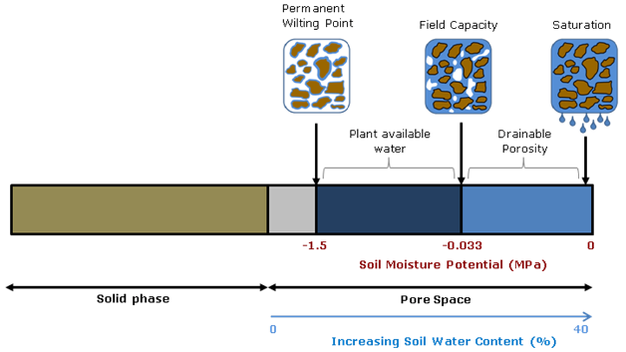
Soil moisture is critical for advancing plant and atmospheric sciences,  but the fact that different measurement techniques yield different values points to the fact that soil moisture is essentially an abstract idea.  While the water content of soil would seem to be straightforward, whether you calculate volumetric or gravimetric water content, and whether you consider chemically- and physically-immobilized water or only plant-available water (field capacity minus permanent wilting point) matters a great deal.


Diagram source.

Spatial and temporal scale also matters.  Do you want an instantaneous point measurement, or a daily weekly average for an entire county’s drought status?  Picking the right tool for the job means understanding the streghths and weaknesses of the entire gamut of technologies capable of reporting soil moisture.  This article will start with traditional in situ point measurement techniques and continue to review broad-scale soil moisture modeling and remote-sensing efforts.


from Shuttleworth 2013

Small-scale measurement can be accomplished using point-sampling with portable soil moisture probes, such as TDR and traditional (active) neutron probes.  Of course, any discussion of soil moisture measurement techniques would be incomplete without mentioning the gravimetric method, or simply weighing a soil sample wet and then dry.  But as with the other point techniques, this method can only measure hyperlocal conditions and must be replicated and averaged to inform landscape-scale management.

TDR, or time-domain reflectometry, uses the electrical properties of soil and water to calculate volumetric percent soil moisture.  For most soils, excluding those with very high organic matter (OM>10%), the TDR method without calibration provides water content in the range from zero to 50% with accuracy better than 1-2%.  While calibration and new TDR such as TRIME-TDR can improve accuracy by a factor of 10-100, the amount of microscale variability in soil means that these point measurements must be replicated dozens to hundreds of times to build up a picture of average site moisture. Microvariability can be important when precipitation preferentially flow along soil heterogeneities such as roots, textural changes, and bioturbation pathways.    Buried probes that use the TDR techniques, such as the Stevens Hydroprobes I used in my graduate research, are fixed in place and are therefore severely limited by their inability to average site variability.
  
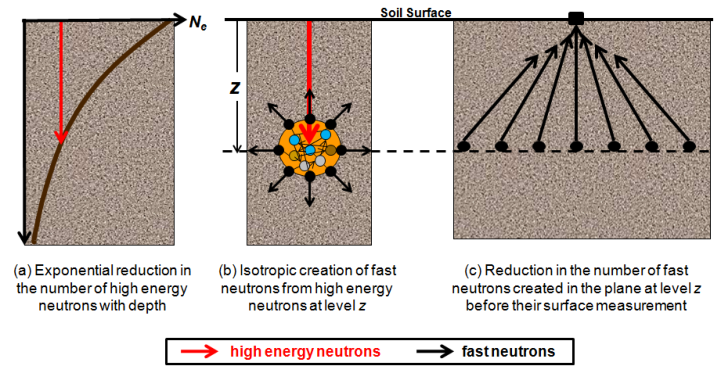
Traditional neutron probes work by bombarding the soil with high-energy neutrons and recording the number of neutrons emitted by the soil.  Hydrogen absorbs neutrons so the amount of H2O can be calculated.  This technique solves many of the problems of TDR, but the sensors are expensive and the measurement still must be repeated several times to measure field soil moisture.  

-

Meso-scale measurement can now be accomplished using the new COSMOS (Cosmic-ray Surface MOisture Sensor) program to measure whole ecosystem moisture.  Neutron moisture probes have been around for decades but COSMOS uses advances in particle-physics technology to increase sensitivity enough to rely solely on the background cosmic radiation as a uniform source of neutrons.  This advance makes possible, for the first time, instantaneous field-scale measurement of soil moisture.


These new sensors were originally deployed in 2010. They have the potential to revolutionize studies of soil moisture because they are the only technique to measure soil moisture at scales between the hyper-local point measurements and the kilometer-swaths of satellites.  They also are the only soil moisture probe that can account for water stores in living tissue.  According to Hydroinnova, one company that makes these $10,000 units, the measured soil footprint is 86% within 350 meters and the effective measuring depth changes with soil moisture, from a maximum of 70 cm in completely dry soil, to a minimum of 12 cm in saturated soil. 


Source.
While these sensors are few in number and relatively widely dispersed, they offer a whole new picture of soil moisture at the landscape level.  They are the only truly effective direct measure of soil moisture at the hectare level, and can be used to better calibrate the informational products discussed below.  However, as with all techniques, COSMOS must also be calibrated to take account of different soil types and changes in vegetation.

-

Large-scale measurement of soil moisture can be accomplished using proxies, satellites, models, or some combination of techniques.

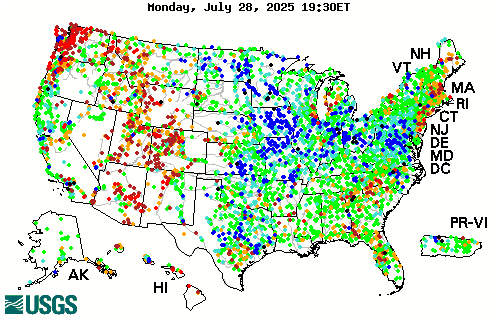
River flow data can reveal how much water is running off or through the soil from watersheds, so using a site like the USGSstreamflow network is a good proxy for large-scale short-term drought and deluge.


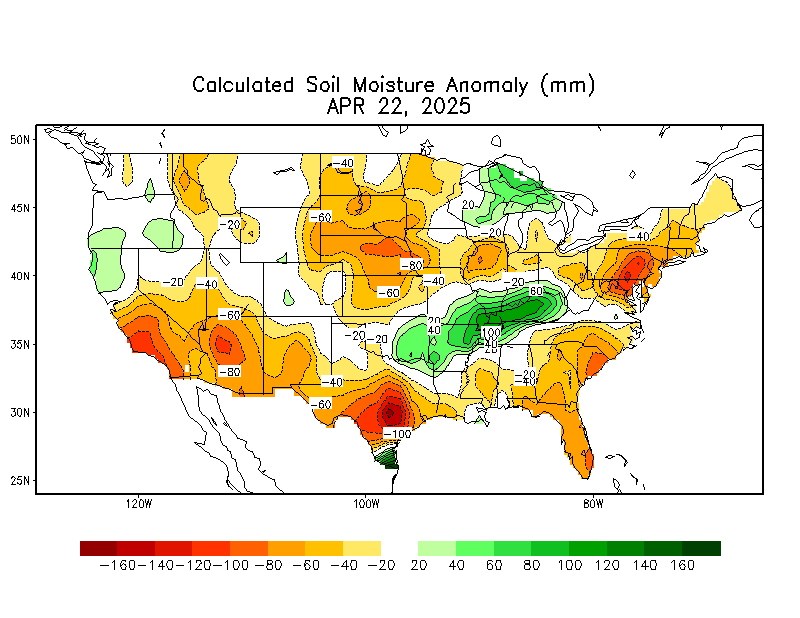
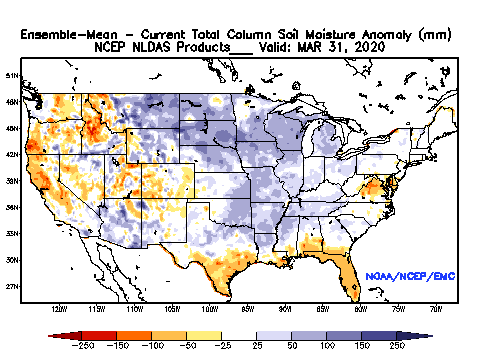
The current best methods for estimating large-scale soil moisture are the Drought.gov model products, which include the Palmer Drought Severity Index, soil moisture index, etc.  The Calculated Soil Moisture Anomaly is calculated based on observed precipitation and temperature.  Soil moisture, evaporation, and runoff for the entire US and globe are then modeled based on observations from a small area of eastern Oklahoma.  While this method is clearly biased, it is the best available.

The National Land Data Acquisition System is developing a more accurate model of soil moisture that incorporates soil textural properties and average percent vegetation (which impacts evapotranspiration).  The precipitation data used in the model is at approximately 25km resolution, interpolated to 13km grid cells:


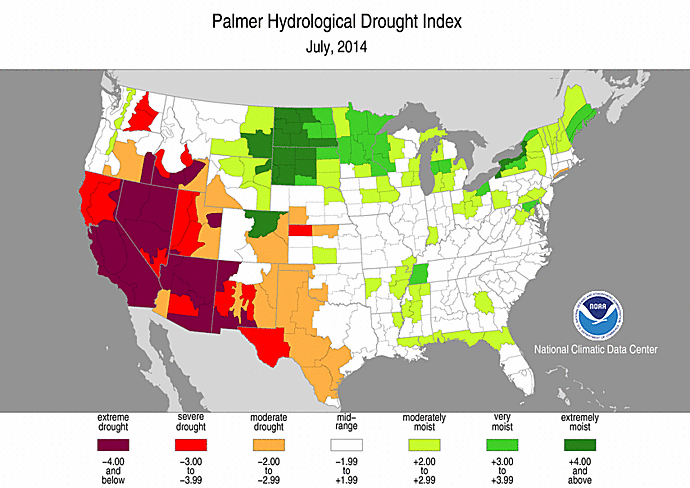
Palmer Drought Indices are similar to soil moisture models in that precipitation, evapotranspiration, and runoff are used to calculate remaining water balance.  There are long-term (Palmer Drought Index (PDI) and Palmer Hydrological Drought Index (PHDI) indices that measure changes in groundwater and reservoir levels, and short-term indices (Palmer Z Index and Crop Moisture Index (CMI)) that affect agriculture during the growing season.


 Interestingly, the US Drought Monitor, which looks essentially like one of the Palmer indices, is subjectively drawn using “a blend of science and subjectivity”.


Tuesday, February 27, 2007

Nuclear solutions?

Stewart Brand is a great visionary and thinker. But how did the inventor of the Clock of the Long Now become convinced that GMOs and nuclear power are a good thing? The main problem I have with his reasoning about technology is the premise he starts with; that we must maintain our current profligate and wasteful use of energy and natural resources.

If we are locked into such a zero-sum game then yes, nuclear and GMOs may be the best of many bad options. But if we can instead optimize our whole economic system we may find that designed efficiency improvements can completely eliminate our imagined need for more power plants. (I refer the reader who wants to learn more about market-based efficiency solutions to the ample work of Amory Lovins)

Unfortunately the real problem is not a lack of energy or resources (if anything, we produce too much) but a lack of price signals that would tend to optimize the current system. If the market reflects the true cost of energy (instead of reflecting subsidies and missed externalities) these efficiency improvements would already have happened and we would not be forced to choose between pollution today or pollution 10,000 years from now.

Brand argues based on the premise of the lesser of two evils, but when it comes to big, hard questions about adopting new technologies we have an obligation to do much better. Brand is at his best when he puts his faith in the emergent properties of complex systems. Unfortunately our current economic system is not perfect. The solutions do exist and it is the hope of our generation that we can implement them before we are scared into a future of increasingly hazardous big-technology fixes.