Showing posts with label physiology. Show all posts

Friday, January 16, 2026

A Decadal Porcupine Survey in Arizona

My last post was a summary of iNaturalist porcupine sightings in Arizona.  This post compares those results to previously published results.  Brown and Babb published the results of their 2000-2007 survey data in 2009 (Brown&Babb 2009) and McCarthy followed up with the results of his 2011-2015 survey in 2017 (McCarthy 2017).  

Since my results focus on porcupines observed since 2016, it is interesting to compare these three decades of porcupine surveys.

Also, Taylor published a comprehensive survey of Arizona porcupines in 1935 from work in the late 1920's and early 1930's.  


Porcupine Population

Porcupine populations can be estimated to some degree by the number of animals observed in a given time.  However, each of the studies used different methods to count porcupines, so the counts are not directly comparable.  

Brown and Babb and McCarthy asked land managers to report porcupines and they compiled the results.  The iNaturalist data I report was submitted by more than 100 iNaturalist observers who happened to encounter porcupines.  


Total Observations 


Porcupines 

Whether compiled from questionnaires sent to land managers or from interested naturalists, fewer than 20 verifiable porcupines are reported per year during this century.  Brown and Babb include data from one land manager from the North Kaibab / North Rim of the Grand Canyon who reported "hundreds" of porcupines, but this report is not an accurate or verifiable count and I excluded it from this analysis.

Taylor's report was motivated by "the porcupine problem" and noted several instances of hundreds of porcupines observed in a single day, more than any of the more recent studies observed in a single year.  The later studies all concluded that porcupines are rare but widely distributed across Arizona.   

Roadkill

The majority of the kills reported by McCarthy were between June and October (61%). They state that this correlates to the months when the porcupines are most active.

This is somewhat true of iNat data, where 50% were reported June to October, but there appears to be a spring peak as well that is not mentioned by McCarthy.  However note that 50% is only 6 animals out of the total 12 roadkill sightings in iNat data so there is not much statistical depth to this observation.  McCarthy's 61% figure is based on 14 animals out of the 23 total roadkill sightings, so their data is not much deeper.

There are many more total observations in iNat (183 versus McCarthy's 56 observations), however there are fewer roadkill sightings.  Therefore 41 % of McCarthy's observations were roadkill, whereas only 6% of the iNat observations are roadkill.  This may be due to citizen scientists bias against photographing dead animals, especially roadkill which are often gruesome to look at and unsafe to photograph.


Months when porcupines are most active

McCarthy states porcupines are most active June to October, however their data actually show broad seasonal activity from April to October.  Brown & Babb show higher sightings May to October.  In contrast, the iNat data show  activity throughout the year.  


Brown and Babb and McCarthy do not separately show seasonality of live porcupines.  In the iNat data, because of a spike in observations of dead porcupines in April, the phenology of live porcupines shows dips in both spring and fall and definitely does not support McCarthy's conclusion that porcupines are most active May-October.


Many of the iNat sightings are from deciduous trees (cottonwoods and willows) where porcupines are more visible during winter leaf-off. 

Previous research did not emphasize the importance of these deciduous species.  

Taylor commented that "Occurrences in junipers, willows. black walnuts, aspens, and cottonwoods are apparently limited to a very few records out of several hundred available. No evidence is at hand that the porcupine, in the Southwest proper, feeds to any extent on these last-named trees…"

Brown and Babb only reported 5 porcupines in riparian deciduous trees out of their total 214+ observations, and McCarthy only reported 4 in these trees out of his total 56 observations.

It is possible that the preponderance of iNat porcupines in these trees is due to observer bias, with the Willow lake and Petrified Forest hosting large numbers of hikers and nature enthusiasts. However, it should be noted that many other areas of the state (including the Grand Canyon and areas around Flagstaff) also host large numbers of recreationalists without reporting large numbers of porcupines.  However, as stated above, deciduous trees leaf-off state does make porcupines easier to spot.


Looking at iNat observations of live porcupines on the ground, it does look like they are most active in June, with elevated activity through October.


Porcupine Distribution

McCarthy reported a continuation of the observations by Brown and Babb, i.e. that porcupines are sparsely spread throughout the habitats where they have been reported.  While this is true as far as it goes, it does appear that there are certain areas of either greater porcupine population density or greater observer bias in photographing them.  About half of the iNat observations are from two discrete locations: Willow lake in Prescott, and Petrified Forest National Park near Holbrook.  

McCarthy noted that porcupines commonly occur in habitats that are not dominated by conifer trees.  That certainly continues to be the case in the iNat data.  Taylor's original paper noted that national forests were the preferred habitat of porcupines, but in more recent years they appear to be more common in deciduous forests, grasslands, and other non-conifer forest habitats.

There are areas of apparently good habitat that do not support porcupine populations.  The Prescott National Forest, despite extensive stands of ponderosa pine with mixed oak understory, has consistently been noted as not having many porcupines.  Brown and Babb reported 7, but interestingly these were all from grasslands, not the forests areas.  Based on personal communication with employees of the Forest, no porcupines have been observed recently on that forest.

Taylor noted: "The porcupine…appears to attain its greatest numbers in parts of the San Juan (Colorado), Carson and Cibola (New Mexico), Coconino and Tusayan (Arizona) national forests. On some forests where conditions seem as favorable as on those mentioned, as the Santa Fe, Manzano, Apache, Kaibab, and Sitgreaves, porcupines are for the most part scarce or of little economic importance. In general as one goes southward porcupines become less numerous. They are decidedly scarce on the Lincoln, Gila, Crook, Tonto, and Prescott forests."

Another area of apparently suitable habitat is the upper Verde river, which has an extensive stand of cottonwood and willow trees surrounded by wildlands.  Surveyors, who look for Yellow Billed Cuckoos throughout this area each month of the growing season, report that they have never seen a porcupine.  Yet porcupines are well known from the cottonwoods and willows around nearby Willow lake in Prescott.

Each of the previous authors have speculated that mountain lion predation may control porcupine abundance.  It may be that mountain lions are less present around Willow lake in Prescott and in Petrified Forest National Park, and more abundant along the upper verde and in the conifer forests of Prescott National Forest.  The present study cannot cast any light on that hypothesis.  

Another hypothesis for the patchy distribution of porcupines is habitat fragmentation by roads and other human development.  As discussed above, the present study did not find a high proportion of porcupine roadkill, but incidental observations and discussions suggests that porcupines are commonly killed on roads but those observations were not documented in iNaturalist.  

If porcupine populations are small and patchy in distribution, and if migrations between populations is difficult and uncertain, then porcupine populations may be reproductively isolated.  

Taylor:  "A noteworthy feature of porcupine distribution is its lack of uniformity. In some regions the animals will be fairly abundant, while in others, perhaps not far away, they will be scarce, although conditions appear to be equally favor-able."

Uldis Roze, in "The North American Porcupine," suggested that porcupines are dependent on a species-specific microbiome to digest their high cellulose diet of rough plant matter.  This is based on observations that when porcupines are introduced to a new area they consume the fecal pellets of resident porcupines in an apparent attempt to inoculate their microbiome.  Porcupines eat a wide variety of plant species, but individual porcupines are documented preferring certain plants, possibly based on their ability to digest them. 

If these ideas are correct, then porcupines may have difficulty colonizing areas that do not currently support porcupines.  It may take awhile to develop a "taste" for plants in different areas. If so, porcupine populations may be at risk of long term decline in Arizona.  Small and isolated populations may die out, and if nearby porcupines cannot safely travel and cannot easily digest the different plants in those areas, it may be difficult or impossible to replace extirpated populations.  

Taylor: "The porcupine must occasionally, if not regularly, make long trips across country. It must possess considerable capacity to adapt itself to whatever dens, natural burrows, rocky shelters, or vegetative cover it can find in the non-timbered areas into which it roams. The obvious wanderlust of the animal must tend to insure the species the widest possible geographic and ecologic range. Foster reports occasional porcupines found in badger holes in the treeless Williamson valley, Yavapai county, Arizona."

The large continuous band of conifers across the national forests of Arizona should continue to provide habitat for sustainable porcupine populations.  Hopefully the few scattered iNat observations across this area are few and scattered due to lack of observers and not lack of porcupines.  If porcupines are  not doing well in this bastion of habitat they indeed face an uncertain future in Arizona.

The American Southwest, including parts of Texas, NM, and Arizona marks the southern extent of porcupines except for a few endangered populations in the mountains of Mexico.  As the climate warms, it is possible that porcupines find Arizona's environment increasingly challenging.  However, Taylor states that porcupines are limited by food availability, not climatic extremes.

Citations
Brown, David E., and Randall D. Babb. "Status of the Porcupine (Erithizon dorsatuh) in Arizona, 2000–2007." Journal of the Arizona-Nevada Academy of Science 41.2 (2009): 36-41.

McCarthy, Michael. "Porcupines (Erethizon dorsatum) in Arizona, 2011–2015." Journal of the Arizona-Nevada Academy of Science 47.1 (2017): 19-22.

Roze, Uldis. The North American porcupine. Cornell University Press, 2009.

Taylor, Walter Penn. Ecology and life history of the porcupine (Erethizon epixanthum) as related to the forests of Arizona and the southwestern United States. No. 3. University of Arizona, 1935.

Saturday, April 27, 2024

Clues toward the Cause of Long COVID

I previously shared some of the amazing data from the paper "Muscle abnormalities worsen after post-exertional malaise in long COVID" by Appelman et al. 

The paper will undoubtable become a classic in the field of Long COVID, providing a fascinating series of clues that the researchers followed past several dead-ends to their interesting implications. 

First, and most importantly, the researchers confirmed beyond a shadow of doubt that Post-Exertional Malaise (PEM) is a real disease, with myriad muscle and metabolic abnormalities in the Long COVID patients following intense exercise.  Metabolomics provided additional key findings, including the first clue: a possible blockage of glycolysis in Long COVID (see diagrams in previous post).  

A Clue: Glycolysis Blockage

In the glycolysis pathway, the phosphoenolpyruvate (PEP) levels of Long COVID patients were increased, while pyruvate levels were decreased, indicating a disruption or imbalance in enzyme activities within the pathway.   This could be due to a decreased activity of the enzyme pyruvate kinase (PK), which converts PEP to pyruvate in the final step of glycolysis.  Reduced PK activity would result in a buildup of PEP.  With less PEP being converted to pyruvate, the downstream levels of pyruvate would be lower.  

There are several interconnected regulatory pathways that can reduce the activity of pyruvate kinase (PK), the two most relevant being Oxidative Stress and Hypoxia.  Increased levels of reactive oxygen species (ROS) or oxidative stress can lead to the oxidation and inactivation of PK.  Under hypoxic conditions (low oxygen levels), the transcription factor HIF-1 (Hypoxia-Inducible Factor 1) can be activated, which can lead to the downregulation of PK expression and activity.  This is part of the cellular adaptation to hypoxia, where glycolysis is regulated to favor the production of metabolic intermediates for other pathways.

Hypoxia?

In the context of Long Covid and post-exertional malaise (PEM), hypoxia from microclots has been suggested to increase lactic acid production. However, in this study the metabolomics showed decreased* lactic acid, because glycolysis was shut down at PEP by loss of PK activity, not at pyruvate by loss of pyruvate dehydrogenase (PDH).  

The researchers looked for but did not find decreased muscle oxygen perfusion or any differences in microvasculature.  The researchers noted decreased oxygen utilization, but this could be due to anything that disrupts metabolism and does not indicate hypoxia as a specific issue.  

They noted amyloid plaques in the extracellular matrix; the plaques were not blocking the microcapillaries and it is unclear what role they play in the pathophysiology of Long COVID: are they a cause of PEM, or a consequence?  

Their observation that Long COVID patients' muscle force was not dependent on The Citric Acid (TCA) cycle enzyme succinate dehydrogenase (SDH) can also be explained by impaired metabolism upstream of TCA Cycle, i.e. in glycolysis.

Oxidative Stress

Therefore, it seems likely that the regulatory pathway most likely to contribute to reduced pyruvate kinase (PK) expression and activity is the oxidative stress pathway.  

Long Covid patients have been reported to exhibit higher levels of oxidative stress markers, such as lipid peroxidation products and decreased antioxidant levels, compared to healthy individuals or those who have recovered from acute COVID-19 infection.  Physical exertion and exercise can lead to an acute increase in reactive oxygen species (ROS) production, potentially exacerbating oxidative stress in individuals with Long Covid and triggering PEM symptoms.

Some studies have suggested that Long Covid patients may experience mitochondrial dysfunction, which can further contribute to increased ROS generation and oxidative stress.

Next Steps

The paper concluded with these results, but the logical next step would be to use metabolomics to assess free radical concentrations.  One theory is that COVID spike proteins form "pores", or holes in the mitochondrial membranes, disrupting the mitochondria and releasing free radicals into the cell.  

The researchers did look at COVID nucleocapsid protein, but found it in both the control and Long COVID groups in equal concentrations, suggesting that remnant viral protein doesn't explain the pathophysiology of Long COVID.  But maybe remnant virus affects the Long COVID patients differently?  

The researchers noted immune cell infiltration into muscle tissue, which could be in response to a signal from excess free radicals, or could be due to some other reason like persistent COVID infection/expression.  

Lactate?

This study seems to indicate the lactate is not an important variable for the pathophysiology of Long COVID.  However, the details about how lactate was measured limit these conclusions. The researchers measured lactate from three different sources:  metabolomic blood (venous) and muscle lactate measured before and after PEM, and capillary (i.e. finger prick) lactate measured during exercise.  Venous lactate measured one week after PEM induction showed a slightly increased level in Long COVID patients, but none of the other metabolomic lactate measurements showed any difference.  The capillary lactate also showed a slightly elevated blood lactate level before exercise in the Long COVID patients, but the difference was not significantly different.  

However, the baseline measurements were not taken in a fasted condition, and because eating normally raises resting lactate it cannot be determined from this study if fasted lactate might show other differences that are important to Long COVID.

Tuesday, July 06, 2021

HIIT Science

 All information is from https://hiitscience.com

HIIT Science will be a classic in exercise physiology.  It breaks down high intensity interval training into 6 different types of training, depending on energy system (aerobic, anaerobic, neuromuscular) to be trained:


"Envisage receiving a stressful hit on your neuromuscular/ musculoskeletal system – day in day out – session after session. As per Figure 1, these would all be HIIT Types #2, 4, 5, & 6. I’m sure you can imagine how this would likely result in a train wreck for most individuals. More often than not, we need substantial periods of recovery (often days) between such sessions to allow the neuromuscular/ musculoskeletal system to adapt appropriately (think how long it takes for muscle soreness to go away)."  https://hiitscience.com/why-the-hiit-types/

Each type is built around specific intensities and interval times:


"Traditionally, HIIT is performed by running or cycling....When such equipment is unavailable, HIIT can even be performed skipping using a jump rope or by completing stationary movements (e.g., squats, frontal or lateral lunges, push-ups, jumps) during the interval period (Table 1). These latter HIIT variations require more familiarisation and are likely more demanding on the neuromuscular system (6), but they can also be effective through their ability to target both cardiovascular and neuromuscular systems simultaneously (5)."  https://hiitscience.com/high-intensity-interval-training-the-key-strategy-to-maintain-fitness-during-periods-of-reduced-activity/

They argue that passive recovery is more beneficial than active, since it allows for more work during each interval.  https://hiitscience.com/recovery-bout-intensity-of-hiit-active-or-passive/


Bottom line:

- Shorter rests increase HR and leads to more cardio conditioning

- Longer sets increase burn and lead to more anaerobic conditioning

- Higher intensity/weights increase neuromuscular stress and lead to more muscle growth

- Focus on all three increases stress and leads to exhaustion, longer time between workouts, and loss of fitness


Tuesday, October 28, 2014

How Long Does Food Stay in the Stomach?

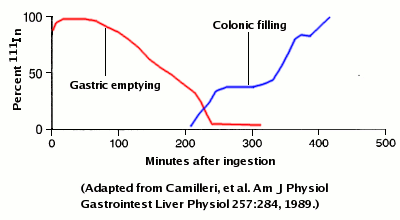
I started wondering how long food stays in the stomach. They say fruit moves through quickly, but can you feel food exiting your stomach, passing through the pylorus to the small intestine?  How does it happen? Bit by bit or in one semi-continuous emptying?  


According to the best website on the topic, "when the peristaltic contraction reaches the pylorus, its lumen is effectively obliterated - chyme is thus delivered to the small intestine in spurts....Liquids readily pass through the pylorus in spurts, but solids must be reduced to a diameter of less than 1-2 mm before passing the pyloric gatekeeper. Larger solids are propelled by peristalsis toward the pylorus, but then refluxed backwards when they fail to pass through the pylorus - this continues until they are reduced in size sufficiently to flow through the pylorus."

If you eat after a meal (i.e. snacking), before the stomach has emptied, what happens? Any liquids or very small bits would almost immediately begin passing the pylorus, but large chunks would swirl in the grinder until they're small enough. But can the stomach segregate new snack bits from older meal bits? Or does adding snacks on top of still-digesting meals slow exit of all food while the stomach continues grinding?  Interestingly, I found out that one of the functions of the stomach is to coagulate colloids (e.g. milk) with acid and protease so that they don't immediately enter the small intestine.

Has does the stomach know when to empty? What controls it? The small intestine can exert negative feedback control on the stomach, slowing down peristalsic emptying if the small intestine is full. In other words, the stomach is a holding tank until the small intestine is ready, and it slows down or speeds up peristalsis to small intestine.

I think even the feeling of intense hunger, which feels like it emanates from the lower stomach, is not the stomach at all but the small intestine communicating, "I'm ready for more!". It is the body speaking to the mind....that raw pang of yearning and focus is the voice of the body.


This website is a great resource!

Monday, April 11, 2011

Physiological Toxicology

Different toxic compounds come to rest in different organs and regions of the body, depending on their mode of transport in the human body. For example, many toxins are "mistaken" for similar compounds, and stored accordingly. Polyaromatic hydrocarbons (PAHs) are fat soluble and look like cholesterol, so they are stored in fat deposits. Lead "looks like" calcium, so it is stored in the bones.

Monday, January 17, 2011

Pourbaix diagram

A Pourbaix diagram is used to show mineral solubility or metal valence, graphed on a Redox (Eh)/pH graph:

Monday, November 15, 2010

Vital Water and Homeostasis

1. Comparing Oxidative-Reductive Potential (ORP) and pH of various foods and drinks to human body fluids, Okouchi et al (2002). 2. The idea of renal net acid excretion (RAE) indicates that homeostasis in animals is mainained against the intake of heterogeneous substances.

1. Okouchi S, Suzuki M, Sugano K, Kagamimori S, Ikeda S. Water Desirable for the Human Body in Terms of Oxidation-Reduction Potential (ORP) to pH Relationship. Journal of Food Science. 2002;67(5):1594-1598.


2. Remer T. Influence of nutrition on acid-base balance--metabolic aspects. European Journal of Nutrition. 2001 October;40(5):214-220.

Sunday, July 04, 2010

How efficient are plants? (part II)

Insolation at Earth's surface (the total solar irradiance, in units of W/m2):


On sunny days, about 1 kilowatt of solar radiation bathes every square meter of the earth's surface every hour. Because of the seasons and weather, the annual average for much of the united states is between 1/2 and 1/3 of this ideal "clear sky" condition.

Photosynthetically Active Radiation, or PAR, is only ~40% of that total, depending on which chlorophyll molecules are present in the plant. Because of physiological requirements, plants actually use an order of magnitude less, usually about 2% of total solar insolation. Of that, orders of magnitude less are available for conversion into biomass. Contrast that with commercial solar arrays that can capture about 20% of the energy in solar radiation!

Either way, the rest of that kW is either reflected or converted to heat...and heat makes the wind blow. A 20mph wind contains enough energy to generate 1 kilowatt per square meter for every hour it blows.

Sunday, February 28, 2010

Winter Olympics: Exercise Physiology


For Crossfit perspective on recovery, see. They don't see much in it, but if you follow the model above, recovery interval is all-important.

Another idea in exercise physiology: "specificity" versus transference.


Wednesday, January 17, 2007

Where the Sinuses (and nasal meati) are...

Yawning, sneezing, breathing from the belly or from the upper chest affect the mucosal lining of our nasal meati (single: meatus), the labyrinths formed above the palate and oral cavity, on either side of the nasal septum, by scroll-shaped bones known as turbinates. As if this complicated spelunking stalactite cave system (connected to the sinuses and the ears) weren't complicated enough, it turns out that the mucus membranes are dynamic, alive, temperamental. They can close off one nostril or the other. They are affected by certain odors, CO2, humidity, pressure, and emotional state. By some accounts this drippy cave of stalactites and boogers acts much like a gas chromatograph, where the heavier or more reactive chemicals are sorbed (either ab- or ad-) onto the membranes first, while the lighter or less reactive ones filter deeper into the cavern. Today, Dr. Bruce Halpern of Cornell confirmed that discrimination is much easier than identification of odors. The trigeminal system includes nerves that enervate throughout the oral and nasal cavity. Interestingly, when the primary olfactory epithelium is not used, menthol and peppermint can still be sensed, presumably by nerves on the roof of the mouth.

At top right is a CT-based reconstruction of the nasal cavity from Zhao et al, 2004. Unfortunately the structure of the turbinates, septum, velum, palate (not to mention sinuses etc) are not easily visible. At lower right is an image from Heilmann and Hummel showing their procedure for discriminating between orthonasal and retronasal smelling. This is usually done under anesthesia, but for the sake of science the smiling volunteer is doing it cold-turkey.