Showing posts with label environmental history. Show all posts

Friday, February 13, 2026

My Attempt to Map a Historic Itinerary

Historic newspapers can be illuminating but also frustrating.  A case in point is the series of articles in the 1864 Arizona Miner detailing "Woolsey's Expedition" in March and April of that year.  

I hoped to deduce some of the actual places visited by the expedition, but the details given were confusing, contradictory, and ultimately insufficient to definitively map where the events took place.  I wonder how many modern newspaper stories, when subject to the same analysis, would fall short?

I analyzed Henry Clifton's account from the May 11, 1864 issue.  The first step was to break the narrative into a numbered itinerary.  I underlined what I thought would be helpful clues, and bolded descriptions I thought would be interesting to compare against present day conditions:


My next step was to try to map the itinerary points on a modern day map.  I added two additionally pieces of information to the text.  First, I looked up that sunrise and sunset were at 6:20am and 6:50pm, respectively. This helps fill in the times for each stop.  Then I filled in the mileage between each stop.  
In the table that follows, question marks indicate uncertainty.  The start and stop points correspond to the itinerary above.


In some cases Clifton gives the mileage, and in some cases the stops can be determined so the mileage can be measured, but in many cases he does not give the mileage.  However, based on the travel and rest times I tried to estimate the mileage.  This can also be constrained by the possible stop locations.  For example, when they stop at a creek or a canyon, there are only so many choices for where that could be.  

This map shows their possible itinerary from Woolsey's ranch to the Apache Rancheria on "Squaw Creek".  Tent icons are campsites and hiking figures are other stops.  

Overview map showing likely itinerary points.

Waypoint #4 makes sense if they followed the drainage downstream from "Cottonwood Spring" SE to the next main drainage that could be described as "east fork of the Aqua Fria".  This fork is now known as Ash Creek.  The "Ash Creek" they named at stop #5 is most likely the next major creek to the SE, which is now known as Little Ash Creek.

My best guesses for stop #4 and stop #5.

Many mysteries remain.  First, they claim to do a lot of hiking at night, but this is extremely rough terrain that would be difficult to navigate by night.  According to the US Naval Observatory historical moon phase calculator, this expedition occurred during the waning last quarter of the moon, so they would not have had much light from the moon.  I don't know what kind of lanterns they had, but they don't describe much difficulty traveling at night, other than a description that they had to "descend carefully" to a creek for stop #7.

At stop #6, which occurred sometime after 10 PM on the night of March 31st, Clifton reports finding species of the garlic family on a ridge.  These small plants seem like they would have been difficult to notice by lantern light.  Interestingly, there are only two species of garlic/onions that grow in this area in the spring now.  One, is Crowpoison, which as the name suggests is toxic.  The other is Largeflower onion, which is not common.  

Second, was the Apache Rancheria at modern Squaw Creek or some other location?  It would make sense that their place name stuck, but Squaw Creek is not exactly a unique name so it is possible that other locations have the same name.  Interestingly these creeks that form the southeast boundary of Perry Mesa have been 
recently renamed Ledni Lii Creek, Gosga Creek, Liya Draw, Che Yagoodiguhn Creek, etc.  I can't find any information about when they were renamed or what the new names mean.

Based on their travel that night from 10 PM until 9 AM and their progress on other legs of the journey, I estimated that they traveled about 10 miles to get there.  However, (for reasons discussed below) I think the site of the Rancheria must have been just upstream of the confluence of Gosga creek and Ilya Draw (AKA North Squaw Creek and Squaw Creek), and this would put them less than 7 miles from camp.  After attacking the Rancheria they managed to get back to camp in less time, so it is possible that they were less than 10 miles from camp.   

Possible site of the Ranchera, upstream of the confluence of Gosga creek and Ilya Draw (AKA North Squaw Creek and Squaw Creek)

In the description of the battle, Clifton states that Company C was west of Company B.  Company B "was in the canon below the rancheria" and chased the Indians up the canyon to where company C was.  Since almost all of the canyons in this part of Arizona run from NE to SW, I had a lot of trouble finding a location where "up canyon" was some westerly.  

Conclusion

Through this exercise of interpreting and attempting to map a historical itinerary, I've come to realize the difficulty of matching newspaper accounts to specific locations.  Without an extremely explicit travelogue, creating a location-based itinerary is either impossible or unreliable.  There were several times when I was ready to give up, but through persevering, rereading the account, and staring at the map I've at least been able to convince myself that some of these locations are approximately correct.  I hope to visit some of these areas in the coming months to retrace the route and add additional information.  

Notes

Note: #PrescottAZHistory blog has an account of Woolsey's expedition that is more of a summary and less of a GIS analysis.  

Note 2: Woolsey organized several expeditions, including a second one in June of 1864 that traversed a much larger area.

Tuesday, July 29, 2025

Quotes from On the Border with Crook

 The past is another country, but in this book it seems like a different planet.  I hadn't been interested in Cowboys & Indians but this military travelogue is a natural history and ethnography of another world.  I've been looking for a good book that describes the endemic historical ecosystems of the Western US and found it in this story of a military officer who followed famous General Crook from one Indian War to another during the 1870's.  

Apparently this book is known as one of the Top Ten books of the Wild West, with stories of when Tucson was a Spanish town, Arizona was Apache territory, and the great plains were full of buffalo.  The writer is thoughtful and observant, and in another or later life might have been an anthropologist.  In reality, he was directly responsible for forcibly removing native peoples from their ancestral lands and the ending of their unbroken lifeways.  But he writes with respect and admiration, and this firsthand account reveals complexities of the American Indian wars that are lost in our modern moralizing view of that time period.

Perhaps it is best to let him speak for himself; these extended quotations offer a window into another world:

P 146: mixing ecology and narrative

The Tonto Basin was well supplied with deer and other wild animals, as well as with mescal, Spanish bayonet, acorn-bearing oak, walnuts, and other favorite foods of the Apaches, while the higher levels of the Mogollon and the other ranges were at one and the same time pleasant abiding-places during the heats of summer, and ramparts of protection against the sudden incursion of an enemy. I have already spoken of the wealth of flowers to be seen in these high places; I can only add that throughout our march across the Mogollon range some eleven days in time-we saw spread out before us a carpet of colors which would rival the best examples of the looms of Turkey or Persia.

Approaching the western edge of the plateau, we entered the country occupied by the Tonto Apaches, the fiercest band of this wild and apparently incorrigible family. We were riding along in a very lovely stretch of pine forest one sunny afternoon, admiring the wealth of timber which would one day be made tributary to the world's commerce, looking down upon the ever-varying colors of the wild flowers which spangled the ground for leagues (because in these forests upon the summits of all of Arizona's great mountain ranges there is never any underbrush, as is the case in countries where there is a greater amount of humidity in the atmosphere), and ever and anon exchanging expressions of pleasure and wonder at the vista spread out beneath us in the immense Basin to the left and front, bounded by the lofty ridges of the Sierra Ancha and the Matitzal; each one was talking pleasantly to his neighbor, and as it happened the road we were pursuing-to call it road where human being had never before passed— was so even and clear that we were riding five and six abreast, General Crook, Lieutenant Ross, Captain Brent, Mr. Thomas Moore, and myself a short distance in advance of the cavalry, and the pack-train whose tinkling bells sounded lazily among the trees-and were all delighted to be able to go into camp in such a romantic spot-when " whiz! whiz!" sounded the arrows of a small party of Tontos who had been watching our advance and determined to try the effects of a brisk attack, not knowing that we were merely the advance of a larger command.

P 127
All sorts of signals are made for the information of other parties of Apaches. At times, it is an inscription or pictograph incised in the smooth bark of a sycamore; at others, a tracing upon a smooth-faced rock under a ledge which will protect it from the elements; or it may be a knot tied in the tall sacaton or in the filaments of the yucca; or one or more stones placed in the crotch of a limb, or a sapling laid against another tree, or a piece of buckskin carelessly laid over a branch.  All these, placed as agreed upon, afford signals to members of their own band, and only Apaches or savages with perceptions as keen would detect their presence.

The Apache was a hard foe to subdue, not because he was full of wiles and tricks and experienced in all that pertains to the art of war, but because he had so few artificial wants and depended almost absolutely upon what his great mother-Nature stood ready to supply. Starting out upon the war-path, he wore scarcely any clothing save a pair of buckskin moccasins reaching to mid-thigh and held to the waist by a string of the same mate-rial; a piece of muslin encircling the loins and dangling down behind about to the calves of the legs, a war-hat of buckskin surmounted by hawk and eagle plumage, a rifle (the necessary ammunition in belt) or a bow, with the quiver filled with arrows reputed to be poisonous, a blanket thrown over the shoulders, a watertight wicker jug to serve as a canteen, and perhaps a small amount of "jerked" meat, or else of " pinole" or parched corn-meal.
That is all, excepting his sacred relics and " medicine,"

P 125
Unlike the Indians of the Plains, east of the Rocky Mountains, the Apache rarely become good horsemen, trusting rather to their own muscles for advancing upon or escaping from an enemy in the mountainous and desert country with which they, the Apaches, are so perfectly familiar. Horses, mules, and donkeys, when captured, were rarely held longer than the time when they were needed to be eaten; the Apache preferred the meat of these animals to that of the cow, sheep, or goat, although all the last-named were eaten. Pork and fish were objects of the deepest repugnance to both men and women; within the past twenty years-since the Apaches have been enrolled as scouts and police at the agencies-this aversion to bacon at least has been to a great extent overcome; but no Apache would touch fish until Geronimo and the men with him were incarcerated at Fort Pick-ens, Florida, when they were persuaded to eat the pompano and other delicious fishes to be found in Pensacola Bay.

P 177
Man's inhumanity to man is an awful thing. His inhumanity to God's beautiful trees is scarcely inferior to it. Trees are nearly human; they used to console man with their oracles, and I must confess my regret that the Christian dispensation has so changed the opinions of the world that the soughing of the evening wind through their branches is no longer a message of hope or a solace to sorrow.

P 158
Prescott has the distinction of being thoroughly American. Prescott was not merely picturesque in location and dainty in appearance, with all its houses neatly painted and surrounded with paling fences and supplied with windows after the American style-it was a village transplanted bodily from the centre of the Delaware, the Mohawk, or the Connecticut valley. Its inhabitants were Americans; American men had brought American wives out with them from their old homes in the far East, and these American wives had not forgotten the lessons of elegance and thrift learned in childhood. Everything about the houses recalled the scenes familiar to the dweller in the country near Pittsburgh or other busy community. The houses were built in American style; the doors were American doors and fastened with American bolts and locks, opened by American knobs, and not closed by letting a heavy cottonwood log fall against them.

P276
What with the cold threatening to freeze us, the explosions of the lodges sending the poles whirling through the air, and the leaden attentions which the enemy was once more sending in with deadly aim, our situation was by no means agreeable, and I may claim that the notes jotted down in my journal from which this narrative is condensed were taken under peculiar embarrassments.

"Crazy Horse's" village was bountifully provided with all that a savage could desire, and much besides that a white man would not disdain to class among the comforts of life:
There was no great quantity of baled furs, which, no doubt, had been sent in to some of the posts or agencies to be traded off for the ammunition on hand, but there were many loose robes of buffalo, elk, bear, and beaver; many of these skins were of extra fine quality. Some of the buffalo robes were wondrously embroidered with porcupine quills and elaborately decorated with painted symbolism. One immense elk skin was found as large as two and a half army blankets; it was nicely tanned and elaborately ornamented. The couches in all the lodges were made of these valuable furs and peltries. Every squaw and every buck was provided with a good-sized valise of tanned buffalo, deer, elk, or pony hide, gaudily painted, and filled with fine clothes, those of the squaws being heavily embroidered with bead-work. Each family had similar trunks for carrying kitchen utensils and the various kinds of herbs that the plains' tribes prized so highly. There were war-bonnets, strikingly beautiful in appearance, formed of a head-band of red cloth or of beaver fur, from which depended another piece of red cloth which reached to the ground when the wearer was mounted, and covered him and the pony he rode. There was & crown of eagle feathers, and similar plumage was affixed to the tail-piece. Bells, ribbons, and other gew-gaws were also attached....

P. 310: Battle of the Rosebud
By daylight of the next day, June 17, 1876, we were marching down the Rosebud.  The Crow scouts with whom I was had gone but a short distance when shots were heard down the valley to the north, followed by the ululation proclaiming from the hill-tops that the enemy was in force and that we were in for a fight. Shot after shot followed on the left, and by the time that two of the Crows reached us, one of them severely wounded and both crying, "Sioux! Sioux!" it was plain that something out of the common was to be expected.

p. 380: "Horse Meat March"
We marched comparatively little the next day, not more than twenty-four miles, going into camp in a sheltered ravine on the South Fork of the Grand River, within sight of the Slim Buttes, and in a position which supplied all the fuel needed, the first seen for more than ninety miles, but so soaked with water that all we could do with it was to raise a smoke. It rained without intermission all day and all night, but we had found wood, and our spirits rose with the discovery; then, our scouts had killed five antelope, whose flesh was distributed among the command, the sick in hospital being served first. Plums and bull berries almost ripe were appearing in plenty, and gathered in quantity to be boiled and eaten with horse-meat. Men were getting pretty well exhausted, and each mile of the march saw squads of stragglers, something which we had not seen before; the rain was so unintermittent, the mud so sticky, the air so damp, that with the absence of food and warmth, men lost courage, and not a few of the officers did the same thing. Horses had to be abandoned in great numbers, but the best of them were killed to supply meat, which with the bull berries and water had become almost our only certain food, eked out by an occasional slice of antelope or jack rabbit.

The 8th of September was General Crook's birthday; fifteen or sixteen of the officers had come to congratulate him at his fire under the cover of a projecting rock, which kept off a considerable part of the downpour of rain; it was rather a forlorn birthday party, nothing to eat, nothing to drink, no chance to dry clothes, and nothing for which to be thankful except that we had found wood, which was a great blessing. Sagebrush, once so despised, was now welcomed whenever it made its appearance, as it began to do from this on; it at least supplied the means of making a small fire, and provided the one thing which under all circumstances the soldier should have, if possible. Exhausted by fatiguing marches through mud and rain, without sufficient or proper food, our soldiers reached bivouac each night, to find only a rivulet of doubtful water to quench their thirst, and then went supperless to bed.

In all the hardships, in all the privations of the humblest soldier, General Crook freely shared; there was no mess in the whole column which suffered as much as did that of which General Crook was a member; for four days before any other mess had been so reduced we had been eating the meat of played-out cavalry horses, and at the date of which I am now writing all the food within reach was horsemeat, water, and enough bacon to grease the pan in which the former was to be fried. Crackers, sugar, and coffee had been exhausted, and we had no addition to our bill of fare beyond an occasional plateful of wild onions gathered alongside of the trail. An antelope had been killed by one of the orderlies attached to the headquarters, and the remains of this were hoarded with care for emergencies.

Cheyenne names
Thunder Cloud
Blown Away
Singing Bear
Fast Thunder
Black Mouse
Shuts the Door
Horse Comes Last

Arapahoe names
Sleeping Wolf
Red Beaver
Sitting Bul
Yellow Owl
Singing Beaver

Thursday, March 24, 2016

Tama Hills and Environmental Consciousness in Japanese Anime Films


In 1994 Studio Ghibli produced Pom Poko, (directed by Isao Takahata) a trippy animated film about a community of magical shape shifting raccoons desperately struggling to prevent their forest home from being destroyed by urban development.  The movie draws heavily on traditional Japanese folklore (especially the reputed power of the raccoon's testicles), but the setting is the 1960's rapid conversion of the Tama hills rural farmland into planned suburbs of Tokyo (called Tama New Town).

In 1995, Studio Ghibli came out with a very different film.  Whisper of the Heart is a realistically-animated love story about a teenage girl who loves reading books, and the boy who had previously checked out all of the library books she chooses.  It was set in a peaceful suburb in the hills of West Tokyo.  Specifically, the Tama hills.

Development of Tama Hills, as depicted in Pom Poko.

Scenes from Whisper of the Heart:
Walking along Tama Hills, above Tama River.

Walking along Tama River, toward Tama Hills.
It is difficult to describe the cognitive dissonance these two films create.  The first, a story of animals defending nature against human development, and the second, a human-centered love story set in that very development.

Tama Hills (Tama New Town), Tokyo.  Yes, those are golf courses on the hills.  There is an amusement park, too.
Map.

The main character, Shizuku, in Whisper of the Heart even composes a song, set to the tune of "Country Road".  She and her friend Yuuoko sing it together.

"Konkuriito roodo, doko made mo
Mori wo kiri, tani wo ume
Uesto Toukyou, Maunto Tama
Furusato ha, konkuriito roodo

Concrete Roads, to everywhere
Cutting forests, burying valleys
West Tokyo, Mount Tama
My home town is a concrete road...

(both laugh)"

(transcribed by Nausica.net)

Teenage lovers from Whisper of the Heart, overlooking Tokyo from Tama Hills.


It is possible to visit many of the locations that were used in Whisper of the Heart.

Young raccoon lovers from Pom Poko, overlooking Tokyo from Tama Hills.

More information about locations that inspired Japanese animated films.

Friday, January 24, 2014

Restoration Quandraries

"Playing God with Nature" can be funny as well as drop-dead serious.  On the funny side of things:

Nature Conservancy scientists are tooth-brushing corals to keep the clean.  A massive nursery effort is working to transplant corals to bleached-reefs.  Coral organisms are symbionts, like lichen.  When the coral are stressed from water pollution, eutrophyication, high temperatures, or acid water (from CO2) they may jetison their symbiotic algae.  So, unlike bleached teeth, a bleached reef is not a pretty sight.  The vainglorious restoration hope is to stay ahead of some of the myriad problems affecting corals, which have seen a 95% decrease in the Caribbean.  If viable breeding populations of the Endangered corals can be maintained, they just might have enough time to evolve or adapt resistance and resilience to climate change.     However, there are not enough sea urchins  in the collapsed-ecosystem of the bleached reef to eat algae growing over the coral.  Some people say the sea urchins got sick, but whatever their problem, nature conservancy divers are forced to go down with toothbrushes to try and save transplanted baby corals. source.  

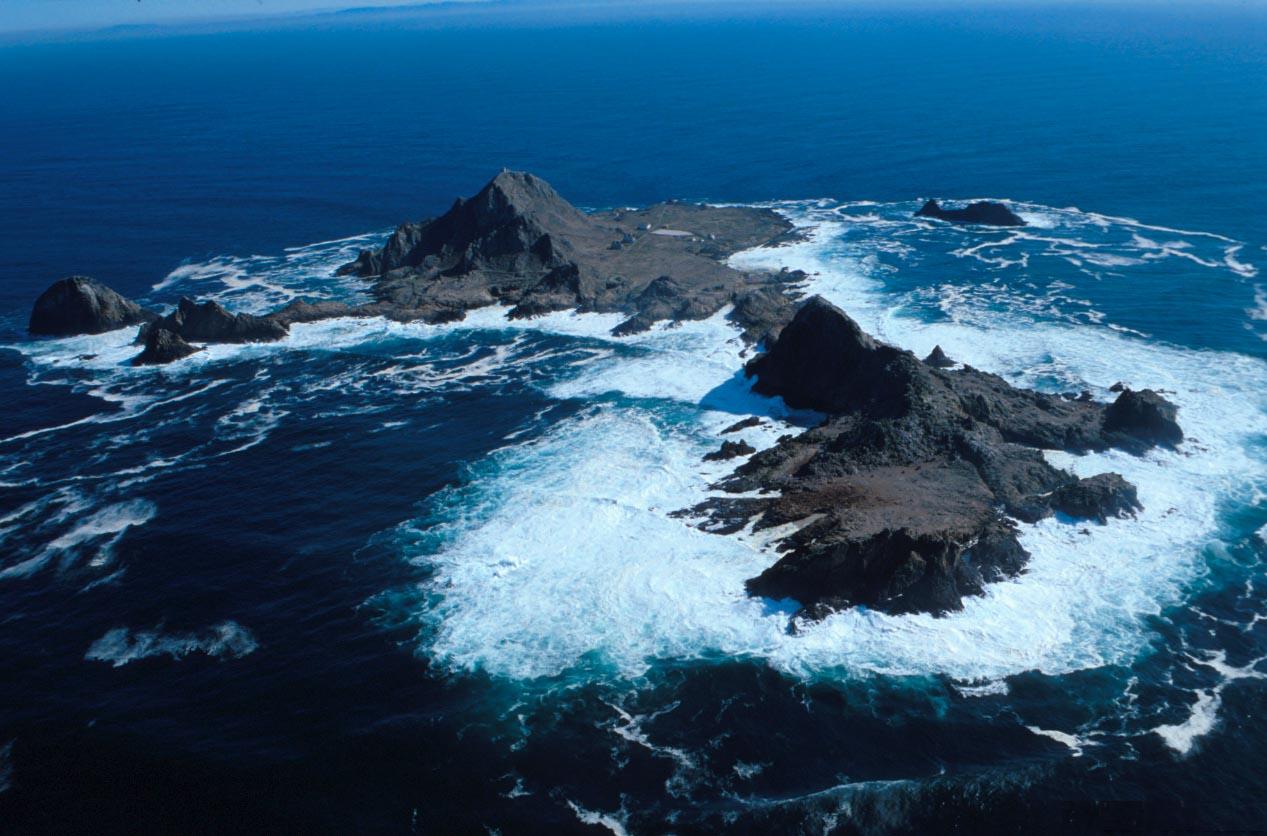
Audubon magazine reports USFWS using EPA-outlawed rodent poison on breeding bird colonies.  The islands are threatened by invasive mice, but not by eating seabird eggs.  Instead, the profligate creatures entice great horned owls to set up shop.  But Great Horns are Super Predators: when they eat all the mice, they turn to eating shorebird eggs and chicks.  So the fact that poisoning the mice laces them with toxins that bioaccumulate up the food chain is justified -- because the ultimate environmental victims are ecological bullys. (Farallon Islands.)  These photos show the underwater environment.

Speaking of Farallon Islands: instead of eating bycatch (popular in New Orleans now), some advocate repressurizing stunned fish such as this rockfish whose swim bladder has tripled in size, pushing his eyes out of his head.  Yes, they do revive using proper technique. Rockfish are exceptionally long-lived and slowly reproducing so repressurization is probably an ecologically sound, if unlikely, response to catching one.  This is the best blog, BTW for NE Pacific Ocean natural history.
Bighorn sheep reintroduction ends up becoming a feeding frenzy for local Catalina mountain lions.  31 bighorn sheep were reintroduced to the mountains outside tucson, after an unexplained absense since the 1990's.  Since then, 7 (as of this writing) have been eaten by the resident mountain lions, who are being hunted by AZ Game and Fish to try to save the sheep.  The mountain lions, as discerning diners, posted yelp reviews of the "succulent" new menu item, but take exception to the rude retaliation.  And please don't imply them engaging in "High Mountain Lion Activity"!  Delightful dining on the Bighorn Experience dissolves into dangerous experience.  4 out of 5 stars.


Monday, November 15, 2010

Toxic Bodies by Nancy Langston

"Toxic Bodies: Hormone Disruptors and the Legacy of DES" explores why our environment has become saturated with synthetic chemicals that disrupt hormones, and asks what we can do to protect human and environmental health. In this thorough undertaking, Environmental Historian Nancy Langston examines endocrine disruptors as a case study of environmental risk assessment and response. Interesting to compare this book's stance on weight-of-evidence to Our Stolen Future or The Secret History of the War on Cancer by Devra Davis. Compare that to a more formal report by the American Institute for Cancer Research.

Sunday, October 11, 2009

The Magical North Central Texas that Used To Be


North Central Texas is composed of three major ecosystems, the Cross Timbers, Black Prairie, and Fort Worth Prarie. Less than 150 years ago, sparkling streams were abundant with trout, perch, and catfish...and alligators! Indeed, Kendall (1845) found alligators along the San Gabriel in the southern Blackland Prairie as "too plentiful for any useful purposes." Black bear were also common, along with mountain lion. Brooke (1848) reports gray wolves as far east as McLennan County, ocelot in bottoms of Brazos River near Waco in McLennan County. The last jaguar record was a large male killed in Mills County (Lampasas Cut Plain) in 1903.

Other vanished creaturs out of this Noah's Ark world include river otter, ringtail (a cat-like creature), badger, javalina (collared peccary), bison, pronghorn antelope, turkeys, and prarie chickens. Many of these animals still persist in zoos or mountains out west, but some cannot be found anywhere on the planet. For example, both the ivorybilled woodpecker and the carolina parakeet, once found near modern day Dallas/Ft. Worth, are extinct.

Estimates of the destruction of the Blackland Prairie ecosystem range from 98% (Hatch et al 1990) to 99% (Riskind and Collins 1975) to more than 99.9% (Burleson 1993). Some of the last remnants can still be seen at the Nature Conservancy's Clymer Meadow Preserve. Slightly more Fort Worth Prarie and Cross Timbers survive. Dyksterhuis (1946) studied relics of the Fort Worth Prairie, and, surprisingly, Cross Timbers are still one of the largest relatively unaltered forest vegetation types in the eastern United States (Stahle &Hehr 1984), but there are more in Oklahoma, for example, Pontotoc Ridge Preserve. Examples of old-growth Cross Timbers forests in North Texas are found in Comanche County (Leon River), Tarrant County (Fort Worth Nature Center), and Throckmorton County (Nichols Ranch).

Prairie remnants are threatened by eastern red cedar (Juniperus virginiana) and cedar elm (Ulmus crassifolia) because of a lack of natural fire. Results include reduction in broad-leaved plants and increased abundance of grasses. (Diamond & Meins 1993). Over much of the slope-lands, as muich as three feet of soil have been eroded, exposing barren rock where once was prairie soil (Hayward &Yelderman 1991). So, although remnants remain, they are often degraded by various human activities such as heavy grazing or selective cutting and their authenticity is rarely noticed or protected.....I wonder how many people realize what used to be?

Much of this text, and the image, are from Shinner's and Mahler's Illustrated Flora of North Central Texas, published by Botanical Research Institute of Texas.

More great info about Texas Native Plants, from the Plant Resources Center at UT - Austin.

Friday, June 20, 2008

Southwest Exploration: A Timeline and Bibliography

The more I study ecology, the more I need to study history. Everything from the extinction of the paleolithic megafauna through the grenshorizont of peatland bog studies (shift in peat formation two to three thousand years ago as the midwest became wetter and cooler) to the presence or absence of bufalo (Bison bison bison) in the Arid West....Ecology is paleoecology, which is forensic and contingent on largely unknowable past events. But without that past the changing movie of life is only a single strobe, an event, a stained glass window that we can look at but now through. This perspective is important for science, but equally important for public policy. We can't protect what we've already forgotten.

Below is a partial list of early explorers and colonists of the American Southwest, especially New Mexico, which has a 500+ year written history. We desperately need an ecological historian to compile these original observations, translate and condense, collate, draw conclusions, and eventually inbed it all in a google earth kml layer, like the Mannahata project.

This is a New Mexico centric list, prepared with much help from to William Goetzmann http://www.nps.gov/history/history/categrs/explr/biblio-g2.htm and Ruth Marie Colville, "La Vereda: A Trail through Time."

1537 Cabeza de Baca seven year trek from Texas to Sea of Cortez, fording the Rio Grande "breast high".
Journal: unreliable "recounting"
Book: Cyclone Covey, ed. And trans., Cabeza de Vaca's Adventures in the Unknown Interior of America, Univ. of NM Press, Albuquerque, NM, 1993.

1540 Francisco Coronado two years exploring Rio Grande Valley as far north as Taos, east to Kansas, west [in]to the Grand Canyon.
Journal: ?
Book: Coronado, Knight of Pueblo and Plains, Univ. NM Press, by Herbert E. Bolton, Albuquerque, NM, 1964
Book:[?]Pedro de Castañeda, The Journey of Coronado, repr., Dover, San Francisco, 1990,

1580 Rodrigues expedition: Fray Augustin Rodrigues and Captain Francisco Chamuscada. Rio Grande valley east to Pecos River
Journal: "Relaciones"

1582 Espejo party rescue mission: Antonio Espejo went east beyond the Manzano Mountains, west to ZUni and Hopi, as far as Flagstaff, then back home along the Pecos.
Journal: Diego Perez de Lujan

1590 Gaspar Castano de Sosa illegal colonization: went up the Pecos river to Pecos Pueblo
Journal: Castano de Sosa.
Book: "A Colony on the Move" by Albert Schroeder and Dan Matson.

1598 Don Juan de Onate colonization, settled at head of Espanola Valley.


1776 Escalante Expedition from Santa Fe, through SW Colorado, SE Utah, and NE Arizona.
Book: Bolton, Pageant in the Wilderness: The Story of Escalante's Expedition to the Interior Basin, 1776, Univ. of Utah,Salt Lake City, Utah, 1950,


1806 Pike Expedition: Zebulon Pike
Journal: "The expeditions of Zebulon Montgomery Pike to headwaters of the Mississippi River, through Louisiana Territory, and in New Spain, during the years 1805-6-7
Book: Donald Jackson, ed., The Journals of Zebulon Montgomery Pike With Letters and Related Documents, U. of Oklahoma Press, Norman, OK, 1966.
Book:Elliott Coues, The Expeditions of Zebulon Montygomery Pike, 2 vols., Dover, NY, 1987.

1821 Fowler Adventure to eh Sources of the Rio Grande
Jounral: Cous, E. (editor) 1965 The Journal of Jacob Fowler: Narrating an Adventure From Arkansas Through the Indian Territory, Oklahoma, Kansas, Colorado, and New Mexico, to the Sources of the Rio Grande Del Norte, 1821-1822. Ross & Haines, Inc., Minneapolis, MN.

1846 Kearny-Emory expedition. US Mexico Boundary Survey. Lieutenant W.H. Emory. Arkansas, Del Norte, and Gila rivers
Book: Ross Calvin, ed., Lieutenant Emory Reports: A Reprint of Lieutenant W.H. Emory's Notes of a Military Reconnaissance, U. of NM Press, Albuquerque, NM, 1951.
Book: William H. Emory, Report on the United States and Mexican Boundary Survey, 3 vols., 34th Cong. 1st Sess. H. Exec. Doc. 135, Serial 861-63, Washington, D.C., 1857-59, and repr. William H. Goetzmann, ed, 3 vols., TSHA, Austin, TX, 1997.
Book: John Russell Bartlett, Personal Narrative of Explorations and Incidents in Texas, New Mexico, California, Sonora and Chihuahua, Connected With the United States and Mexican Boundary Commission During the Years 1850, '51, '52 and '53,, 2 vols., Appleton, NY, 1854, repr., 2 vols., Rio Grande Press, Chicago, IL, 1965.
Book: Dawn Hall, ed., Drawing the Borderline: Artist-Explorers and the U.S.-Mexico Boundary Survey, The Albuerque Museum, Albuquerque, NM, 1996, P.B.

1849 Washington Expedition to make peace or prosecute a war with the Navajo
Book: Navajo Expedition: Journal of a Military Reconnaissance from Santa Fe, New Mexico to the Navvaho Country Made in 1849 by James H. Simpson, Durwood Ball, Frank McNitt

1851 Sitgreaves
1853 Whipple
1854 Parke
1854 Pope
[misc ]
see Herbert E. Bolton, Spanish Exploration in the Southwest, 1542-1706, Scribner, NY, 1916, repr. Barnes & Noble, 1995, ...

David Weber, The Taos Trappers, the Fur Trade in the Far Southwest, 1540-1846, U. of Oklahoma Press, Norman, OK, 1982.

Ralph P. Bieber, ed., Exploring Southwestern Trails, 1846-1854, Clark, Glendale, CA, 1938, William H. Emory,

Thursday, March 27, 2008

The Natural West: Environmental History in the Great Plains and Rocky Mountains by Dan L. Flores
I disagree with the assertion that, just because aboriginal hunter-gatherer societies didn't practice (efficient) resource management or population control, aboriginal peoples share our modern day ecological failings. For, despite the causes of the Pleistocene extinctions, it does appear that Native Americans lived in North America for 12,000 years without bumping off many, or even any, of their animal neighbors (an achievement we moderns seem unlikely to match).

Flores argues that the disparity in environmental damage between Moderns and aboriginals is merely one of degree, and that somehow this ecological disharmony is hardwired into the 'carnivorous, clan and kin-centered primate brain'.

I would like to point out that all animals create or accumulate additional or enhanced habitat for their neighbors. Modern humans, not hunter-gatherers, are the only exception to this rule, with out urban deserts and suburban shopping centers. Aboriginal peoples, as long as they utilized local resources, invariably created more habitat and enhanced ecologies. Of course, the proof of this assertion is (hundreds of?) years of back-breaking ecological fieldwork measuring productivity and species richness.

The Eternal Frontier: An Ecological History of North America and Its Peoples by Tim Flannery
What's the difference between centripetal and centrifugal evolution? Despite needing better editing and a careful cross-checking of important numbers (pre-1492 population of the Americas anyone?), this is an inspiring book with lots of grist for the mental mill. In the interest of Big Ideas this book (written at Harvard don't you know) plays loose and easy with facts and rhetoric, often glossing important points and proclaiming rather than analyzing. But the Big Ideas are worth it! The parallel between the 300 year heyday and collapse of Clovis culture (11,000BC-12,700BC) and the 300-year opening of the American frontier (1580AD -1880 AD), the influence that growing weeds (succesional colonizers) as crops had on creating r-selected (weedy) society, the placing in context of our own extinction event with the last 100 million years of extinction and colonization events...the analysis and structure are a bit thin but the gist is pure gold...plus hearing an Aussie psychoanalyze America is priceless. I can't wait to read his parallel account of Australia's last 300 million years, "The Future Eaters."

Flanery asks whether a "nation so conceived in liberty can long endure" and compares the mindset of "liberty" with that of a weed (which most of our crops are) that experiences "release" in a new environment before adaptation sets in. When will Americans adapt to America and become truly native? Maybe once we've all read this book...

It is only at the end of the book that we discover how all this history answers Aldo Leopold's assertion that we must "know what the world was like" in order to save the environment. Flanery comes out strongly in favor of restoring parts of America to pre-Clovis (pre-human, approximately 13,000 years ago) conditions. By reintroducing extirpated animals as well as analogs or homologs of extinct animals, he hopes to restore America to "rival Africa" in terms of large mammal diversity, as well as creating balanced and sustainable ecosystems. Its amazing to think that where we live used to look like the Serengeti, or the Costa Rican rainforest. But, according to Flanery, we still have the choice to put things back how they were. Wolf reintroduction anyone?