Thursday, April 17, 2014
Water-year to Date Departure from Normal
The area East of Carlsbad, NM in Eddy county going into Lea county has had 2-4 or even 6 inches more rain than normal since October 1st. The figure above shows that this is almost triple the normal precipitation in places. The mesquite is bright green and there are many flowers, despite below-freezing temperatures at the beginning of the week. A good place for some springtime botany!
Tuesday, February 04, 2014
Passion-flower Distribution in the Sonoran Ecoregion
![]() |
| Source: SEINet |
Passiflora (Passion flower vine) is a tropical genera of vines, which reach their northernmost distribution with P. mexicana in the Santa Teresa mountains, North of the Gila River. They produce edible passion fruits, but the herbiage is extremely unpalatable to animals, to the point that (reportedly) starving horses will not eat P. foetidius due to the stinky sticky hairs.
I have never seen these monsoon-bloomers in the wild in Arizona, but hope springs eternal in the Sky Islands...there are three species in Arizona: P. arizonica, P. bryonoides, and P. mexicana:
P. arizonica ca 4-5.5 cm in diameter, whitish, the corona white or purplish.
P. bryonioides ca. 2.5-4.5 cm in diameter, whitish with purplish bands on corona.
P. mexicana ca. 2-3 cm in diameter, light green or yellowish green, the corona red or reddish purple.
There are two more species in the Sonoran Desert south of the border:
P. palmeri (no description available)
P. suberosa (no description available)
Monday, February 03, 2014
Range Monitoring on Chihuahan Desert Grasslands
We helped out with a long-term monitoring project at a ranch in Southwestern New Mexico.
Diverse plots contained upwards of 30 perennial grass and forb species, plus half a dozen shrubs. Degraded areas might contain only three or four annual, weedy species. We found evidence of ecosystem engineers like termites and banner-tailed kangaroo rats. Also, the remains of last year's grasshoppers were thick in the better grasslands. Interestingly, the only mole we found was in the one of the most degraded sites, an area with only sparse annual grasses -- not much roots for a mole to munch!
| Reading a vegetation transect line in a thick Giant Sacaton (Sporobolus wrightii) flat. More photos. |
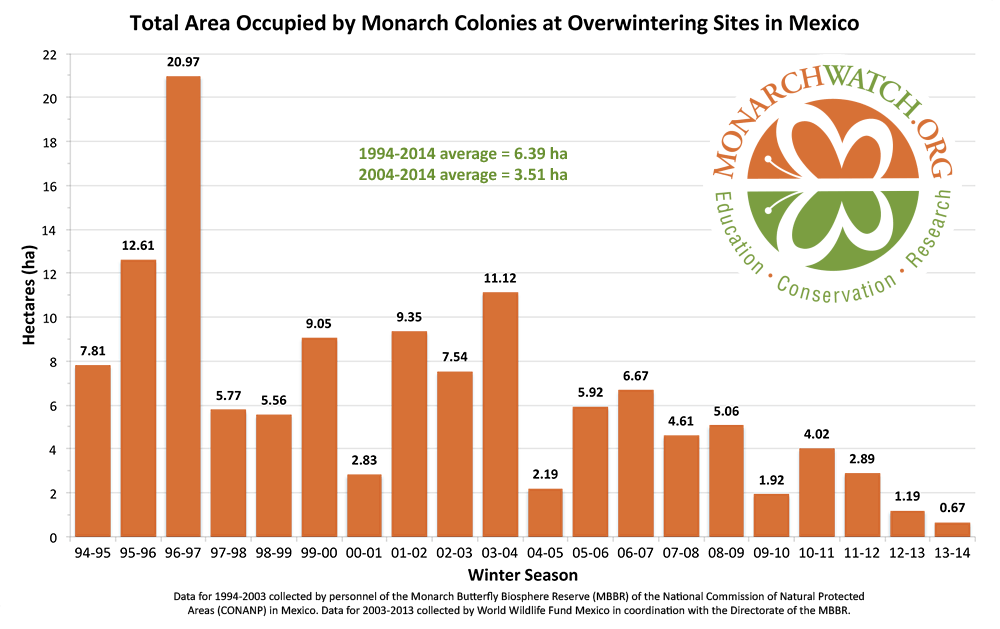
Monarch Decline Blamed on Changing US Agriculture
| Graph of returning migration Monarch Butterflies from MonarchWatch.org |
CBS quoted entymologist Lincoln Brower: "The main culprit," he wrote in an email, is now genetically modified "herbicide-resistant corn and soybean crops and herbicides in the USA," which "leads to the wholesale killing of the monarch's principal food plant, common milkweed."
The website MonarchWatch.org has the best in-depth analysis of the triple threat of habitat loss. What to do? Plant milkweed!
Cows eat grass...and Rain grows grass (!)
Grasslands can recover from grazing, provided there is sufficient moisture to grow. Arid environments often lack moisture, so recovery can be extremely slow (Valone et al) or nonexistent. That is the overarching conclusion of several long-term vegetation studies in Arizona and New Mexico. Shrub removal can increase grass cover, but at low levels shrubs do not seem to compete with grasses. At the Santa Rita experimental range, south of Tucson, invasive species pushed aside native grasses, but then all vegetation cover decreased during the following 20-year drought.
It may sound obvious that grazing can decrease grass cover and that it may take several wet years to regain aboveground growth. Range science has long advocated for differential season of grazing, or intensive grazing, or other management alternatives, but some studies such as Mashiri et al find no long-term differences between management methods.
A recent study from Bestelymeyer et al did find some slight differences between winter- and summer-season grazing, but they were the opposite differences that traditional range science manuals would predict for Black Grama grass!
![]() |
| Figure from Bestelmeyer et al. Black Grama grass cover on the Jornada Experimental Range decreased with grazing and increased following grazing. |
References:
Bestelmeyer, Brandon T., Duniway Michael C., James D.K., Burkett L.M., and Havstad Kris M. A test of critical thresholds and their indicators in a desertification-prone ecosystem: more resilience than we thought. Ecology Letters, 01/2013, Volume 16, p.339-345, (2013)
Mashiri, F., M. McClaran, and J.S. Fehmi. 2008. Short- and Long-term Vegetation Change Related to Grazing Systems, Precipitation and Mesquite Cover. Rangeland Ecology and Management 61:368-379.
Valone, T. J., Meyer, M., Brown, J. H. and Chew, R. M. (2002), Timescale of Perennial Grass Recovery in Desertified Arid Grasslands Following Livestock Removal. Conservation Biology, 16: 995–1002.
Saturday, January 25, 2014
Keystone pipeline presents environmental quandary
![]() |
| This was a boreal forest. |
Mining proponents point out that the tar sands oil will be mined even without the pipeline. Trains would carry tar sands oil if Obama denies the pipeline. But trains are (apparently) more risky than pipelines in terms of frequency of spills (what about size of spills?). So not building the pipeline could actually result in worse environmental consequences. Catch 22?
What if....instead of building the keystone pipeline, we reduced the equivalent amount of energy (negawatts) by guaranteeing loans or rebates or tax incentives on geothermal systems. Solar panels on roofs are nice, but electric technology has a shorter lifespan, whereas geothermal heating and cooling is a truly long-term infrastructure investment. Cutting off supply only works if we reduce demand.
More photos. Video presentation.
Friday, January 24, 2014
Restoration Quandraries
"Playing God with Nature" can be funny as well as drop-dead serious. On the funny side of things:
![]() |
| Nature Conservancy scientists are tooth-brushing corals to keep the clean. A massive nursery effort is working to transplant corals to bleached-reefs. Coral organisms are symbionts, like lichen. When the coral are stressed from water pollution, eutrophyication, high temperatures, or acid water (from CO2) they may jetison their symbiotic algae. So, unlike bleached teeth, a bleached reef is not a pretty sight. The vainglorious restoration hope is to stay ahead of some of the myriad problems affecting corals, which have seen a 95% decrease in the Caribbean. If viable breeding populations of the Endangered corals can be maintained, they just might have enough time to evolve or adapt resistance and resilience to climate change. However, there are not enough sea urchins in the collapsed-ecosystem of the bleached reef to eat algae growing over the coral. Some people say the sea urchins got sick, but whatever their problem, nature conservancy divers are forced to go down with toothbrushes to try and save transplanted baby corals. source. |
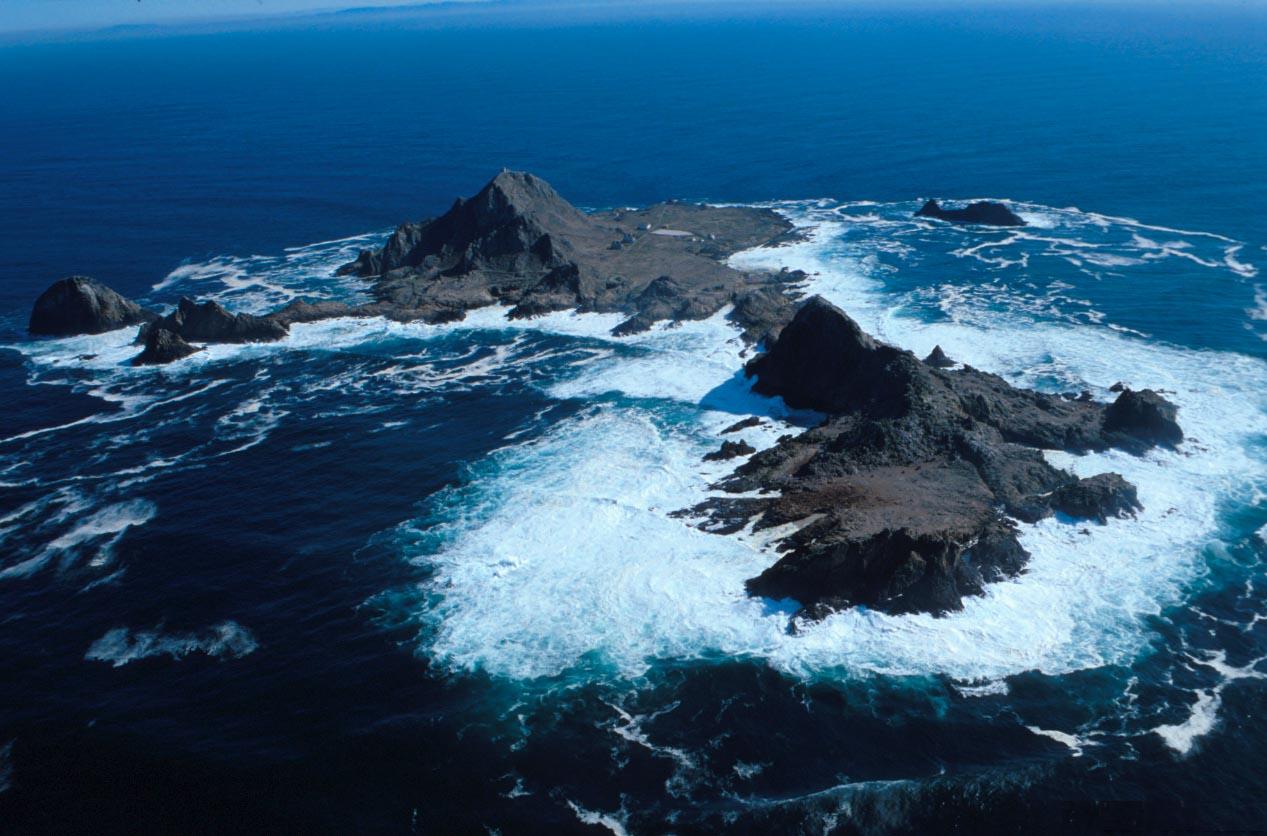
Audubon magazine reports USFWS using EPA-outlawed rodent poison on breeding bird colonies. The islands are threatened by invasive mice, but not by eating seabird eggs. Instead, the profligate creatures entice great horned owls to set up shop. But Great Horns are Super Predators: when they eat all the mice, they turn to eating shorebird eggs and chicks. So the fact that poisoning the mice laces them with toxins that bioaccumulate up the food chain is justified -- because the ultimate environmental victims are ecological bullys. (Farallon Islands.) These photos show the underwater environment.
Speaking of Farallon Islands: instead of eating bycatch (popular in New Orleans now), some advocate repressurizing stunned fish such as this rockfish whose swim bladder has tripled in size, pushing his eyes out of his head. Yes, they do revive using proper technique. Rockfish are exceptionally long-lived and slowly reproducing so repressurization is probably an ecologically sound, if unlikely, response to catching one. This is the best blog, BTW for NE Pacific Ocean natural history. ![]() Bighorn sheep reintroduction ends up becoming a feeding frenzy for local Catalina mountain lions. 31 bighorn sheep were reintroduced to the mountains outside tucson, after an unexplained absense since the 1990's. Since then, 7 (as of this writing) have been eaten by the resident mountain lions, who are being hunted by AZ Game and Fish to try to save the sheep. The mountain lions, as discerning diners, posted yelp reviews of the "succulent" new menu item, but take exception to the rude retaliation. And please don't imply them engaging in "High Mountain Lion Activity"! Delightful dining on the Bighorn Experience dissolves into dangerous experience. 4 out of 5 stars. |
Hydrophobic soils after fire? All soils are more or less hydrophobic...
As explained by "Geomorphology: Themes and Trends". The book is worth it just for the classic essay on erosion and runoff. A combination, it turns out, of pore size and particle characteristics.
These images are from Chapter 5, "Geomorphological processes, soil structure, and ecology" written by A.C Imeson. Yes, the x-axis is scaled as square-rooted minutes.
Plant roots can change both the permeability and wettability of soil (as well as many other qualities). For more information, read Reid, TB and Goss, MJ. 1981. Effect of living roots of different plant species on the aggregate stability of two arable soils. Journal of Soil Science.
The book also has a chapter on the Geomorphology of stream channels and craters on Mars!
Saturday, January 18, 2014
Salvage Logging is Not Supported by Published Research
I completed a literature review on the effects of salvage logging (SL). I read all of the major papers, including the two extant literature reviews, the old Forest Service-funded one by McIver and Starr, and the newer one by conservation ecologists Lindemeyer and Noss. The conclusions are consistent: in general, SL increases fire risk, increases erosion, reduces wildlife habitat, and impairs natural recovery. SL has the potential to be much more detrimental than traditional (green) logging (Lindenmeyer and Noss 2006).
*Reduced wildlife habitat: Most wildlife species rely on dead trees in one way or another. Of the 102 terrestrial vertebrate species in Washington State, over half (56) require dead tree boles (snags) to nest or den (Hutto 2006). Across the West, 150 species of vertebrates rely on dead trees for nesting or denning (Rose et al 2001).
*Impaired natural vegetation recovery: SL results in increased mortality of pine seedlings (Castro et al 2011).
Going forward, there needs to be broader recognition of the ability of ecosystems to recover from natural disturbances and the essential role of biological legacies (in this case, dead burned trees) in the maintenance of biodiversity and ecosystem processes (Lindenmeyer, Burton, and Franklin, 2008). Those burned trees are hard at work shepherding the forest back to life, not wasted timber that must be "salvaged".
| Natural post-fire erosion can deplete soil, further impairing vegetative recovery. Human disturbance can compact soils and channelize flow paths, thereby exacerbating natural erosion. |
*Reduced wildlife habitat: Most wildlife species rely on dead trees in one way or another. Of the 102 terrestrial vertebrate species in Washington State, over half (56) require dead tree boles (snags) to nest or den (Hutto 2006). Across the West, 150 species of vertebrates rely on dead trees for nesting or denning (Rose et al 2001).
| Less than three months post-fire, bark beetles in the Jemez Mountains, NM were so active they created large piles of sawdust. Needless to say, woodpeckers were extremely active in this area. |
*Impaired natural vegetation recovery: SL results in increased mortality of pine seedlings (Castro et al 2011).
Going forward, there needs to be broader recognition of the ability of ecosystems to recover from natural disturbances and the essential role of biological legacies (in this case, dead burned trees) in the maintenance of biodiversity and ecosystem processes (Lindenmeyer, Burton, and Franklin, 2008). Those burned trees are hard at work shepherding the forest back to life, not wasted timber that must be "salvaged".
Wednesday, January 15, 2014
And then there was 1....
AZ Star Article: Jaguar Tracks found at Site of Proposed Rosemont Mine
The newspaper came out in favor of the mine several days later. Many people think that Endangered Species on Federal lands are protected. But the USFWS has decided that the mine would not significantly affect the overall population of jaguars throughout the Americas. Even though it would make a lake out of the mountain whereupon resides the only (last) known jaguar in the US. Many development or land management projects impact Threatened and Endangered species, with management plans written to address incidental take and to make a decision of No Significant Impact. For example, the caves of several thousand Mexican Long-Nosed Bats (also Endangered) would be destroyed, but because this particular population of bats represents less than 10% of the remaining bats in AZ, the mine will be allowed to go ahead.
![]() |
| Possibly the only jaguar in the US. |
Subscribe to:
Posts (Atom)