Wednesday, September 16, 2015
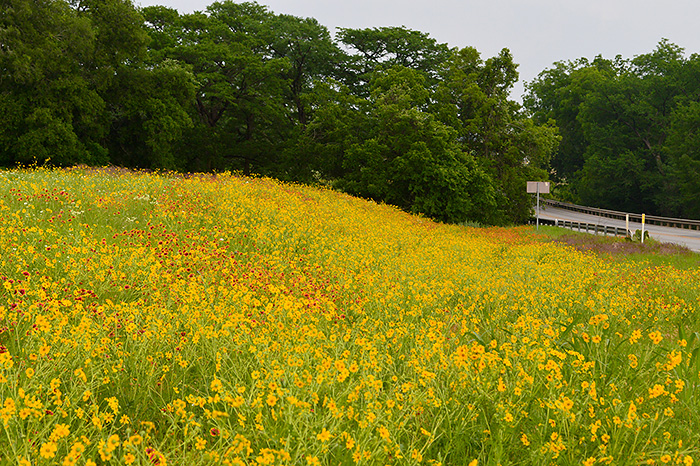
Roadsides Provide Critical Habitat for Pollinators
"Over the past 18 months, support for pollinators has undergone a seismic shift, led by President Obama, who called for a national Pollinator Task Force in the spring of 2014. Less than a year later, in a book-length "Strategy to Protect the Health of Honey Bees and Other Pollinators," the federal government set ambitious goals that include the restoration or enhancement of 7 million acres of land for pollinator habitat over the next five years. Roadsides will comprise a significant portion of that acreage..."
Read the rest of the article.
Thursday, September 10, 2015
Xenotopias
We lack –we need—a term for those places where one experiences a transition from a known landscape into new country or another world: somewhere we feel and think significantly differently.
I have for some time been imagining such transitions as ‘border crossings’. These borders do not correspond to national boundaries, and papers and documents are unrequired at them. Their traverse is generally unbiddable, and no reliable map exists of their routes and outlines. They exist even in familiar landscapes: there where you cross a certain watershed, treeline or snowline, or enter rain, storm, or mist, or pass from boulder clay onto sand, or chalk onto greenstone.
Such moments are rites of passage that reconfigure local geographies, leaving known places outlandish or quickened, revealing continents within countries.
What might we call such incidents and instances – or, rather, how to describe the lands that are found beyond these frontiers? I suggest the term ‘Xenotopias’, perhaps, meaning ‘foreign places’ or ‘out-of-place places’, a term to complement our ‘utopias’ and our ‘dystopias’.
[A quotation from Robert MacFarlane's The Old Ways]
Friday, August 28, 2015
Juridicational Wetlands
The Clean Water Act (CWA) regulates all of the "navigable" water bodies in the U.S. The precise definition of navigable waters is important for specifying what impacts may or may not be allowed to the Waters Of The United States (WOTUS). However, since the inception of the CWA, numerous Supreme Court cases have challenged the definition of WOTUS. On May 27, 2015, the U.S. Army Corps of Engineers (USACE) and Environmental Protection Agency (EPA) issuing a new definition of WOTUS. While the new definition is already the subject of numerous lawsuits, it is now the new basis of the CWA.
| Graphic from SWCA, The Wire. |
So what does the new definition say? Well, it is pretty straight-forward. There are just 8 possible cases:
1. traditional navigable waters
2. interstate waters
3. territorial seas
4. impoundments (of 1 - 3 above and 5 below)
5. tributaries
6. adjacent waters
7. five special groups of similarly situated waters
8. case-specific significant nexus waters
For more information, see this excellent article in SWCA's The Wire.
Monday, August 24, 2015
Smoke from WA Wildfires Reaches Albuquerque, New Mexico.
The smoke from large wildfires burning in NE Washington, N Idaho, and N. Montana reached as far as Albuquerque, New Mexico on Sunday morning.
The smoke covers a large part of the Western U.S.
![]() |
| Cliff Mass has excellent reporting on the smoke from the WA wildfires. |
![]() |
| Airquality.weather.gov has the best air pollution monitoring data. The AIRPACT website has high-resolution models of smoke production and transport in the PNW. |
![]() |
| U.S. Wildfire Activity Map. From ESRI. |
Wednesday, July 29, 2015
Wednesday, June 10, 2015
Threatened and Endangered Species of the Williamette Valley Prairie Savannas
There are 6 listed species endemic to the ecoregion.
Fender's Blue butterfly (E) (Icaricia icarioides fenderi)
Willamette daisy (E) (Erigeron decumbens var. decumbens)
Bradshaw's desert-parsley (E) (Lomatium bradshawii)
Kincaid's Lupine (T) (Lupinus sulphureus ssp. kincaidii)
Nelson's checker-mallow (T) (Sidalcea nelsoniana)
Golden Paintbrush (T) (Castilleja levisecta) - extirpated from Williamette valley
Several other nonlisted species are also considered sensitive:
Taylor’s (whulge) checkerspot butterfly, Euphydryas editha taylori
Pale larkspur, Delphinium leucophaeum
Willamette Valley larkspur, Delphinium oreganum
Peacock larkspur, Delphinium pavonaceum
Shaggy horkelia, Horkelia congesta ssp. congesta
White-topped aster, Sericocarpus rigidus
Hitchcock’s blue-eyed grass, Sisyrinchium hitchcockii
There are two major rare habitats in the Williamette valley responsible for the listed and sensitive species: upland prairies and wet prairies. Prairies are dependent on disturbance to prevent succession, and many have been either plowed under or allowed to develop into forests or shrublands. A recovery plan extends throughout the Williamette valley, and south of Roseburg to the Douglas county line to include a third disjunct habitat in the Umpqua valley.
The plant composition of upland prairies is dominated by bunchgrasses, including Festuca idahoensis, Danthonia californica, Elymus glaucus, Achnatherum lemmonii, and Koeleria macrantha. The spaces between the bunchgrasses are typically covered by mosses, fruticose lichens, or native forbs. Showy, slow-growing perennial forbs include Eriophyllum lanatum, Potentilla gracilis, Fragaria virginiana, Sidalcea malviflora, and Symphotrichum (=Aster) hallii, and the bulbs Calochortus tolmiei and Dichelostemma congestum. Some fast-growing annual forbs, including various species of tarweed (Madia spp.) and Clarkia, are also prominent members The main threat are vegetatively spreading non native grasses included Agrostis, Festuca, as well as Rubus (blackberry).
Wet praries are dominated by herbs. Deschampsia cespitosa (tufted hairgrass),and tufted microhabitats. Non-native Agrostis and Cirsiums are threat.
El Nino in the Spring
Monday, May 11, 2015
San Diego T & E Species
The U.S. Fish and Wildlife Service has a new website to identify species of conservation concern. This system is easy enough that anyone can search for and learn about the Threatened and Endangered species in their county.
For example, here is the list for San Diego County, California:
Cultivating a Healthy Skin Microbiome
A company is marketing a probiotic spray designed to help cultivate a healthy skin microbiome. The spray contains Ammonium Oxidizing Bacteria (AOB; specifically the genus Nitrosomonas) that derive their energy solely from consuming the ammonia and urea found in sweat. Supposedly, if you have enough AOB, you don't smell bad because they consume all your sweat, releasing beneficial nitric oxide gas!

I wanted to learn more about the skin microbiome, and found this comprehensive article with diagrams to show skin follicles, etc the complex topography and ecology of the skin environment.
These new data are based on DNA assays, and with improvements to these techniques, viruses, mites, and fungi are also being inventoried. This is certainly an improvement from the old days when only culturable bacteria were studied. Here is a classic paper about the microbial correlates of dandruff. Apparently there is no cause of dandruff, but simply a feedback between bacteria and fungi and the scalp. A fungus called Malassezia spp can release compounds that stimulate epidermis to proliferate. Fungicides cure dandruff by killing the Malassezia spp, but many people harbor Malassezia spp without dandruff. Perhaps an "ecological" cure could involve cultivating probiotic bacteria?
Interestingly, soap and shampoo may be destabalizing our skin microbiome, in the same way that antibiotics can impact the gut microbiome. For example, many ingredients in personal care products have been found in laboratory tests to inhibit "good-guy" AOBs, including sodium lauryl sulfate (SLS is one of the harshest detergents), sodium coco-sulfate, and even castile-type soaps. (Source)
To maximize ammonia utilization, AOBsproduce unique enzymes on elaborately folded cell membranes. These membranes are intricately folded so that they can increase the surface area for ammonia-oxidation. This means that they are able to boost both their ammonia-oxidizing capacity and their energy output. However, this elaborate membrane architecture also renders AOBs particularly sensitive to membrane-disrupting chemicals, such as anionic surfactants found in modern soaps and detergents.
Detergents replaced simple soap in our hygiene routine soon after WWII and form a major part of most bath products. Anionic detergents such as lauryl sulphates, sarcosines and sulfosuccinates can be harsh to the skin and especially the microbiome.
When reading the ingredients list on your cleaning products, you can identify anionic surfactants as those that have the following in their names:
Sodium
Ammonium
Magnesium
Sulfate
Sulfonate
Gluconate
(For example, sodium laurel sarcosinate, magnesium laurel sulfate, and sodium gluconate.)
Nonionic surfactants are gentler to the skin microbiome, although not entirely harmless. (Source) They include:
Ethoxylates
Alkoxylates
Cocamide
All of my soaps and shampoos contain these ingredients, except for Black African soap "made from shea butter and palm kernel oil mixed with ashes". The detergent in this soap is laurel glucoside, (AKA dodecyl glucoside) a non-ionic surfactant molecule. Because it is non-ionic, it is a milder detergent, often used in cosmetics, shampoos, etc. Glycosides are produced from lauryl alcohol and glucose.

I wanted to learn more about the skin microbiome, and found this comprehensive article with diagrams to show skin follicles, etc the complex topography and ecology of the skin environment.
These new data are based on DNA assays, and with improvements to these techniques, viruses, mites, and fungi are also being inventoried. This is certainly an improvement from the old days when only culturable bacteria were studied. Here is a classic paper about the microbial correlates of dandruff. Apparently there is no cause of dandruff, but simply a feedback between bacteria and fungi and the scalp. A fungus called Malassezia spp can release compounds that stimulate epidermis to proliferate. Fungicides cure dandruff by killing the Malassezia spp, but many people harbor Malassezia spp without dandruff. Perhaps an "ecological" cure could involve cultivating probiotic bacteria?
The same article also has the classic diagram showing different microbial communities on different body parts, based on their temperature, moisture and oilyness (sebum versus apocrine ).
To maximize ammonia utilization, AOBsproduce unique enzymes on elaborately folded cell membranes. These membranes are intricately folded so that they can increase the surface area for ammonia-oxidation. This means that they are able to boost both their ammonia-oxidizing capacity and their energy output. However, this elaborate membrane architecture also renders AOBs particularly sensitive to membrane-disrupting chemicals, such as anionic surfactants found in modern soaps and detergents.
Detergents replaced simple soap in our hygiene routine soon after WWII and form a major part of most bath products. Anionic detergents such as lauryl sulphates, sarcosines and sulfosuccinates can be harsh to the skin and especially the microbiome.
When reading the ingredients list on your cleaning products, you can identify anionic surfactants as those that have the following in their names:
Sodium
Ammonium
Magnesium
Sulfate
Sulfonate
Gluconate
(For example, sodium laurel sarcosinate, magnesium laurel sulfate, and sodium gluconate.)
Nonionic surfactants are gentler to the skin microbiome, although not entirely harmless. (Source) They include:
Ethoxylates
Alkoxylates
Cocamide
All of my soaps and shampoos contain these ingredients, except for Black African soap "made from shea butter and palm kernel oil mixed with ashes". The detergent in this soap is laurel glucoside, (AKA dodecyl glucoside) a non-ionic surfactant molecule. Because it is non-ionic, it is a milder detergent, often used in cosmetics, shampoos, etc. Glycosides are produced from lauryl alcohol and glucose.
It may be possible to specially order detergents from companies like this one.
Subscribe to:
Posts (Atom)


