Saturday, December 27, 2025

Porcupines in Arizona


An Arizona Porcupine observed at Willow Lake in Prescott.  Link to iNat observation.  


Porcupines are infrequently observed in Arizona, with only 206 total observations on iNaturalist since 2009, of which 198 are positively identifiable.  (Compared to about 900 observations in New Mexico.)  

Of the 198 in Arizona, 35 were at Willow Lake in Prescott, 55 at Petrified Forest National Park in NE Arizona, and about 30 between Williams and Flagstaff.  The remaining 78 were observed in ecosystems across the state, except for the Sonoran desert.

102 were observed on the ground, but 24 were dead, and half of those (6% of the total) were roadkill (viewer discretion advised).

Porcupine dead on road in Prescott.  Link to iNat observation.

96 porcupines were observed using different tree species as habitat.  The most common tree was cottonwood (Populus fremontii), followed by Ponderosa Pine (Pinus brachyptera).  Willows (Salix goodinggii) were also frequent.  Porcupines were observed in all common tree species, including oaks (Quercus), Junipers (Juniperus), Pinyon pines, Elms, and Douglas Fir (Pseudotsuga menziesii).  

Porcupine in cottonwood tree, Willow lake. Link to iNat observation. 


Friday, December 19, 2025

What's up with iNat in Japan?

 I recently listened to a fascinating podcast about the naturalist community in Japan, specifically the entomology fanatics. However, when I look at iNaturalist statistics for Japan, there appear to be very few observations/observers/identifiers given the population and level of development.

image

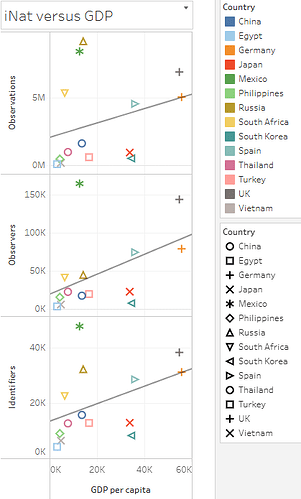
This figure shows the number of Observations, Observers, and Identifiers for select countries that have similar populations. Japan (red X) is way below the trend lines for all 3 metrics. The full dataset can be explored interactively on Tableau.

Interestingly, South Korea (blue triangle) clusters with Japan, although South Korea has a population that is less than 1/2 that of Japan.

Based on feedback from the iNat forum, it seems likely that nature-nerds in some of these countries are using other platforms to record their observations.

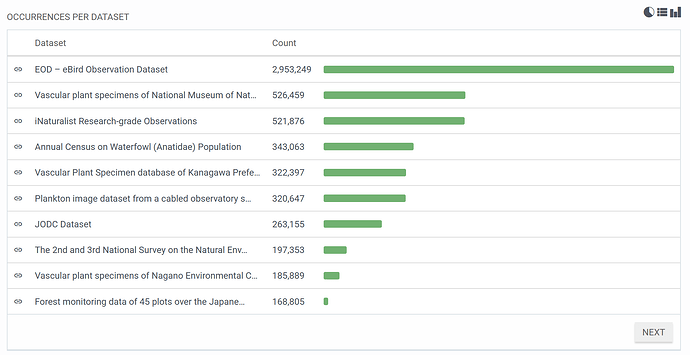
However, if they are using other platforms, they do not record data in a universal format that is indexed in the Global Biodiversity Information Facility (GBIF):

image

This chart shows GBIF records from Japan.

Hopefully over time more people will discover iNaturalist to record their natural history observations!