Tuesday, February 12, 2008

Tucson


0.
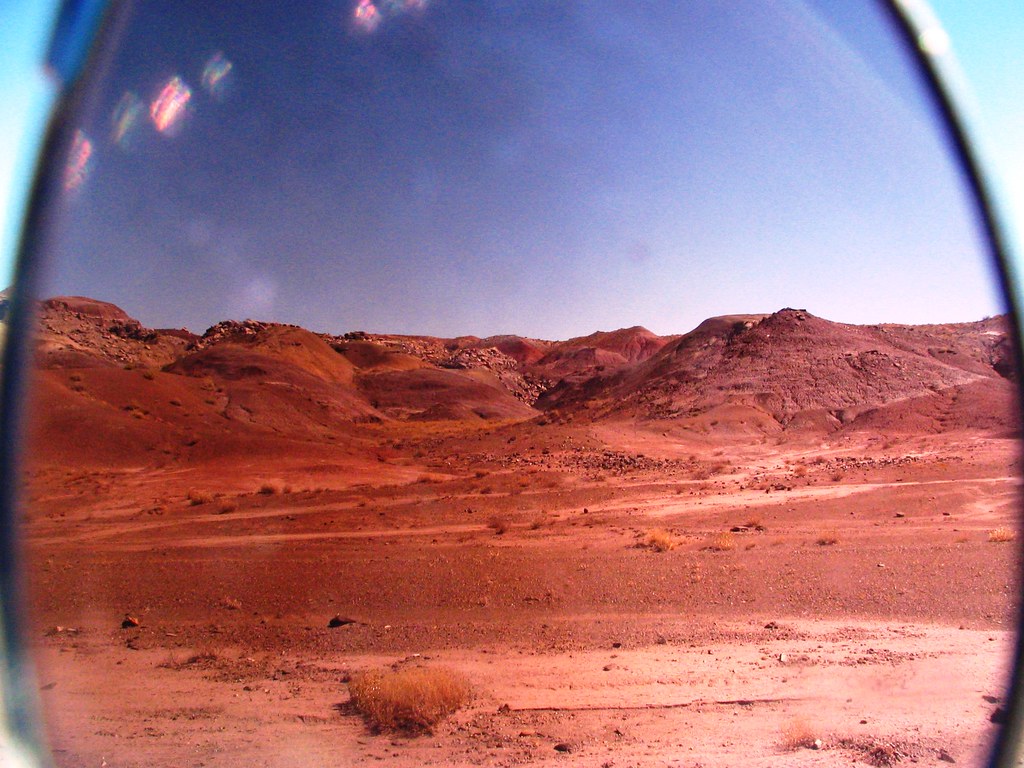
Even the great amoeba cities, clutching each other, skewered on their endless myopic highways, shrink in comparison to the vastness of the landscape in the West. These desert cities, surmounted and circumscribed by wondrous mountains wink small and lonely in the dark night, lost in all-encompassing wilderness. We live that we may be worthy of this landscape.


I.
Tucson, loud city of impolite dogs and cars, planted with inedible fruit and painted with bland colors, at least you are ringed by mountains for every mood. The humble-yet-graceful hump of the Rincons, huge on the Eastern horizon. The jagged charismatic physiognomy of the Santa Catalinas looming in the North, dominant, heroic, common. The austerely lush, picturesque Tucson mountains, dry yet creative, flowering along the West. And finally the distant-beyond-estimation Santa Ritas, spooky at a distance, foreign and strange and Southerly.


II.
Santa fe, quiet city of streamlined roads twisting past close-set fences...[unfinished]

Hiking Barefoot?


"The Barefoot Hiker" A Book About Bare Feet
by Richard Frazine, BD [Bachelor of Divinity?]
1993, Ten-Speed Press, ISBN: 0-89815-525-8
Read the book. Join the club.

This is an excellent and well-written book full of irreverent spunk and practical advice for hikers who habitually go barefoot. It is also an interesting addition to my "What would caveman do" bookshelf (see: Anopsology and my analysis). But, this book is written by Easterners, and I must humbly take exception to the application of their advice to the west, particularly Tucson.

The authors would sore regret hazarding a single barefoot footfall, let alone an entire cavalcade of such vulnerable events, in the Sonoran Desert, a Desert incomparably well-equipped to puncture the inflated expectations of innocent trespassers. The rapacious wit and perspicacious criticism embodied in the hard reality of the Sonoran desert would soon render the author's philosophy moot as he became a human dumpling skewered on the spines of cholla, saguaro, fish hook, and porcupine cactus, not to mention the infinitely small, sharp, and numerous "glochids" of the prickly pear.

The idea that humans are fit to live in the environment uncouth and unshod is an admirable one, an idea dating back perhaps to Genesis and the Garden of Eden. But the beauty of wilderness, especially Sonoran desert wilderness, bursts such hubristic bubbles and skewers such dainty pedagogy. Aristotle's peripatetic circumlocutions aside, this shit is sharp. To take humble pride in the profligate-armed Saguaro, to know that we are outmatched and vulnerable at his side, is to know the true reality of wilderness: not unadorned freedom to trample as we wish, but careful respect for all creatures great and sharp, and a willingness to adapt our footprint to the landscape we inhabit.

Friday, February 08, 2008

Thoughts on Ecology by Begon, Harper, and Townsend


Not Just Drops of Goo
The smallest idividual droplets of life are fundamentally different from one another, as opposed to physics or chemistry where the fundamental parts are interchangable. There are at least 100 million distinct types of droplets (excluding viruses, proteins, and undiscovered types), each with its own inherent and combinatorial talents. These special abilities are written out in the droplets' DNA, so that every tiny snippet in my body is fundamental to me and contains the possibility of me.
People and animals and plants (and indeed all life) were not put here randomly-- we each have a reason. Sometimes that reason is just because here is near where our parents happened to live. Everywhere in the world children live near their parents. But if you go live on an island you would become different. The 'you' that you are can't go live on an island without becoming a different 'you'. The 'you' that you are is based on where you are. And so all life forms are different in different places. Yet Darwin teaches that they are the same stuff, from the same parents. We are all brothers and sisters, made of the same protoplasmic ooze.
This, then, is the tension in biology: we are all fundamentally the same goo but we are all fundamentally different goo. "There are no differences but differing degrees of difference and non-difference." CF. "The Influence of Darwinism of Philosophy", 1909 John Dewey.


"All species are absent from almost everywhere"
But: not everything important is alive - rocks, sunlight, clouds, motorcycles. All of these things push and shove on each other and on life. So to study life we have to study all of these things. Life itself is constantly bouncing against itself and, in fact, this is what makes life alive. What does this constant bouncing need to keep going? It is many things in many places; different things in different places. It is often a balancing act between hot and cold, between light and dark...
Everything in nature is good at something; balancing, breathing, sweating, slurping. But the sad wisdom Darwin teaches is that we only know we were good at something in the past - who knows if we will fit in the present or find a place in the future? There is evidence all around us of stranded animals and plants and people who stayed while the world changed around them. The past is no garuntee of the future.


The fundamental questions of Ecology: Why does this thing live here (why am I here) and Why do different things live in different places (Why am I different)?

Winter Wildlife Tracking

Feline tracks, probably Bobcat.

Canine Tracks, probably Coyote.


Human tracks, definitely Homo sapiens

How the Sonoran Desert says "Don't Touch"

[Ferocactus cylindraceus]

Monday, February 04, 2008

Riparian Restoration in the Southwest


"In the not too distant past, lower Rincon Creek (a portion of a small stream in the Sonoran Desert) was dominated by a riparian forest that in some areas extended more than half a kilometer from each side of the stream channel. The predominant woody vegetation was Arizona walnut (Juglans major), with some of the larger individuals exceeding 5m in circumference and towering close to 20m above the floodplain...

This riparian ecosystem no longer exists. During the past 60 years, the combined impacts of groundwater pumping, stream channelization, agriculture, livestock grazing, and, currently, urbanization have almost completely destroyed this area. Today, streamflow occurs only following heavy rains, and scattered remnants are all that remain of the once immense riparian forest.

Unfortunately, the devastation that befell the riparian ecosystem of lower Rincon Creek is not unique. Riparian ecosystems have disappeared at an alarming rate all across northern Mexico and the southwestern United States. Although the extent of the damage is still not well understood, most observers will agreee that the deterioration of riparian ecosystems in this part of the world has reached significant proportions."

Riparian Ecosystem Recovery in Arid Lands.
Mark K. Briggs. 1996 University of Arizona Press.


This book is an introduction to restoration work in Arizona and New Mexico. The quote above, excerpted from the Preface, begins what could have been an authoritative account of the devastation of riparian ecosystems. Unfortunately the author proceeds to obfuscate his initially clarion message with euphemisms and understatements which could confuse anyone without field experience. For example, "improved grazing practices" almost invariably means 'get the cows outa there!' but you'd never know it from the text. While the true extent of riparian damage may be hard to describe in words, Briggs' buttoned-down rhetoric doesn't begin to do justice to the near-apocalyptic destruction common in the Southwest. The armchair reader would be hard-pressed to appreciate the scope and severity of the problem from this book.

That said, this book remains an impressive resource for the restoration professional, has an excellent bibliography, and marshals a considerable range of experience. Certainly not all of the language is obscure; the precise definitions develop a professional vocabulary. For example, the difference between rigorous terms like recovery, restoration, rehabiliation, and replacement vs. subjective terms like rewild, rebalance, regenerate, and revitalize will be important to improving communication in this field.

Also, while the text does feature a suite of case studies, it remains more theoretical than practical, advocating a philosophy of 'site-specific, whole watershed' analysis rather than listing specific techniques. (for specific evaluation techniques see "User's Guide for the Rapid Assessment of the Functional Condition of Stream-Riparian Ecosystems in the American Southwest." Stacey, Jones, Catlin, Duff, Stevens and Gourley. Wild Utah Project.

This is a conservative synopsis of where we find ourselves and perhaps implies something of the urgency of recovering what we have lost. For, as we transform this beautiful home into a wasteland, so too we transform the human heart. So little now remains of these shady glades and bubbling streams, the destruction is so complete and pervasive, that even the memory dries up and blows away, we forget that it was ever otherwise; general amnesia descends, fostering complacency and despair... The creek this author speaks about was one of many that once flowed into Tucson's perennial rivers. Tucson's rivers are dry and these ecosystems have evaporated and today it is a revolutionary act to demand that the rivers flow again. The work of restoration goes beyond ecosystems to involve the entire community. ...


Monday, January 28, 2008

Matthiessen's Wildlife in America

'And I brought you into a plentiful country, to eat the fruit thereof and the goodness thereof; but when ye entered ye defiled my land and made mine heritage an abomination.' Jeremiah 1:6

In some ways, Wildlife in America. (New York, Viking Press, 1959) by Peter Matthiessen appears to be an apology for human-caused extinction. But perhaps Matthiessen is simply being realistic when he questions whether all species really need to be protected. Should we ruin a ranching community trying to save a relictual species that only lives in one small pool in the desert, a species that would likely become extinct anyway? What about the ridiculous perfusion of species, such as the hundreds of varieties of freshwater clams the Tennessee Valley Authority spends millions of dollars protecting? What about species that, as Matthiessen puts it, have "become senile and over-specialized in their long period of isolation...unable to compete with the younger species..."? Despite the strange word choice, his point that some species fail to adapt to natural changes, is well-taken. When Panama rose out of the sea to connect North and South America many species became extinct because they could not competitively adapt to the wave of immigrants. Perhaps our rush to fight invasive species while protecting endemic species is ultimately as futile as trying to stop Panama from linking the two American continents?

(Ironically, we seem to have done precisely that with the Panama Canal, which prevents genetic exchange between many species with populations in North and South America, such as the Jaguar.)

Unfortunately, by Peter Matthiessen is ultimately unsatisfying because Matthiessen never directly answers the question of why the extinction of species matters. Too busy telling a 'balanced story' to directly confront the value of non-human species, he leaves this task to later authors, notably Rachel Carson, who argued that all life is connected and that what we do to others we eventually do to ourselves. But perhaps Matthiessen is wise to leave that argument to specialists; indeed, much of the Deep Ecology movement is an attempt to explain how species that cannot argue their own case can have inherent worth.

But let there be no mistake -- Matthiesson's opinion of the extinction crisis is clear. He is unmistakable when he argues that "the concept of conservation is a far truer sign of civilization than that spoliation of a continent which we once confused with progress." Although he doesn't deign to list specific reasons, he is at his best intoning arguments that pull at the heart and echo the damnation of the apocalypse (CF. the quote from Jeremiah above, also featured at the beginning of Wildlife in America)

"Even today, despite protection, the scattered individuals of species too long persecuted are hovering at the abyss of extinction and will vanish in our lifetimes. The slaughter [for food] has subsided this century but the vertebrate animals as a group are obscured by man's dark shadow. Such protection as is extended them too rarely includes the natural habitats they require, and their remants skulk in a lean and shrinking wilderness.

The true wilderness -- the great woods and clear rivers, the wild swamps and grassy plains whcich once were the wonder of the world -- has been larely despoiled and today's voyagers, approaching our shores through the oiled waters of the coast, are greeted by smoke and the glint of industry on our fouled seaboard, and an inland prospect of second growth, scarred landscapes, and sterile, often stinking, rivers of pollution and raw mud, the whole bedecked with billboards, neon lights, and other decorative evidence of mankind's triumph over chaos.

In many regions the greenwood not converted to black stumps no longer breathes with sound and movement, but is become a cathedral of still trees; the plains are plowed under and the praires ravaged by overgrazing and the wind of drought. Where great, wild creatures ranged, the vermin prosper."

Saturday, January 12, 2008

In Search of the Elusive Elephant Tree


The Elephant Tree (Bursera microphylla) is a rare member of the Sonoran scrub community, left behind in a few relictual populations after the ebbing of the last ice age. Our amateur expedition convened to verify its rumored existence with our own senses. Lacking professional expertise, we relied on a map of hearsay and riddles. Intoning these raw directions with varying emphasis, turning the map while squinting, convincing ourselves of our own speculation, falling back into self-doubt at the next turn in the road...by faith and blind reckoning we journeyed and when we couldn't drive any more we got out and walked.


The crunch of desert gravel, second-growth ironwoods twisted like deep time, patches of magically incongruous moss growing in the deep shadows, a butterfly (Hemiluca tricolor) warming to the January morning. It seemed nothing could hide in the glorious panopticon of brilliant Sonoran sunlight. But it was only the illusion of omniscience - we knew the elusive Elephant Tree lurked somewhere in the thick desert scrub, but we didn't know where.


We pushed on. Past abandoned mines, over barbed wire and barbed cacti. The steep and gutted tracks curved around a dry valley, attained the saddle, and continued up the south-facing slope of Mt. Silverbell. There, tucked in a cozy drainage of austere smooth rock waterfalls, clinging to unlikely toeholds on the sheer wall, were the Elephant Trees; the thick trunks peeling elegantly in the sparse shadows. Fragrant limbs and resinous (juniper-like) berries carried a pungent and uniquely fragrant odor, a benediction to the dry dust desert.


We watched the sun cross the sky from our perch among them, tucked away with them in cozy niches, waiting patiently or perhaps resigned to fate, relicts in a strange world. They are safe and comfortable raising small families in their isolated enclave. We thanked them for their time and magnanomous patience when posing for our photographs. None of us wanted to leave, but we have faith now that the elusive Elephant Trees can abide without us.

Tuesday, January 08, 2008

You remember the San Pedro


You remember driving up out of the Santa Cruz valley from Nogales through hills and then up over a wide country of wineries where you exclaim "oh I didn't know Arizona could be like this!" We hike along the Babocomari river under the trees and watch the Great Horned Owls. The Rincons, the Mustang and Whetstone, the Burro, the Huachuca, the Canelo hills, and the Santa Ritas and Empire Mountains are all arrayed round about; the town of Elgin, the sun and the full moon and the purple-tinged shadow of the Earth.


But what you don't know is that if you follow the river you meander around the Mustang mountains and leave them standing still behind you like some kind of massive eroded stonehenge....and then you enter a great valley with cities and people and mountains all around. This is one of the last great river-valleys before the continental divide, one of the last surviving Arizona rivers, the San Pedro.


But this green ribbon snaking through an ocean of desert scrub and cactus is already dead. The aquafer has been drained and it is only a matter of time before this valley, like its neighbors, becomes dust and bones. "Man's ego is going to fill his pockets, and the river be damned." (ibid)

For more information and maps (though not a solution to the problem) see the Upper San Pedro Partnership