Showing posts with label population. Show all posts

Tuesday, January 20, 2015

How Many Great- (Great...) Grandparents Did I Have?

Ancestry studies based on mitochondrial or Y chromosome assays only detect a single path through our complicated family tree.  For example, my Y chromosome is inherited from my father, and my father's father, who got it from his father's father's (...) father.  A test based on my Y chromosome wouldn't take into account any of the rest of my ancestry contributed from, for example, my father's mother's father's (...) father).

So maternal and paternal lineage data is really about just two branches picked out of our entire family tree.  The results are presented using "haplogroups", which are unique patterns of mtDNA or Y DNA that can be traced back to a single mutation event.  But ancestry is exponential, not linear! Haplogroups only detect a single branch out of a very large number of branches.  And what if my family tree isn't a tree, but a bush?  The scientific term for this is "pedigree collapse".

Assuming a generation time of 20 years, 500 years ago (=25 generations) I could have had 33 million great [...] grandparents! But the population of Europe (I have European ancestry) was only around 60 million in A.D. 1500 (Jan de Vries, compilation of estimates). Assuming no interbreeding of ancestors in the last 500 years, I would have to be related to everyone with European ancestry a little over 25 generations ago. Clearly there must have been some interbreeding, which would imply that I did NOT have 33 million great [...] grandparents.


This probably explains the question better than I can.  

I think the key question is...How many great [...] grandparents did I have? THAT would tell us how informative mtDNA or Y-chromosome haplogroups are.  If I had more grandparents then these tests are less informative.  If I had fewer grandparents they could be quite informative.

I'd be curious just to know ballpark figures. Did I have 10 million or 10,000 great [...] grandparents in A.D. 1500?

I found a study that shed some light on this issue: The Geography of Recent Ancestry across Europe by Peter Ralph and Graham Coop.  According to their results, there was a genetic bottleneck in, for example, the Balkans, around A.D. 1400 and a much larger bottleneck around B.C.  100.  This means that, for example, two average unrelated people in Europe share almost all of the same ancestors as recently as 1,000 years ago!


Monday, April 30, 2012

The Future of Forests...is People

 David Wear, USFS, predicts large declines in forest area in the US as more and more land is developed for housing.  Over the next 50 years the US population is forecast to double again to 500 million, mostly along the coasts. 
 

Most of the RPA interval projections by the USFS are driven by economic analyses.  Increased wealth greatly increases the impact of any increase in human population, because wealthier people build bigger houses, shop more, and need more roads.  More people will need more food, leading to higher food prices that threaten to undo the conservation reserve program, putting reforested land back into food production.  But higher prices for timber or biomass would actually increase forested area!  With a higher value on trees, timbered lands might be worth too much to develop....

I conclude that the US needs a healthy forest products (including, somehow, forest biomass) industry to push back against the teeming urban hordes.

Thursday, June 10, 2010

Top-Down or Bottom-Up?


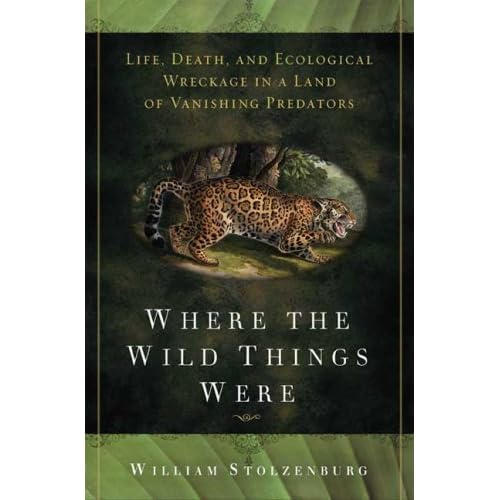
A number of science controversies surrounding trophic cascades are well-presented in William Stolzenburg's book, "Where the Wild Things Were: Life Death, and Ecological Wreckage in a Land of Vanishing Predators". 2008. The book deals with the 20th century history of population ecology and the struggle to understand whether populations of animals and plants are controlled from the top by large predators or from the bottom by primary productivity. From Elton's realization of the pyramid of biomass on Spitzbergen to Hairston, Smith, and Slobodkin's Green World Hypothesis, to Paine's experimental verification of top-down control in starfish and mussel systems, the book covers the origin and development of such key concepts in ecology and conservation as keystone species and trophic cascades.

In addition to covering classic work such as Paine's starfish and mussel studies, the book also delves into controversies over killer whales and sea otter populations. While the latter are controversial because the results are relatively new, other controversies such as those over the rise and collapse of deer herds on the Kaibab plateau after the removal of top predators are controversial because the data are so old.

I wish the book had covered more of the controversy surrounding the Yellowstone wolves-grazing story in Wicker 2003 . The classic story of the wolves restoring Yellowstone's ecosystem to equilibrium should be interrogated because of differing interpretations of top-down (predator controlled) or bottom-up (hydrology-controlled) factors. For example, Wolf, Cooper, and Hobbs (2007) call much of Wicker's simplistic assumptions into question. And Meyer and Persico (2009) question Wolf, Cooper, and Hobbs' climate assumptions for the Holocene. The latter are both good papers, coming from different paradigms, all illustrating some of the difficulties for assigning "cause" and "effect" in dynamic and contingently evolving ecosystems.

Stolzenburg writes that "while the fall of the great terrestrial predators can be summed up as a casualty of the agricultural age, the subsequent collapse of their marine counterparts owes itself to the coming of the technological age." The work concludes with an excellent analysis of the conservation biology idea of linked conservation reserves, and the human opposition to acceptance of large wild animals. In the end, whatever the ecological story, the human social story will always get the last word.