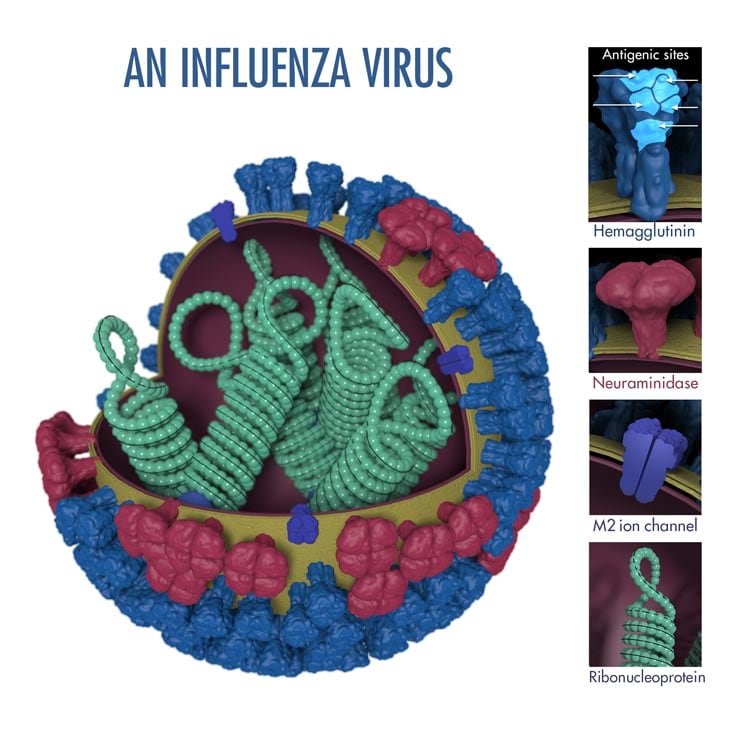
Image of flu virus with antigen proteins on phospholipid(?) surface and RNA in the middle. From. http://www.cdc.gov/flu/professionals/laboratory/antigenic.htm. Tamiflu works by binding the purple neurominadse proteins. Tamiflu was developed from shikimic acid, which was originally available only as an extract of Chinese star anise but by 2006 30% of the supply was manufactured recombinantly in E. coli.[54][55]
Vaccine viruses are chosen (i.e., February for the Northern Hemisphere flu vaccine) because it takes 6-8 months to grow them in chicken eggs. Health officials would like to grow them in human(?) cell culture, but that it not currently allowed. Eggs are problematic because viruses may adapt to the egg.
"As a result, Immunologically naïve ferrets) are the most sensitive method available for detecting antigenic differences between influenza viruses."(from http://www.cdc.gov/flu/professionals/laboratory/antigenic.htm)
Evolution and Types of Virus
H3N2 (swine) flu and H1N1 (avian) flu are main lineages. Major outbreaks occur suddenly and unpredictably through transmission of new varieties from animal hosts. Seasonal (common) flus are derived from the same lineage, but generally evolve slowly and predictably. Each year, novel viruses make the leap from animal to human. For example, during the 2013–14 influenza season, one case of human infection with an new strain of H3N2v virus occurred in a child from Iowa with known direct exposure to swine. Birds seem to have co-evolved with the flu virus and do not mount an immune response to it. Therefore (luckily!) it appears to evolve much more slowly in resevoir species than in humans. This has important implications for the dynamics of seasonal and epidemic flu outbreaks.
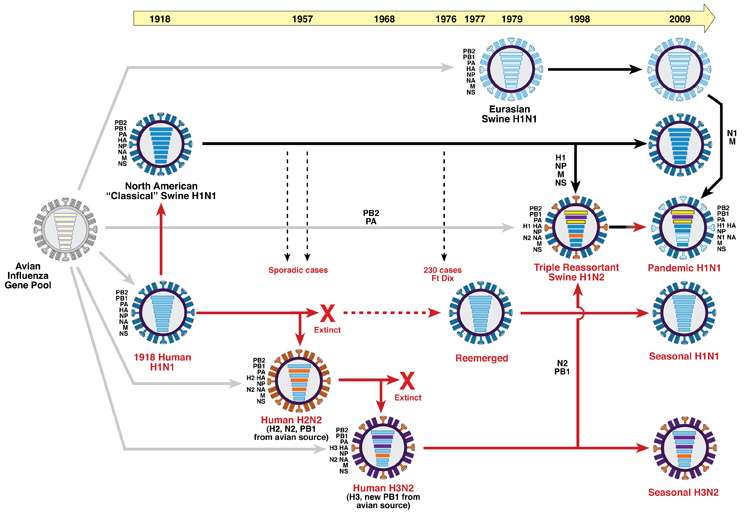
Influenza A is the most common. It is highly likely that of all the seasonal influenza strains circulating at the present, one of them will multiply and give rise to the entire seasonal influenza populations in around 5 years. The descendants of all other viruses will most likely be extinct.
For example, the 2014–15 influenza vaccines used in the United States have the same antigenic composition as those used in 2013–14. The trivalent vaccines should contain an A/California/7/2009-like (2009 H1N1) virus, an A/Texas/50/2012-like (H3N2) virus, and a B/Massachusetts/2/2012-like (B/Yamagata lineage) virus. (http://www.medscape.com/viewarticle/826572_6)
The lineage of evolutionarily successful viruses is usually termed the trunk of H3N2 influenza’s evolutionary treea:

The tree is based on hemagluttin protein sequence evolution, colored according to estimated geographic location, indicating high permanence of the trunk in China and Southeast Asia. The genetic changes occur on the neuroamidase and hemoagglutin virus surface proteins, causing antigenic drift. The truck of the H3N3 tree with a single dominant lineage contrasts with more branching trees of other flu types where different varieties often co-circulate, such as H1N1, and Influenza B and C. This graph and these findings are complicated by whole-genome sequencing: a new graph shows overall viral genome evolution in The evolution of epidemic influenza by Martha I. Nelson and Edward C. Holmes Nature Reviews.
Figure courtesy of Lemey P, Rambaut A, Bedford T, Faria N, Bielejec F, et al. http://theglobalscientist.com/2014/11/03/what-can-data-science-tell-us-about-influenza/
Current Trends - CDC FluNet
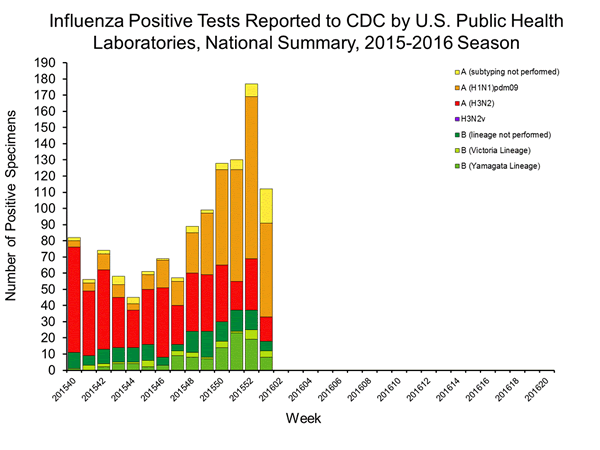
http://www.cdc.gov/flu/weekly/
Is flu increasing...
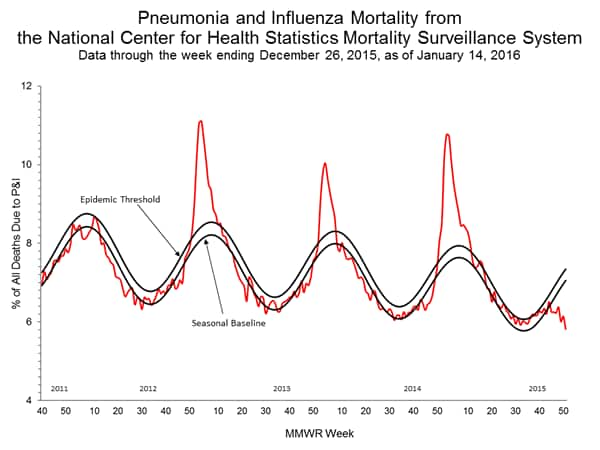
This chart is from the same page....http://www.cdc.gov/flu/weekly/. The periodicity of flu seasons and epidemics is still being studied. Peaks occur during the winter in northern latitudes at ~2–5 year intervals, usually during H3N2-dominant seasons, since the 1968 pandemic. Recent phylogenetic analysis of viruses from single populations has shown that the virus does not ‘over-summer’, but dies out at the end of each seasonal epidemic, and that subsequent seasonal viral re-emergence is ignited by imported genetic variation.
Or decreasing?
Weekly Map
http://www.cdc.gov/flu/weekly/usmap.htm
