 |
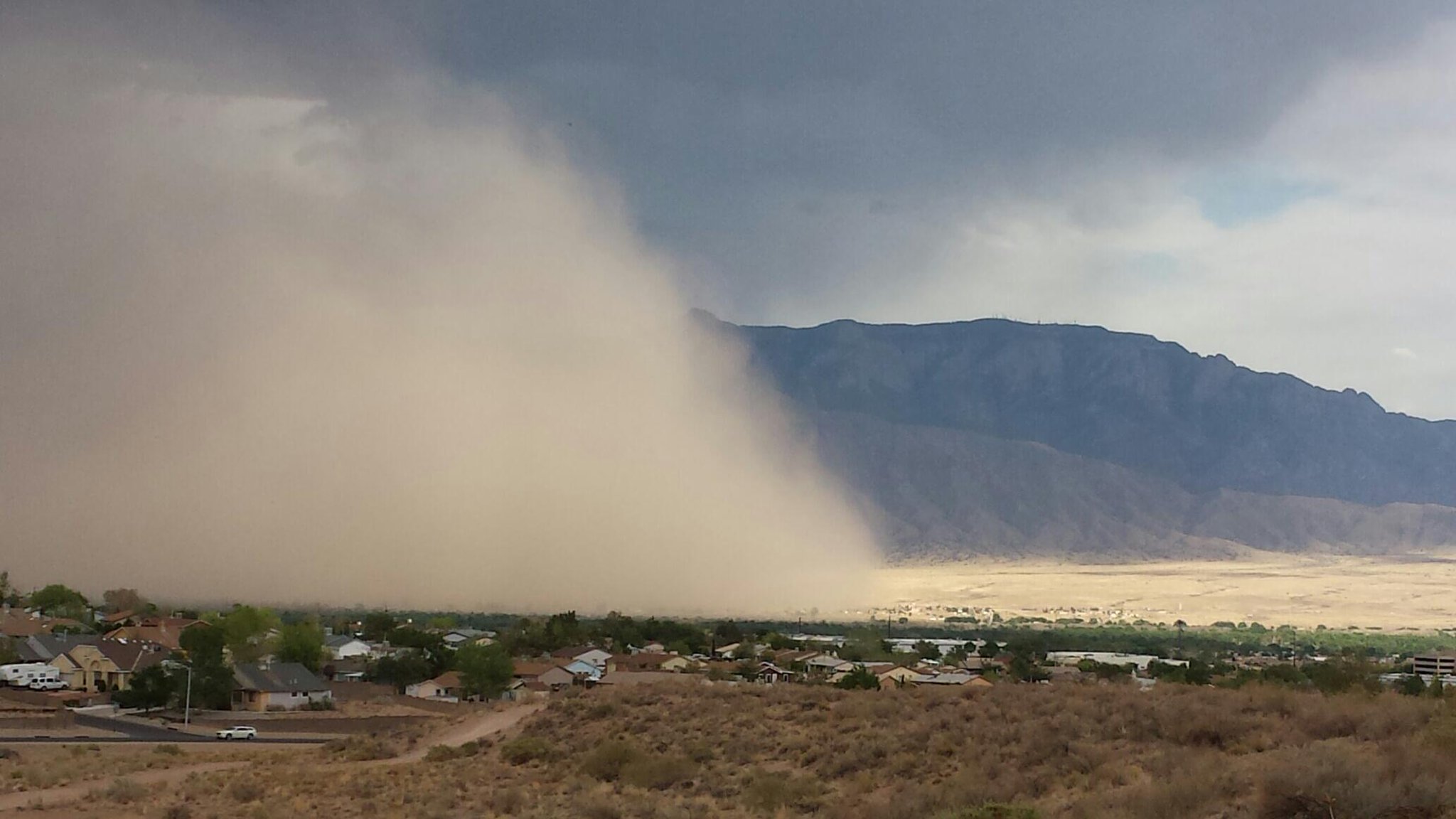
| From the ABQ NWS Homepage. |
Showing posts with label albuquerque. Show all posts
Showing posts with label albuquerque. Show all posts
Wednesday, September 28, 2016
Albuquerque 2016 Monsoon Season

Tuesday, April 05, 2016
Portable Real-Time Measurement of Air Quality
 I recently purchased a Uni-Trend Air Quality Meter.
It measures VOCs (both natural and man-made), PM2.5, and temperature and humidity.
Coarse particles (PM10) have a diameter of between 10 micrometers and 2.5 micrometers and settle relatively quickly whereas fine (PM2.5) (0.1 to 2.5 micrometers in diameter) particles remain in suspension for longer. To put things into perspective, human hair has a diameter of 50-70 micrometers and a grain of sand has a diameter of 90 micrometers.

Sources of fine particles include all types of combustion activities (motor vehicles, power plants, wood burning, etc.) and certain industrial processes. Sources of coarse particles include crushing or grinding operations, and dust from paved or unpaved roads.


PM2.5 is made up of sulfates, nitrates, carbon, and soil.
Albuquerque reports the Air Quality Index for daily pollen and Fine/Coarse Particulates:

But these numbers are reported as "Index" values, and have to be converted to ug/m3 to compare to measured values:

Over the last week, Albuquerque has reported AQI for PM2.5 of almost 50, which should be about 15 micrograms per square meter, whereas my unit typically reports 30-50 micrograms per square meter, indoors and outdoors. It is possible that ABQ measures air quality higher from the ground than my unit, or that PM2.5 is lower during the night when I don't check it.
Here is an excellent resource for more information. Most of the graphics on this page are from this source.
Wednesday, November 19, 2014
Threatened and Endangered Species around Albuquerque, New Mexico
Threatened and Endangered Species from Bernalillo County, New Mexico:
Birds
Mexican spotted owl (Strix occidentalis lucida) USFWS T State S The owl inhabits canyon and forest habitats across a range that extends from southern Utah and Colorado, through Arizona, New Mexico, and west Texas, to the mountains of central Mexico. They require mature, old-growth forests of white pine (Pinus strobus), Douglas-fir (Pseudotsuga menziesii), and ponderosa pine (Pinus ponderosa); steep slopes and canyons with rocky cliffs for their habitat.
Southwestern willow flycatcher (Empidonax traillii extimus) USFWS E
State E The southwestern willow flycatcher breeds in relatively dense riparian tree and shrub communities associated with rivers, swamps, and other wetlands including lakes and reservoirs. Historically the southwestern willow flycatcher nested in native vegetation including willows (Salix sp.), seepwillow (Baccharis salicifolia), boxelder (Acer negundo), buttonbush (Cephalanthusoccidentalis), and cottonwood (Populus sp.). Following modern changes to riparian communities, this subspecies still nests in native vegetation, but also uses thickets dominated by non-native tamarisk (Tamarix sp.) and Russian olive (Elaeagnus angustifolia), or in mixed native non-native stands
Yellow-billed Cuckoo (Coccyzuz americanus) USFWS T
State S Status applies only to western population beyond the Pecos River Drainage; breeds in riparian habitat and associated drainages; springs, developed wells, and earthen ponds supporting mesic vegetation; deciduous woodlands with cottonwoods and willows; dense understory foliage is important for nest site selection; nests in willow, mesquite, cottonwood, and hackberry; forages in similar riparian woodlands;
Fishes
Rio Grande Silvery minnow (Hybognathus amarus) USFWS E
State E The Rio Grande silvery minnow extirpated; historically Rio Grande and Pecos River systems and canals; reintroduced in Big Bend area; pools and backwaters of medium to large streams with low or moderate gradient in mud, sand, or gravel bottom; ingests mud and bottom ooze for algae and other organic matter; probably spawns on silt substrates of quiet coves.
Mammals
New Mexico meadow jumping mouse (Zapus hudsonius luteus) USFWS E
State E
The New Mexico meadow jumping mouse (jumping mouse) is endemic to New Mexico, Arizona, and a small area of southern Colorado (Hafner et al. 1981, pp. 501-502; Jones 1999, p. 1). The jumping mouse appears to only utilize two riparian community types: 1) persistent emergent herbaceous wetlands (i.e., beaked sedge and reed canarygrass alliances); and 2) scrub-shrub wetlands (i.e., riparian areas along perennial streams that are composed of willows and alders) (Frey 2005, p. 53).
Other Special-Status Species in Bernalillo County, New Mexico:
Invertebrates
Obsolete Viceroy Butterfly (Limenitis archippus obsoleta) USFWS SOC
Slate Millipede (Comanchelus chihuanus) USFWS SOC
Birds
Burrowing owl (Athene cunicularia) USFWS SOC Associated with prairie dog (Cynomys sp.) towns in dry, open, short-grass, treeless plains.
Common black-hawk (Buteogallus anthracinus)
State NM T
Southwestern U.S. is the northern extent of this species’ range. Occurs in New Mexico almost exclusively during the breeding season and in migration. Breeding populations known chiefly from the Gila River Valley in the southwestern portion of the state and from along the Mimbres River and the Rio Hondo watershed. Strongly tied to cottonwood gallery forests. In Texas breeds in or near the Trans-Pecos Region, with breeding documented in particular in the Davis Mountains and possible breeding along the Rio Grande. In New Mexico, uncommon summer resident, generally, restricted to the mountainous riparian habitats of the San Francisco, Gila, and Mimbres river drainages.
Neotropic Cormorant (Phalacrocorax brasilianus)
State NM T
The Neotropic Cormant reaches its northern distribution in southern New Mexico. It feeds in lakes and wetlands.
Bald eagle (Haliaeetus leucocephalus alascanus)
State NM T
Occurs in New Mexico year-round. Breeding is restricted to a few areas mainly in the northern part of the state along or near lakes. In migration and during winter months the species is found chiefly along or near rivers and streams and in grasslands associated with large prairie dog colonies. Typically perches in trees.
Northern aplomado falcon (Falco femoralis septentrionalis)
USFWS E
State E
Associated with semi-desert grasslands with scattered yuccas, mesquite, and cactus.The species has also been reintroduced on the Armendaris Ranch in Socorro and Sierra Counties and on lands administered by the BLM, White Sands Missile Range, and the SLO beginning in 2006.
Peregrine falcon (Falco peregrinus)
State T
A year-round resident and local breeder throughout NM, nests in tall cliff eyries; also, migrant across state from more northern breeding areas in US and Canada, winters along coast and farther south; occupies wide range of habitats during migration, including urban, concentrations along coast and barrier islands; low-altitude migrant, stopovers at leading landscape edges such as lake shores, coastlines, and barrier islands.
Arctic peregrine falcon (Falco peregrinus tundrius)
State NM T
Winters along coast and farther south; occupies wide range of habitats during migration, including urban, concentrations along coast and barrier islands; low-altitude migrant, stopovers at leading landscape edges such as lake shores, coastlines, and barrier islands.
Southwestern Willow flycatcher (Empidonax trailli extimus)
USFWS E
State NM E
The flycatcher is a summer breeder within its range in the United States. It is gone to wintering areas in Central America by the end of September. For nesting, requires dense riparian habitats (cottonwood/willow and tamarisk vegetation) with microclimatic conditions dictated by the local surroundings
Northern goshawk (Accipiter gentilis)
State NM S
Breeds in coniferous forests; winters in farmlands, woodland edges, and open country. Breeds from Alaska east through Mackenzie and northern Quebec to Newfoundland, and south to New Mexico, Great Lakes, and New England; also southward to northern Appalachians. Winters south to Virginia and Southwest.
Unlikely to occur in project area due to lack of coniferous forest habitat.
Broad-billed hummingbird
State NM T
Reaches extreme northern range in desert canyons of southern New Mexico with dense mesquite thickets.
Unlikely to occur due to lack of canyon habitat.
White-eared hummingbird (Hylocharis leucotis)
State NM T
Irregular summer visitor to extreme southeastern Arizona; rare in New Mexico and Texas. Found in Mountain woodlands.
Brown Pelican (Pelecanus occidentalis)
State NM E
Generally found in warm marine waters, rarely occurring inland. Only individuals seen in New Mexico, near water. May be storm-driven birds that moved inland during duress.
Baird's sparrow (Ammodramus bairdii)
State NM T
A winter resident in New Mexico and Texas. Generally prefers dense, extensive grasslands with few shrubs. Avoids heavily grazed areas.
Bell’s Vireo
State NM T
A small insectivorus bird, prefers dense vegetation of scrubby woodlands, old fields, or mesquite brushlands.
Gray Vireo (Vireo vicinio)
State NM T
Species strongly associated with piñon-juniper and scrub oak habitats. Distributed mainly across the western two-thirds of the state. Prefers gently sloped canyons, rock outcrops, ridge tops, and moderate scrub cover.
Mammals
Spotted Bat (Euderma maculatum)
State T
Found in open habitats, Ponderosa Pine forests, and marshlands. Suitable roosting sites limits distribution to areas within flying distance of cliffs and stony outcrops. (Adams, 2003)
Pale Townsend’s Big-eared Bat (Corynorhinus townsendii)
State S
Habitat includes montane forests and arid habitats with limited desert scrub vegetation. Roosting sites include caves, cliffs, and rock ledges but have been found in abandoned mines and other man-made structures. (Adams, 2003)
E = Endangered. Any species considered by the USFWS as being in danger of extinction throughout all or a significant portion of its range. The ESA specifically prohibits the take of a species listed as endangered. Take is defined by the ESA as to harass, harm, pursue, hunt, shoot, wound, kill, trap, capture, or collect, or to engage in any such conduct.
T = Threatened. Any species that is likely to become an endangered species within the foreseeable future throughout all or a significant portion of its range. The ESA specifically prohibits the take (see definition above) of a species listed as threatened.
Tuesday, October 07, 2014
Harvest Reflections on Growing Food
"When does the keen knife edge of human ambition dull into a mere quest for survival? Perhaps it relates somehow to those "lives of quiet desperation" that Thoreau was always harping about as he often expressed opinions on the futility of the agricultural lifestyle. I can relate, perfectly."
--Joe Hutto, Touching the Wild

General Thoughts
Agriculture is hard, necessary, and always just-in-time. Whatever you may think about agricultural policy exceptionalism (i.e. exemption from the Clean Water Act (this is changing), tariff protections and subsidies), the truth is that farming is hard and food is a miracle.
While I support organic agriculture and believe we must find holistic solutions to meet our nutritional needs, I don't begrudge any farmer who chooses to use every tool available... whether that means artificially-bred chickens that grow 4x faster than heirloom breeds, or GMO crops (still no scientifically-documented health risks), to the use of chemical fertilizers, herbicides, pesticides, and fungicides.
I have some personal experience with organic and Permaculture farming; enough to know I'm lucky that my ability to get food on the table isn't dependent on my success in the garden. Whether its trying to keep crops alive in 110 degree heat of a Tucson June, or trying to defend my pumpkins this summer in Albuquerque from squash bugs, I haven't always been successful!
It seems amazing that it would take less time, energy, and money to produce chemical pesticides in a factory somewhere, ship cross-country, and spray on my pumpkins -- then it is for my wife and me to spend an hour each and every morning picking bugs off our plants. In the Big Argument whether organic food can feed the world, its important to weigh the individual microeconomic decisions of farmers; how much time they're willing to devote to organic agriculture. In Albuquerque, I would argue that almost no one has the time to grow organic pumpkins and squash: either you don't grow them, or get ready to rain down chemical death on your adversaries. (I've also heard that planting very late, i.e. after monsoons begin in July, may mean missing peak squash bug season.)
Gardening is slow knowledge that takes time to build. Next year I think I'll try planting late -- but I'm also going to keep a chemical arsenal ready. Just as I try to eat healthy and avoid antibiotics (in soap, etc), I won't refuse antibiotics if I get really sick or my pumpkins get infested with squash bugs again. Every tool should be on the table. This is one issue some organic consumers run into when they shop at local farmers markets -- many local farmers try to grow organic, but don't certify as such because 1) certification is expensive, and 2) they don't want to give up tools they might need if their crops are sick. So supporting local agriculture means coming to terms with a world that isn't black-and-white, where there is a place for local knowledge, building the soil, complementary planting AND chemical pesticides.

Post-Mortem on our Garden
Our corn was lackluster this year -- either because we bought the local variety, or maybe a lack of fertilizer and poor soil quality. We let morning glories climb over everything because they have pretty flowers , but they really are pernicious weeds w/out many redeeming qualities.

Three Sisters Agriculture seems like bullshit. Pests hide in dense vegetation, and we've found that well-spaced plants are healthier and easier to maintain with fewer insects and mold problems.
Native Wildflower Mix + Straw = Tons of Weeds
Native wildflowers grew slowly, if at all, and were easily overwhelmed by look-alike weeds that grew quite well on little precipitation and bad soils. The fact is that weeds grow amazingly well in New Mexico (as any botanist will observe) -- in a land where not much else can survive.
Tried to grow (again) Chia seeds but the tall mint-like plants never flower. We also tried growing quinoa, which is supposed to grow robustly in arid regions -- it is in the same family as some of the most successful weeds in New Mexico, so it might have a chance...!
--Joe Hutto, Touching the Wild
General Thoughts
Agriculture is hard, necessary, and always just-in-time. Whatever you may think about agricultural policy exceptionalism (i.e. exemption from the Clean Water Act (this is changing), tariff protections and subsidies), the truth is that farming is hard and food is a miracle.
While I support organic agriculture and believe we must find holistic solutions to meet our nutritional needs, I don't begrudge any farmer who chooses to use every tool available... whether that means artificially-bred chickens that grow 4x faster than heirloom breeds, or GMO crops (still no scientifically-documented health risks), to the use of chemical fertilizers, herbicides, pesticides, and fungicides.
I have some personal experience with organic and Permaculture farming; enough to know I'm lucky that my ability to get food on the table isn't dependent on my success in the garden. Whether its trying to keep crops alive in 110 degree heat of a Tucson June, or trying to defend my pumpkins this summer in Albuquerque from squash bugs, I haven't always been successful!
It seems amazing that it would take less time, energy, and money to produce chemical pesticides in a factory somewhere, ship cross-country, and spray on my pumpkins -- then it is for my wife and me to spend an hour each and every morning picking bugs off our plants. In the Big Argument whether organic food can feed the world, its important to weigh the individual microeconomic decisions of farmers; how much time they're willing to devote to organic agriculture. In Albuquerque, I would argue that almost no one has the time to grow organic pumpkins and squash: either you don't grow them, or get ready to rain down chemical death on your adversaries. (I've also heard that planting very late, i.e. after monsoons begin in July, may mean missing peak squash bug season.)
Gardening is slow knowledge that takes time to build. Next year I think I'll try planting late -- but I'm also going to keep a chemical arsenal ready. Just as I try to eat healthy and avoid antibiotics (in soap, etc), I won't refuse antibiotics if I get really sick or my pumpkins get infested with squash bugs again. Every tool should be on the table. This is one issue some organic consumers run into when they shop at local farmers markets -- many local farmers try to grow organic, but don't certify as such because 1) certification is expensive, and 2) they don't want to give up tools they might need if their crops are sick. So supporting local agriculture means coming to terms with a world that isn't black-and-white, where there is a place for local knowledge, building the soil, complementary planting AND chemical pesticides.
Post-Mortem on our Garden
Our corn was lackluster this year -- either because we bought the local variety, or maybe a lack of fertilizer and poor soil quality. We let morning glories climb over everything because they have pretty flowers , but they really are pernicious weeds w/out many redeeming qualities.
Three Sisters Agriculture seems like bullshit. Pests hide in dense vegetation, and we've found that well-spaced plants are healthier and easier to maintain with fewer insects and mold problems.
Native Wildflower Mix + Straw = Tons of Weeds
Native wildflowers grew slowly, if at all, and were easily overwhelmed by look-alike weeds that grew quite well on little precipitation and bad soils. The fact is that weeds grow amazingly well in New Mexico (as any botanist will observe) -- in a land where not much else can survive.
Tried to grow (again) Chia seeds but the tall mint-like plants never flower. We also tried growing quinoa, which is supposed to grow robustly in arid regions -- it is in the same family as some of the most successful weeds in New Mexico, so it might have a chance...!
Wednesday, September 03, 2014
Smoke from Jemez Mountains Controlled Burn Impacts Albuquerque
The fire was caused by lightening in the foothills of the Jemez Mountains more than two weeks ago. Instead of suppressing the fire, managers have used the smoldering blaze to burn out undergrowth and unhealthy Ponderosa thickets. While the forest is moist enough to preclude any danger of catastrophic fire, that moisture may also increase the amount of smoke.

Last night smoke from the fire drained down the Jemez River valley and into the Albuquerque metro area. By this morning the smog was visible as a distinct haze in the valley. Clear skies and dry air probably helped establish an inversion that contained the smoke within the valley. The smoke quickly dissipated once daytime convection began.
The Albuquerque branch of the National Weather Service noted that the "smoke event" this morning was "dense" and "impactful". Some politicians have used the smoke to argue against this type of forest restoration.
The NWS does not expect smoke to be as bad today as it was yesterday. But on a recent update to Inciweb, fire managers note that "hand and aerial ignitions will be used again today to direct the wildfire over an area similar in size to yesterday’s activity. Large columns of smoke from this ignition will be visible..."
Current air quality information can be found at http://www.nmenv.state.nm.us/aqb/PinoFireInformation.htm.
Last night smoke from the fire drained down the Jemez River valley and into the Albuquerque metro area. By this morning the smog was visible as a distinct haze in the valley. Clear skies and dry air probably helped establish an inversion that contained the smoke within the valley. The smoke quickly dissipated once daytime convection began.
 |
| ABQ Journal Photo |
The NWS does not expect smoke to be as bad today as it was yesterday. But on a recent update to Inciweb, fire managers note that "hand and aerial ignitions will be used again today to direct the wildfire over an area similar in size to yesterday’s activity. Large columns of smoke from this ignition will be visible..."
Current air quality information can be found at http://www.nmenv.state.nm.us/aqb/PinoFireInformation.htm.
Sunday, June 16, 2013

Subscribe to:
Posts (Atom)