Thursday, November 02, 2006

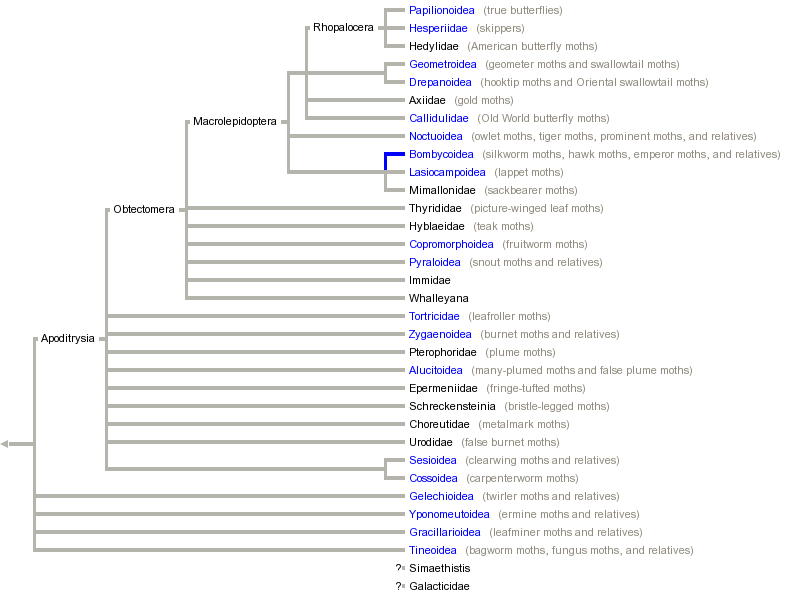
We're way up there, towards the top...


This is stolen from Tolweb. Try clicking up and down the tree to get an idea of the scale just of the butterfly family

Why study a particular model organism? Fruit Fly, Mouse, Rat, Chimp, Chinese Hamster, Barn Owls... most animals are chosen for convenience, rarely for the question being asked. Rather, the tool determines the sorts of questions the lab can ask. A bad example of this is a lab
studying olfaction in a species that is not known to use smell for any ecologically-relevant behavior. A good example of this was when Konishi used barn owls to study auditory processing.

Many jokes are made about whether scientists are studying mice or vice versa, but the truth is that learning the techniques, terminology, and temperament of an organism has a steep learning curve, and often the survival of the postdoc and his mice are yoked together.

My Home: Tucson

The Tucson Valley as seen from the Rincon Mountains in Saguaro National Park East. Also visible are the Tucson Mountains to the left and the Santa Catalina Mountains to the Right. Tucson hugs the desert at the intersection of the Rillito and Santa Cruz Rivers. Photocredit: Annika Silvernoinen.

At work today...


At work today I sectioned the thorasic ganglia and cervical connective of the moth Manduca sexta.

Netflix Offers One Million Dollars for Better Suggestion System

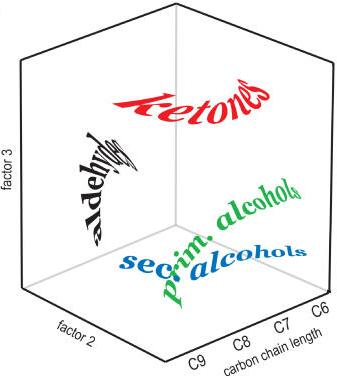
There are basically two approaches that I have seen, which I'll label AMAZON and PANDORA for ease of use. In the first you collect user data and suggest what other people with similar "profiles" selected. This is problematic in Amazon where you might be buying gifts that don't reflect your taste, but in Netflix it should be fairly robust. The other is much more labor-intense, and involves semantic coding of the artwork. In the case of Pandora, they invested hundreds of thousands of man hours listening to music and creating a 'genome' for each work, which allowed them to objectively correlate the songs in n-dimensional factor analysis.

Oops, two more approaches: There is also the flickr / del.icio.us use of tags, a FOLKSONOMY, and I think currently Netflix is using a fourth hybrid system which I'll call GOOGLE because they seem to use some database (say, IMDB) that lists directors and they just harvest the relevant links. Hell, maybe Netflix even uses Google to find the top 100 pages that come up for "Kill Bill" and then they just compare all the words in all those pages with all the titles of movies in their database, assuming that movies that are mentioned on the same page are in some way relevant to one another.

But these three options assume that "better" is already defined. Is that an objective property of a suggestion? Its hard to imagine what that would mean. Instead, is it most user-friendly? Which opens the whole FORM-FUNCTION debate. I mean, maybe just a better GUI ("better" would be defined as "more user selections"=more clicks) would satisfy that requirement.

And then there is the question of why they'd really want a better suggester. Their profits are not linked to the number of movies someone rents. So is the million just self-promotion? Or philanthropy to the unemployed programmers of the world?

Now that Google has Youtube, everyone is wondering what they're going to do with it. How do you make money off of indexing a huge database of free movies? Two ways, either LEECH (ie targetted advertizements) or CHARGE (micropayments for content). Micropayments haven't caught on yet, but with the continuing expansion of Google content (ie one login for calendar, email, personalized google search, etc) similar to Yahoo, it shouldn't be too hard to set up micropayment accounts.

Paying for content isn't all bad; according to economic theory, value equals money, and vice versa. If you pay money for something you create valuable information. If it cost a small fee to link another website from your site, the average quality of links would go way up. Similarly, if the post office raised the bulk (junk) mailing rate from 13 cents closer to first class (39 cents) the average amount of bulk would decline, but both because of decreased information overload and because of the recognition of the cost inherent in the medium, people would pay alto more attention to the bulk mail (currently 50% is thrown away unopened). So this would not necessarily be bad for the advertisers. Perhaps the same logical structure could entail for micropayments on media content, although I can't quite see how right now. http://econ.arizona.edu/downloads/Seminars/AndersonF06.pdf

Anyway, information markets are still the best way to self-organize information. More later.

Friday, October 20, 2006

Electrochemistry of the Neuron

Best book/blog in the neurosphere: http://nine-radical.blogspot.com/


Also, I have been trying to get a handle on the electrochemistry of the neuron, and to that end have been studying the nearest-known system in physics, since physicists try to understand things and biologists are content to just use whatever instruments the chemists and physicists make. And what is this nearest-neighbor? The P-N semiconductor of course, that eponymous minimal substrate for the most common metaphor in neuroscience, "the brain is a computer". And it turns out there is some weird sh*t going down. Positive charges are just the spaces created by the removal of negative charges, but they can be modeled as if they have a physical extension, can move, and have mass. There is a 'band-gap' (in "potential-space") that separates the electron-filled quantal energy levels and the unfilled, and the size of this gap and its relation to the place-below-which-half-the-energy-levels-are-filled (AKA Fermi Level) determines whether the material is a Conductor, a Resistor, or, if the Fermi Level falls in the band gap, a P-N semiconductor.


What does this have to do with nerves? Well, I realized I don't understand the whole ion channel thingy. Partial pressures...apparently the charge of the ions doesn't matter, in that an overabundance of Ca+ can't influence the action of, say, K+ or Cl- in anyway. Weird, if you think that every drug we put into the body must have its own partial pressure to. And different parts of the body are under different pressures. You've heard about 'the bends' (thanks, Radiohead) of nitrogen 'coming out of solution'. It seems that these affects most be omnipresent in the body where these pressure differentials crop up (and don't forget the microscale of vesicles literally 'popping' out of terminals in the synapse). My uncle is studying something to do with this and the pressure that tumors build up trying to grow against the luminal matrix of the body.

That isn't directly related to my P-N semiconductor ponderous ponderings, but it gives a flavor of the kind of questions I want to ask but don't know enough about yet to. Meanwhile, I am reading about harvesting monoclonal vs. polyclonal antibodies.

Monday, October 09, 2006

Top Ten Things To Do To Make Tucson Sustainable

(1) Harvest and conserve water
Step One:  Enjoy sponge baths or basin baths rather than showers.
Note:  A person can bathe in less than a quart of water this way!
At full sustainability Tucsonans will have cisterns, composting toilets, neighborhood water harvesting, and comprehensive water education.    

(2) Use the sun's energy
Step One:  Hang your laundry to dry in the sun.  
Note:  Some communities have restrictions against hanging out laundry.
At full sustainability Tucson will derive all its electricity and transportation from the sun's energy.
   
(3) Eat local and native foods
Step One:  Visit a farmers market.
Note:  Farmers Markets are listed in Tucson Weekly.
At full sustainability Tucson will have a City Food Policy to ensure access to healthy food for all Tucsonans.   Large daily farmers markets with bioregional products will supplement neighborhood food production and neighborhood desert food harvesting.  

(4) Work outdoors with neighbors
Step One:  Organize a neighborhood walk/doorknocking to discover neighborhood assets and what projects interest your neighbors.  
Note:  For tips on organizing neighborhood doorknockings, contact Pro Neighborhoods, (520) 882-5885.
At full sustainability every neighborhood will be safe for pedestrians and bicyclists, have a workable plan for emergencies which cares for all dependents, and engage in sustainable urban food production.
                 
(5) Ride bicycle or walk to your eco-village hub
Step One:  Identify your local commercial hub and do errands there without using fossil fuel; take public transit if your destination is further or you are physically challenged.
Note:  As you walk and bike your neighborhood you may notice places which need   shade trees.  These locations can become urban agriforestry projects.
At full sustainability Tucson will be organized into 60 to 80 complete eco-villages to which people can walk or bike.   These eco-villages will be connected by a safe comprehensive system of bike paths which do not mingle with auto traffic.

(6) Plant A Food Bearing Tree
Step One:  Dig a hole and bust through the caliche.  
Note:  This is more fun if you dig with friends and throw a party when the tree is planted.  Get hold of a caliche bar.  Contact Tucson Botanical Gardens or Tucson Organic Gardeners for best species of trees to plant in your location.
At full sustainability Tucson will be an edible urban forest.

(7) Save food scraps and compost with worms
Step One:  Build a simple home made "worm farm."  Many websites teach how, e.g.: www.earth911.org/master.asp?s=lib&a=organics/composting/wormcompost.asp
Note:  Worms create worm castings and worm juice which are rich plant food.
At full sustainability Tucson's home kitchens, restaurants and cafeteries will be connected by a comprehensive composting program.

(8) Grow food in home garden or community garden
Step One:  Contact Tucson's Community Food Bank or Tucson Organic Gardeners for information on how to grow food.
Note:  We can garden year round in Tucson.   Water is our limiting factor; therefore, water harvesting for gardening is crucial.   Sustainable Tucson highly recommends Brad Lancaster's book Rainwater Harvesting for Drylands, available at Antigone Books, Silverbell Trading, and through Sustainable Tucson in case quantities.
At full sustainability, Tucson and its bioregion will be mostly food self-sufficient.  

(9) Educate yourself and Tucson's representatives about sustainability. 
Step One:  Read the voter's guide for the upcoming election.   Who takes sustainable positions on solar and wind energy, mass transit, bike paths, water conservation?
Note:  Sustainability education is enjoyable in a group.  Our eco-zone potlucks are a wonderful way to share books, DVD's, videos, and ideaswith each other.  Why not start a group in your neighborhood?  Then invite a person running for office.
At full sustainability any school child will be able to tell a visitor to Tucson how our sustainable city works.

(10) Become an entrepreneur in the growing sustainable economy
Step One:  Identify your own art/passion/potential product or service.
Note:  Many entrepreneurs (self-employed people) market products and services. 
At full sustainability, Tucson (including its bioregion) will be mostly self-sufficient for water,
food, energy, and transportation.  Tucson's sustainable infrastructure will need to be planned, installed, and maintained by local businesses attuned to our city's terrain and culture.   Tucson will have a local credit clearing house which keeps our region's financial resources circulating locally.  

Written by Lindianne Sarno with Nicole Christine, Bob Cook, Tom Greco, and Joanie Sawyer.  
©Sustainable Tucson 2006.
Friday, September 29, 2006

Diet

My uncle asked me why I am not a god (oops, "good") vegetarian anymore. I asked him if he remembers people in his village having cavaties and bad teeth. He said yes, even though it was before Coca-cola and the rest. In hunter-gatherer societies, cavities are almost unheard of. As for pastuerizing and homogenizing (P and H) milk...have you heard of the experiments? I haven't been able to locate the original papers, but basically the cats fed (only) P and H milk had more birth defects and spontaneous abortions, and their kittens were weaker and less curious than cats fed un- P and H milk. I haven't been able to find replications of these high-school level science experiments. Someday I will have my own lab.

"Just think how much people agonize over a diet. All the effort that goes into ingredient charts for foods, solving the riddles of metabolism, and we're not through with it yet! One of my biologist friends is currently exercising his wits on a topic that could appear childishly simple. He is endeavouring to assay the calorie content of fructose, a widespread sugar akin to glucose, whose metabolic properties remain unexplained. All his trials require highly sophisticated calorimeters of which there are only two or three in the world. That explains why the work has been in the doldrums, right up until now. He has already worked, for several years, locking volunteers up in this equipment.

The public has no idea of the effort required to master a single nugget of information; in this case, describing a single molecule. And our physiology is bulging out of jillions of parameters! Knowledge branches out into subdivisions whose numbers are always increasing and ever more specialized. Researchers themselves don't get to communicate; they no longer have the time to read the countless journals that come out daily on topics that are, in fact, closely related. Nobody can have an overall picture that is penetrating enough to drill through to the processes that lie hidden within our bodies and within our cells. After a century of painstaking labour, dietitians, when asked what one should eat to be healthy, always come up with the same old story: a balanced diet." -Anopsology

Thursday, September 28, 2006

What Shape the Umwelt?

"But what exactly is the structure of the
perceptual worlds proposed by von Uexküll? Can we draw
them on paper in the form of maps, allowing us to visualize
a particular animal’s subjective view of the world? Will such
maps allow us to predict the similarity of two stimuli (e.g., two
colors or two scents) by inspecting the distance between the
loci they produce in a perceptual space? Does understanding
the metrics of such maps help us predict how stimulus
mixtures will be perceived?"


Wednesday, August 30, 2006

scientist ivory tower gods mortal authority


(The SCIENTIST is working late into the night, locked safe in his IVORY TOWER, but the GODS are angry with the puny MORTAL for challenging their AUTHORITY. )